
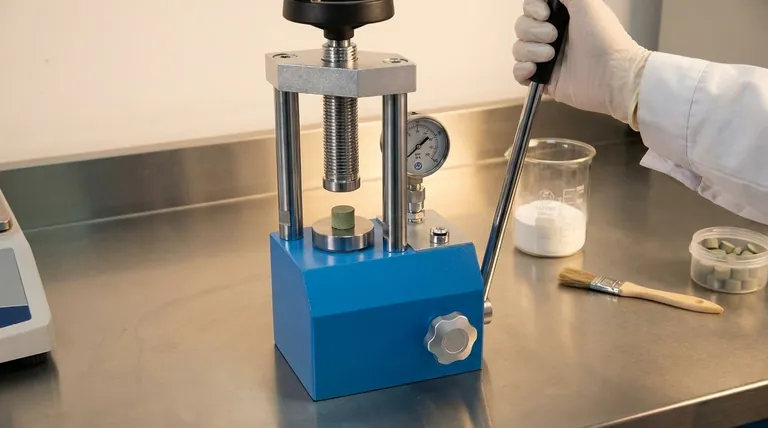
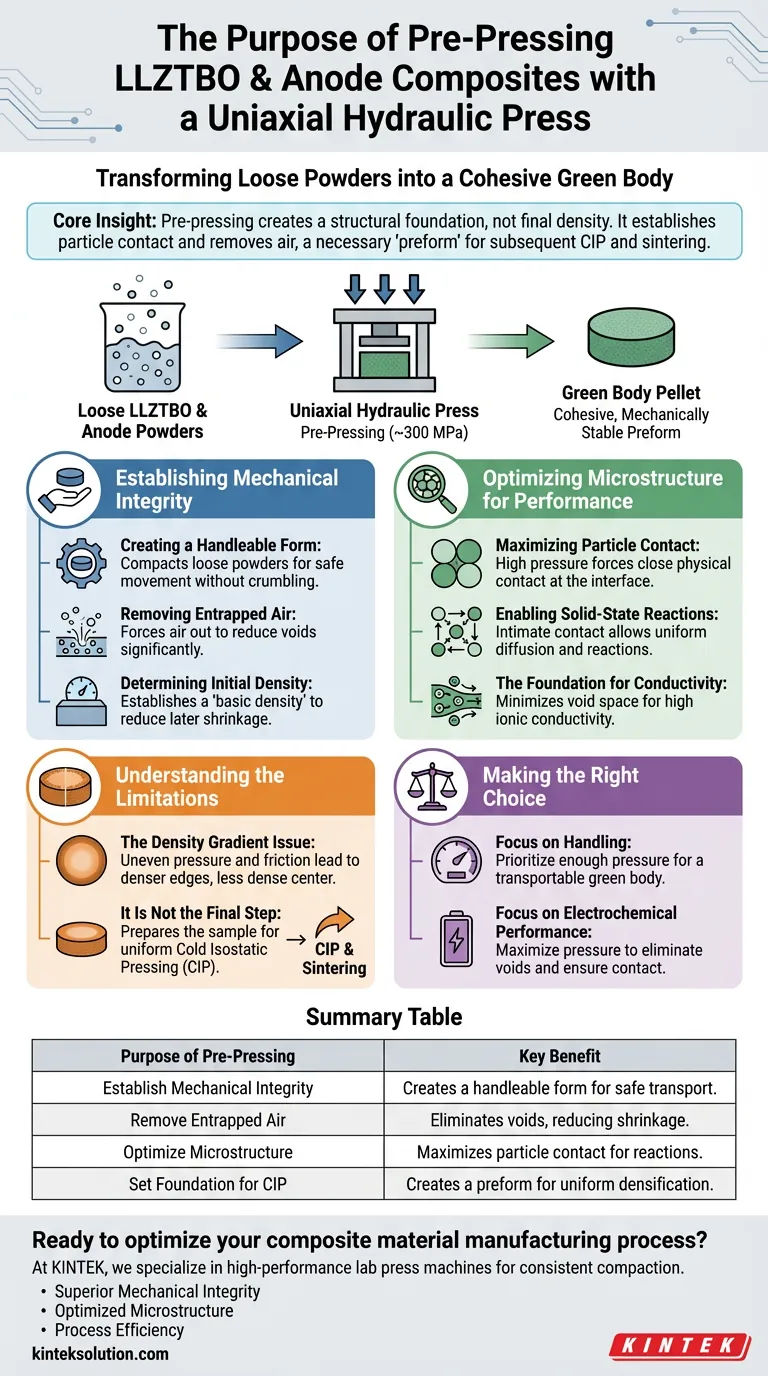
The primary purpose of pre-pressing with a uniaxial hydraulic press is to transform loose LLZTBO and anode powders into a cohesive, mechanically stable "green body." This initial compaction removes entrapped air voids and establishes the baseline density required for safe handling and subsequent processing.
Core Insight: Pre-pressing is not about achieving final density; it is about creating a structural foundation. By establishing intimate particle-to-particle contact and removing air, this step creates a necessary "preform" that ensures the effectiveness of subsequent Cold Isostatic Pressing (CIP) and high-temperature sintering.
Establishing Mechanical Integrity
Creating a Handleable Form
Loose mixed powders lack the structural integrity required for manufacturing. Uniaxial pressing compacts these powders into a defined shape with sufficient mechanical strength to be moved without crumbling.
Removing Entrapped Air
During the mixing process, air becomes trapped between powder particles. Applying unidirectional pressure forces this air out, significantly reducing the volume of voids within the material.
Determining Initial Density
This process creates a pellet with a "basic density." While not fully dense, this state is critical because it reduces the shrinkage and deformation that can occur during later high-temperature stages.
Optimizing Microstructure for Performance
Maximizing Particle Contact
For composite materials like LLZTBO and anode mixtures, performance relies on the interface between materials. High pressure (often around 300 MPa) forces particles into close physical contact.
Enabling Solid-State Reactions
This intimate contact is the physical prerequisite for effective sintering. It ensures that diffusion and solid-state reactions can proceed uniformly, leading to a product with low porosity.
The Foundation for Conductivity
By minimizing void space early in the process, pre-pressing sets the stage for high ionic conductivity. A dense, void-free final structure is essential for the electrolyte to function correctly.
Understanding the Limitations
The Density Gradient Issue
Uniaxial pressing applies force from one direction, which can lead to uneven density distribution. Friction against the die walls often results in a pellet that is denser at the edges than in the center.
It Is Not the Final Step
A common misconception is that uniaxial pressing achieves the final shape and density. In high-performance applications, this is merely a "pre-pressing" step designed to prepare the sample for Cold Isostatic Pressing (CIP), which applies uniform pressure to achieve true homogeneity.
Making the Right Choice for Your Goal
To optimize your composite manufacturing process, align your pressing parameters with your specific end-goals:
- If your primary focus is Handling and Throughput: Prioritize achieving just enough pressure to create a green body that withstands transport without cracking, maximizing speed over density.
- If your primary focus is Electrochemical Performance: Maximize the initial pressure (up to the material's limit) to eliminate virtually all air voids and ensure maximum particle-to-particle contact before sintering.
Summary: Uniaxial pre-pressing is the critical bridge between loose chemical powders and a high-performance solid-state component.
Summary Table:
| Purpose of Pre-Pressing | Key Benefit |
|---|---|
| Establish Mechanical Integrity | Creates a handleable form for safe transport and further processing. |
| Remove Entrapped Air | Eliminates voids, reducing shrinkage and deformation during sintering. |
| Optimize Microstructure | Maximizes particle-to-particle contact for effective solid-state reactions. |
| Set Foundation for CIP | Creates a preform for uniform densification in Cold Isostatic Pressing. |
Ready to optimize your composite material manufacturing process?
At KINTEK, we specialize in providing high-performance lab press machines, including automatic and heated lab presses, designed to meet the precise demands of laboratory research and development. Our equipment ensures the consistent, high-pressure compaction required to create the perfect green body foundation for materials like LLZTBO and anode composites.
Let us help you achieve:
- Superior Mechanical Integrity: Create stable, handleable preforms every time.
- Optimized Microstructure: Maximize particle contact for enhanced ionic conductivity.
- Process Efficiency: Streamline your workflow from powder to final sintered component.
Contact our experts today to discuss how our lab press solutions can advance your solid-state battery research.
Visual Guide
References
- Zongqi He, Kengo Shimanoe. Cosintering the Anode Active Material with Li <sub>7</sub> La <sub>3</sub> Zr <sub>2</sub> O <sub>12</sub> Solid Electrolyte for the All-Solid-State Battery: How to Predict the Interfacial Reaction at Elevated Temperatures. DOI: 10.1021/acsaem.5c02930
This article is also based on technical information from Kintek Solution Knowledge Base .
Related Products
- Automatic Laboratory Hydraulic Press for XRF and KBR Pellet Pressing
- Laboratory Hydraulic Pellet Press for XRF KBR FTIR Lab Press
- Laboratory Hydraulic Press 2T Lab Pellet Press for KBR FTIR
- Laboratory Hydraulic Press Lab Pellet Press Machine for Glove Box
- Manual Laboratory Hydraulic Pellet Press Lab Hydraulic Press
People Also Ask
- Why is pressing powder into a pellet critical before sintering? Ensure Dense, Conductive Solid-State Electrolytes
- What is the role of a laboratory pressure machine and KBr in FTIR? Master Sample Preparation for Flame Retardants
- What are the advantages of using a laboratory automatic hydraulic press for HEA green compact forming?
- What are the advantages of using a lab automatic hydraulic press for HEA green body molding? Ensure Material Integrity
- What are the technical advantages of an automatic laboratory hydraulic press for biomimetic surfaces?


















