
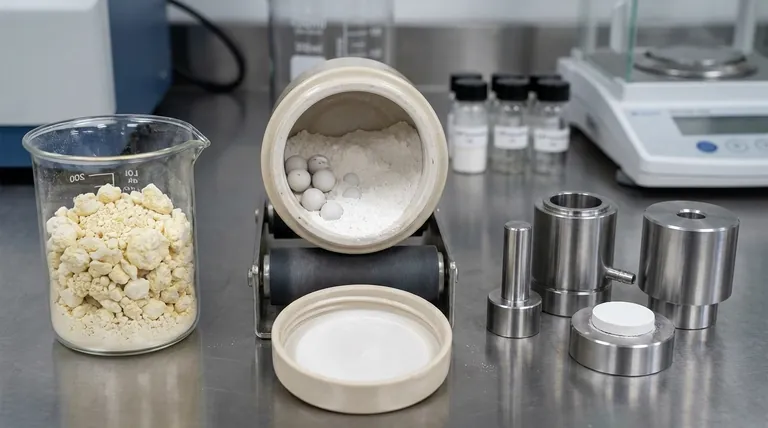
The primary function of using a ball mill to process calcined LATP powder is to mechanically de-agglomerate the material and significantly reduce its particle size. This high-energy grinding step transforms the coarse, irregular powder resulting from calcination into a fine, uniform consistency that is physically capable of being pressed into a high-quality pellet.
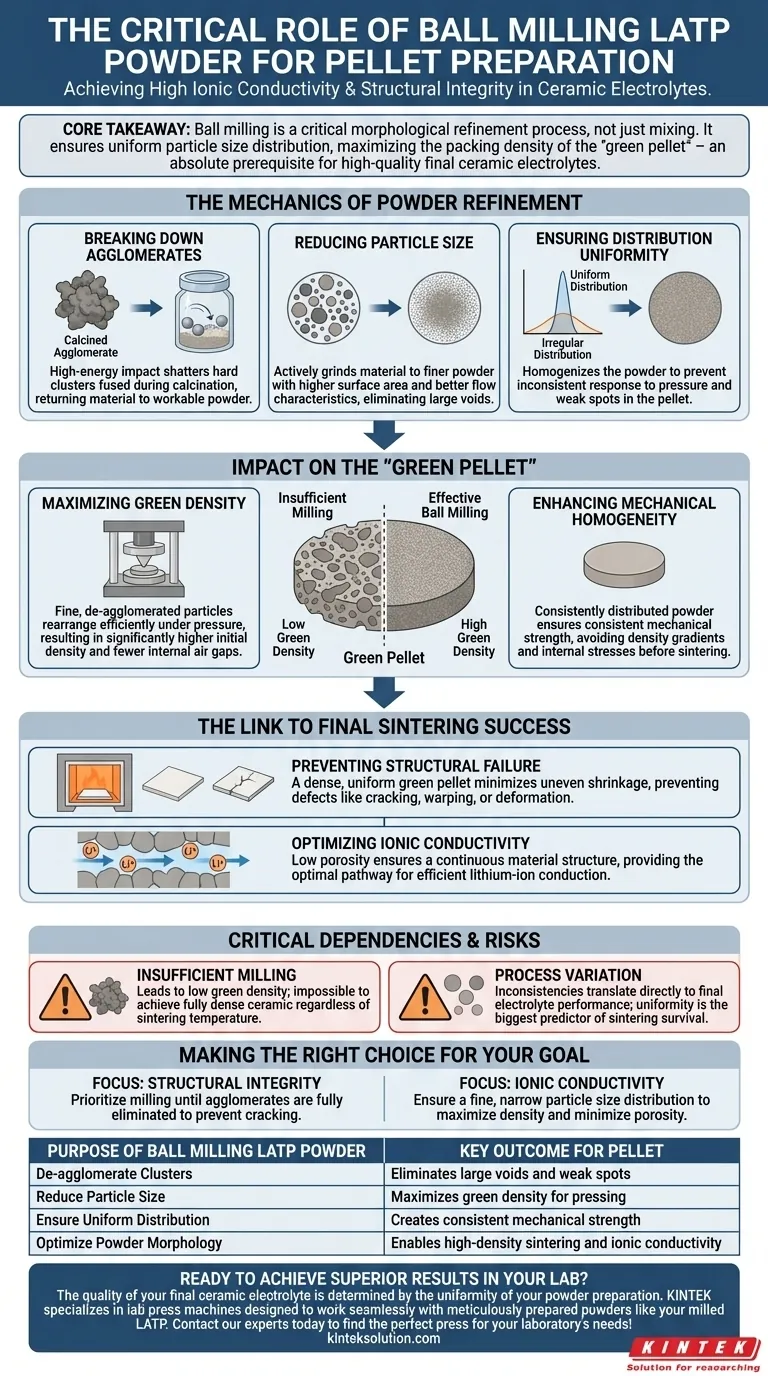
Core Takeaway Ball milling is not merely a mixing step; it is a critical morphological refinement process. By ensuring a uniform particle size distribution, it maximizes the packing density of the "green pellet," which is the absolute prerequisite for achieving a final ceramic electrolyte with high ionic conductivity and structural integrity.
The Mechanics of Powder Refinement
Breaking Down Agglomerates
During the calcination phase, LATP powder particles often fuse together to form hard clusters known as agglomerates.
These clusters are too large and irregular to pack tightly during pressing. Ball milling utilizes high-energy impact to shatter these agglomerates, returning the material to a workable powder state.
Reducing Particle Size
Beyond simply breaking clusters, the process actively grinds the material to reduce the average particle size.
A finer powder possesses a higher surface area and better flow characteristics. This reduction is necessary to eliminate large voids between particles when the powder is eventually poured into a mold.
Ensuring Distribution Uniformity
The ball milling process homogenizes the powder, creating a uniform particle size distribution.
Without this uniformity, the powder would settle unevenly. This leads to inconsistencies in how the material responds to pressure, ultimately causing weak spots in the pellet.
Impact on the "Green Pellet"
Maximizing Green Density
The immediate goal of ball milling is to improve the quality of the "green pellet"—the compressed disc formed during the cold pressing stage (typically at 10 MPa).
Fine, de-agglomerated particles rearrange more efficiently under pressure. This results in a green pellet with significantly higher initial density and fewer internal air gaps.
Enhancing Mechanical Homogeneity
A uniform powder results in a pellet that has consistent mechanical strength throughout its volume.
If the powder were not milled, the pellet would likely suffer from density gradients. These gradients create internal stresses that compromise the structural integrity of the pressed disc before it even reaches the furnace.
The Link to Final Sintering Success
Preventing Structural Failure
The quality of the milled powder directly dictates the success of the high-temperature sintering stage.
A dense, uniform green pellet minimizes the risk of uneven shrinkage during firing. Without effective ball milling, the final ceramic sheet is prone to catastrophic defects such as cracking, warping, or deformation.
Optimizing Ionic Conductivity
The ultimate deep need for this process is to create an efficient pathway for lithium ions.
Ball milling reduces the porosity of the final ceramic sheet. Low porosity ensures a continuous material structure, which provides the optimal pathway required for efficient lithium-ion conduction.
Critical Dependencies and Risks
While ball milling is essential, it creates a dependency chain that must be managed carefully.
The Cost of Insufficient Milling
If the grinding energy or time is insufficient, agglomerates will remain in the powder. This leads to low green density, which makes achieving a fully dense ceramic impossible, regardless of the sintering temperature used later.
The Risk of Process Variation
Inconsistencies in the milling process will directly translate to inconsistencies in the final electrolyte performance. The uniformity of the green pellet is the single biggest predictor of whether the final ceramic will survive the sintering process without defects.
Making the Right Choice for Your Goal
To ensure your LATP electrolyte meets performance standards, you must view ball milling as a quality control gate, not just a preparation step.
- If your primary focus is Structural Integrity: Prioritize milling until agglomerates are fully eliminated to prevent cracking and warping during sintering.
- If your primary focus is Ionic Conductivity: Ensure a fine, narrow particle size distribution to maximize density and minimize porosity in the final sheet.
The success of your final electrolyte sheet is determined before it ever enters the furnace; it is defined by the uniformity achieved in the ball mill.
Summary Table:
| Purpose of Ball Milling LATP Powder | Key Outcome for Pellet |
|---|---|
| De-agglomerate Clusters | Eliminates large voids and weak spots |
| Reduce Particle Size | Maximizes green density for pressing |
| Ensure Uniform Distribution | Creates consistent mechanical strength |
| Optimize Powder Morphology | Enables high-density sintering and ionic conductivity |
Ready to achieve superior results in your lab? The quality of your final ceramic electrolyte is determined by the uniformity of your powder preparation. KINTEK specializes in lab press machines, including automatic lab presses and heated lab presses, designed to work seamlessly with meticulously prepared powders like your milled LATP. Our equipment ensures the precise pressure control needed to form high-integrity green pellets, setting the stage for successful sintering. Don't let inconsistent powder preparation compromise your research—contact our experts today to find the perfect press for your laboratory's needs!
Visual Guide
Related Products
People Also Ask
- What is the purpose of incorporating cartridge heaters into a lab press mold for MLCC block compression? Optimize Results
- What are the requirements for pressing molds when using SSCG? Key Materials for Complex Single Crystal Production
- How do the design and geometric precision of pressing molds and mandrels affect the quality of PTFE composite samples?
- How does the geometry of laboratory molds influence mycelium-based composites? Optimize Density and Strength
- What role do precision positioning and pressure molds play in single-lap joints? Ensure 100% Data Integrity
