
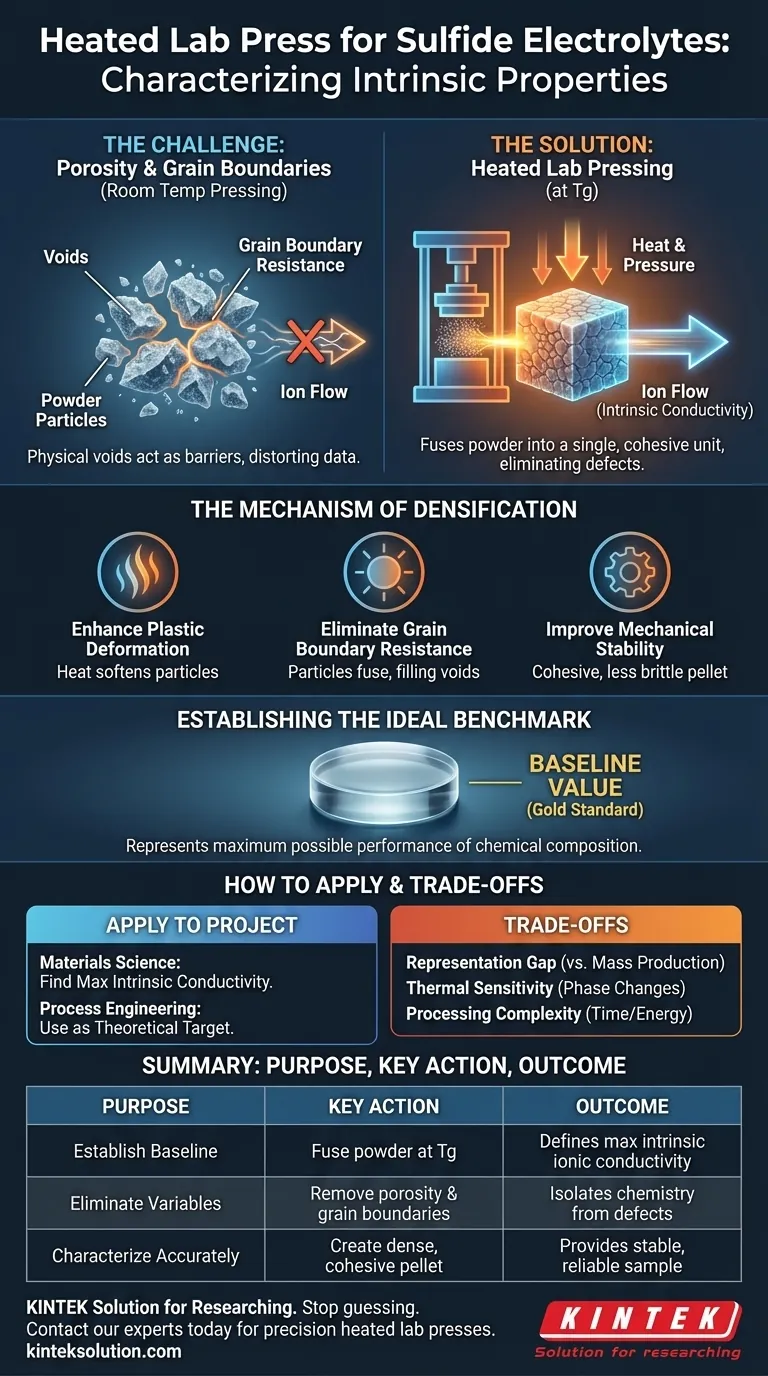
The primary purpose of using a heated lab press for sulfide electrolytes is to create a definitive performance benchmark by isolating the material's intrinsic properties from processing defects. By applying heat and pressure simultaneously—typically near the material's glass transition temperature ($T_g$)—the press fuses powder particles into a single, cohesive unit, effectively eliminating the variables of porosity and grain boundary resistance.
Core Insight: In solid-state battery research, physical voids act as barriers to ion flow, distorting conductivity data. A heated press solves this by producing a "perfect," theoretically dense sample. This allows researchers to distinguish between the fundamental limits of the material chemistry and the limitations of the manufacturing process.
Establishing the "Ideal" Benchmark
Creating a Void-Free State
Sulfide electrolytes typically exist as powders. When pressed at room temperature, tiny gaps (voids) remain between particles. A heated press operates near the glass transition temperature (e.g., around 200°C for certain sulfides), allowing the material to flow.
Achieving Theoretical Density
This process creates a sample that represents the material's ideal "bulk" state. The resulting pellet is often completely dense and transparent, indicating that all internal light-scattering voids have been removed.
Defining the Baseline
Once this fully densified sample is created, its ionic conductivity is measured to establish a baseline value. This value acts as the "gold standard," representing the maximum possible performance of that specific chemical composition.
The Mechanism of Densification
Enhancing Plastic Deformation
The simultaneous application of heat softens the surface of the sulfide particles. This synergy allows the particles to undergo plastic deformation more easily than they would under pressure alone.
Eliminating Grain Boundary Resistance
By softening the particles, the press forces them to fuse together, filling voids that would otherwise interrupt ion pathways. This drastically reduces grain boundary resistance, ensuring that the measured conductivity reflects the material itself, not the gaps between particles.
Improving Mechanical Stability
Beyond conductivity, the fusion of particles results in superior mechanical integrity. The heated press produces a pellet that is less brittle and more cohesive, providing a stable medium for accurate electrical characterization.
Understanding the Trade-offs
The Representation Gap
While hot pressing reveals intrinsic properties, it may not represent the performance of a final, mass-produced battery cell. Most commercial processes rely on cold pressing or roll-to-roll manufacturing, which inevitably leave some porosity.
Thermal Sensitivity Risks
Care must be taken not to exceed the thermal stability limit of the sulfide. Excessive heat during pressing can induce unwanted phase changes or crystallization, which would alter the chemical structure and invalidate the comparison.
Processing Complexity
Hot pressing is time-consuming and energy-intensive compared to cold pressing. It is primarily a characterization tool for understanding material potential, rather than a standard manufacturing step for high-throughput production.
How to Apply This to Your Project
When characterizing solid-state electrolytes, the method of preparation dictates the data you collect.
- If your primary focus is Materials Science (Discovery): Use the heated press to determine the maximum intrinsic conductivity of your new sulfide composition, eliminating processing variables.
- If your primary focus is Process Engineering: Use the heated press sample as a target, then optimize your cold-pressing or slurry processes to see how close you can get to that theoretical benchmark.
By using a heated press, you stop guessing whether low conductivity is due to bad chemistry or simply bad contact between particles.
Summary Table:
| Purpose | Key Action | Outcome |
|---|---|---|
| Establish Baseline | Fuse powder particles at Tg | Defines the material's maximum intrinsic ionic conductivity |
| Eliminate Variables | Remove porosity & grain boundaries | Isolates chemistry performance from processing defects |
| Characterize Accurately | Create a fully dense, cohesive pellet | Provides a stable, reliable sample for electrical testing |
Stop guessing if low conductivity is due to bad chemistry or bad particle contact. KINTEK specializes in precision lab press machines, including automatic, isostatic, and heated lab presses designed specifically for the demanding characterization needs of solid-state battery researchers like you. Achieve definitive benchmarks for your sulfide electrolytes and distinguish intrinsic material limits from processing limitations. Contact our experts today to find the perfect press for your laboratory's discovery and development workflow.
Visual Guide
Related Products
- 24T 30T 60T Heated Hydraulic Lab Press Machine with Hot Plates for Laboratory
- Manual Heated Hydraulic Lab Press with Integrated Hot Plates Hydraulic Press Machine
- Automatic High Temperature Heated Hydraulic Press Machine with Heated Plates for Lab
- Automatic Heated Hydraulic Press Machine with Hot Plates for Laboratory
- Heated Hydraulic Press Machine with Heated Plates for Vacuum Box Laboratory Hot Press
People Also Ask
- Function of a Laboratory Hydraulic Press with Heated Platens in SSE? Enhance Battery Density & Conductivity
- Why is a laboratory hydraulic press with heating plates required for PLA/TEC films? Achieve Precise Sample Integrity
- What role does a laboratory heated hydraulic press play in LTCC? Essential for High-Density Ceramic Lamination
- What is the primary function of a laboratory heated hydraulic press? Mastering Thermoplastic Carbon Fiber Composites
- What is the critical role of a laboratory heated hydraulic press? Mastering PVC Sample Prep for Testing



















