
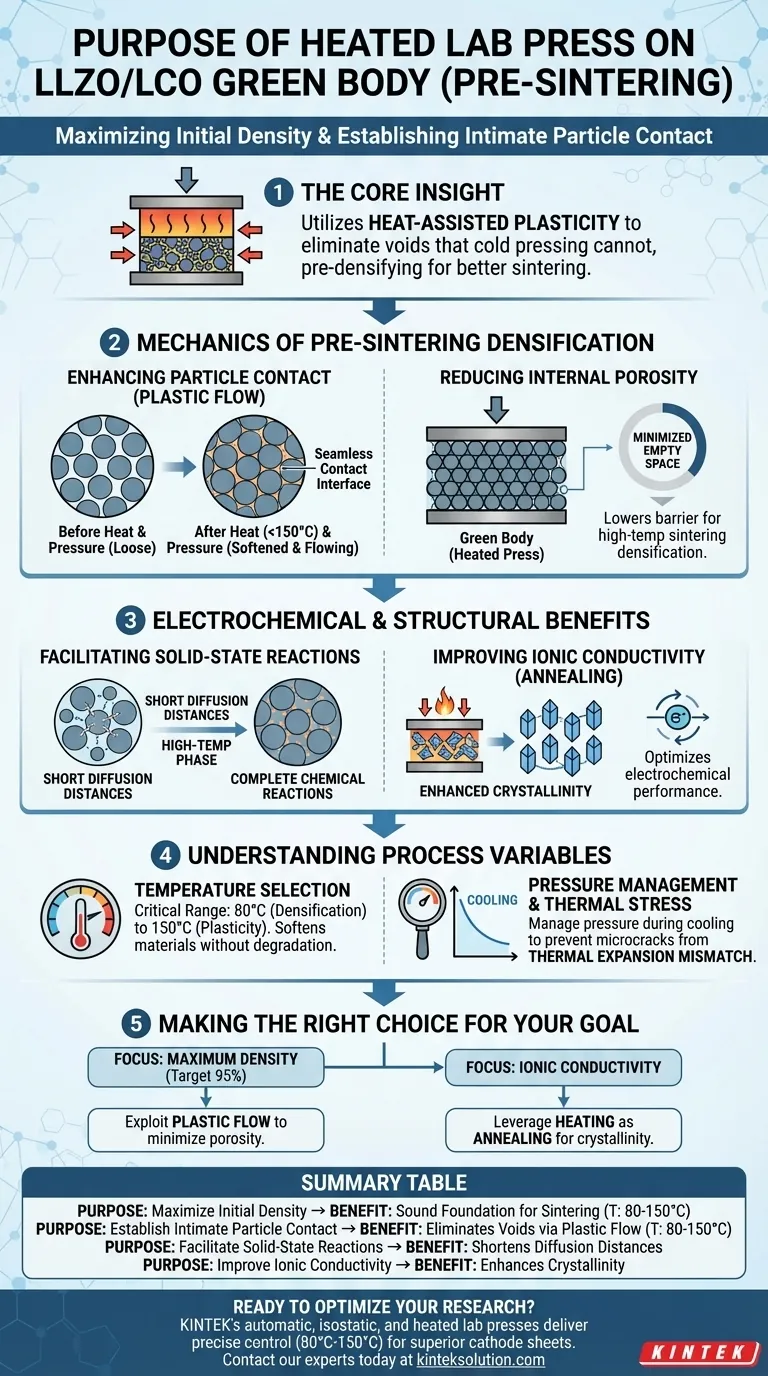
The primary purpose of using a heated lab press on an LLZO/LCO composite cathode green body is to maximize initial density and establish intimate particle contact prior to sintering. By applying pressure at moderate temperatures (typically 80°C to 150°C), this process mechanically reduces internal porosity and softens electrolyte particles. This creates a structurally sound "green body" foundation, which is a prerequisite for achieving a final relative density of up to 95% in the sintered cathode sheet.
Core Insight: The heated press step utilizes heat-assisted plasticity to eliminate voids that cold pressing cannot remove. This pre-densification is critical for facilitating material transport during sintering, directly influencing the final structural integrity and ionic conductivity of the battery component.
Mechanics of Pre-Sintering Densification
Enhancing Particle Contact via Plastic Flow
Applying heat during the pressing stage offers a distinct mechanical advantage over cold pressing. Temperatures below 150°C can effectively soften the electrolyte particles.
This induced softening promotes plastic flow, allowing the electrolyte to deform and fill the interstitial voids between active material particles. This results in a seamless contact interface, which is difficult to achieve through mechanical force alone.
Reducing Internal Porosity
The primary goal of the green body stage is to minimize empty space within the composite. The heated press significantly increases the initial density of the composite material.
By reducing internal porosity at this early stage, you lower the barrier for densification during the subsequent high-temperature sintering. A denser green body leads to a more uniform and complete reaction between particles later in the process.
Electrochemical and Structural Benefits
Facilitating Solid-State Reactions
High-quality sintering relies on short diffusion distances between particles. The heated press creates a "pre-compacted" structure where precursor particles are already in intimate physical contact.
This proximity facilitates more complete chemical reactions during the high-temperature phase. Consequently, this helps achieve a final ceramic product with superior density and structural coherence.
Improving Ionic Conductivity via Annealing
Beyond simple shaping, the hot-pressing procedure functions as an in-situ annealing treatment.
The application of heat and pressure can improve the crystallinity of the electrolyte. Enhanced crystallinity is directly linked to improved ionic conductivity within the composite electrode, optimizing the electrochemical performance of the final cell.
Understanding the Process Variables
The Role of Temperature Selection
The temperature setting is a critical variable that distinguishes this process from standard compaction. References suggest a range, such as 80°C for general densification or up to 150°C to induce plasticity.
The objective is to reach a temperature high enough to soften the low-bulk-modulus materials without triggering premature chemical degradation or unwanted reactions before the main sintering stage.
Pressure Management and Thermal Stress
While the heated press improves density, the transition out of this state requires care. Although often associated with the high-temperature sintering phase, the principle of thermal expansion mismatch is relevant whenever heat and pressure are combined.
Materials like LLZO and graphite dies contract at different rates. If pressure is not managed correctly during the cooling phases of any heated compaction process, internal thermal stress can generate microcracks, undermining the structural integrity gained during pressing.
Making the Right Choice for Your Goal
To optimize your cathode preparation, align your pressing parameters with your specific performance targets:
- If your primary focus is Maximum Density: Utilize the heated press to exploit plastic flow, ensuring the green body porosity is minimized to support a target final density of 95%.
- If your primary focus is Ionic Conductivity: Leverage the heating phase as an annealing step to maximize the crystallinity of the electrolyte within the composite matrix.
Summary: The heated lab press acts as a critical bridge between loose powder and solid ceramic, using heat to mechanically force particle cohesion that sintering alone cannot achieve.
Summary Table:
| Purpose | Key Benefit | Typical Parameter Range |
|---|---|---|
| Maximize Initial Density | Reduces internal porosity, creating a sound foundation for sintering. | Pressure + 80°C - 150°C |
| Establish Intimate Particle Contact | Softens particles for plastic flow, eliminating voids cold pressing cannot. | Pressure + 80°C - 150°C |
| Facilitate Solid-State Reactions | Shortens diffusion distances for more complete reactions during sintering. | N/A |
| Improve Ionic Conductivity | Acts as an in-situ annealing step to enhance electrolyte crystallinity. | N/A |
Ready to optimize your solid-state battery research with precise pre-sintering densification?
KINTEK's range of automatic lab presses, isostatic presses, and heated lab presses is engineered to deliver the exact pressure and temperature control (like the critical 80°C to 150°C range) required for processing advanced materials like LLZO/LCO composites. Achieve superior density, intimate particle contact, and enhanced ionic conductivity in your cathode sheets.
Contact our experts today to discuss how our lab press solutions can accelerate your development and improve your battery performance.
Visual Guide
Related Products
- Automatic High Temperature Heated Hydraulic Press Machine with Heated Plates for Lab
- 24T 30T 60T Heated Hydraulic Lab Press Machine with Hot Plates for Laboratory
- Automatic Heated Hydraulic Press Machine with Hot Plates for Laboratory
- Lab Heat Press Special Mold
- Automatic Heated Hydraulic Press Machine with Heated Plates for Laboratory
People Also Ask
- Function of a Laboratory Hydraulic Press with Heated Platens in SSE? Enhance Battery Density & Conductivity
- How does a laboratory heated hydraulic press facilitate PBN sample prep for WAXS? Achieve Precise X-Ray Scattering
- What are the requirements for electrode pressing with high-viscosity ionic liquids like EMIM TFSI? Optimize Performance
- What are the industrial applications of heated hydraulic presses? Master Heat & Force for Precision Manufacturing
- Why is a laboratory hydraulic press with heating plates required for PLA/TEC films? Achieve Precise Sample Integrity



















