
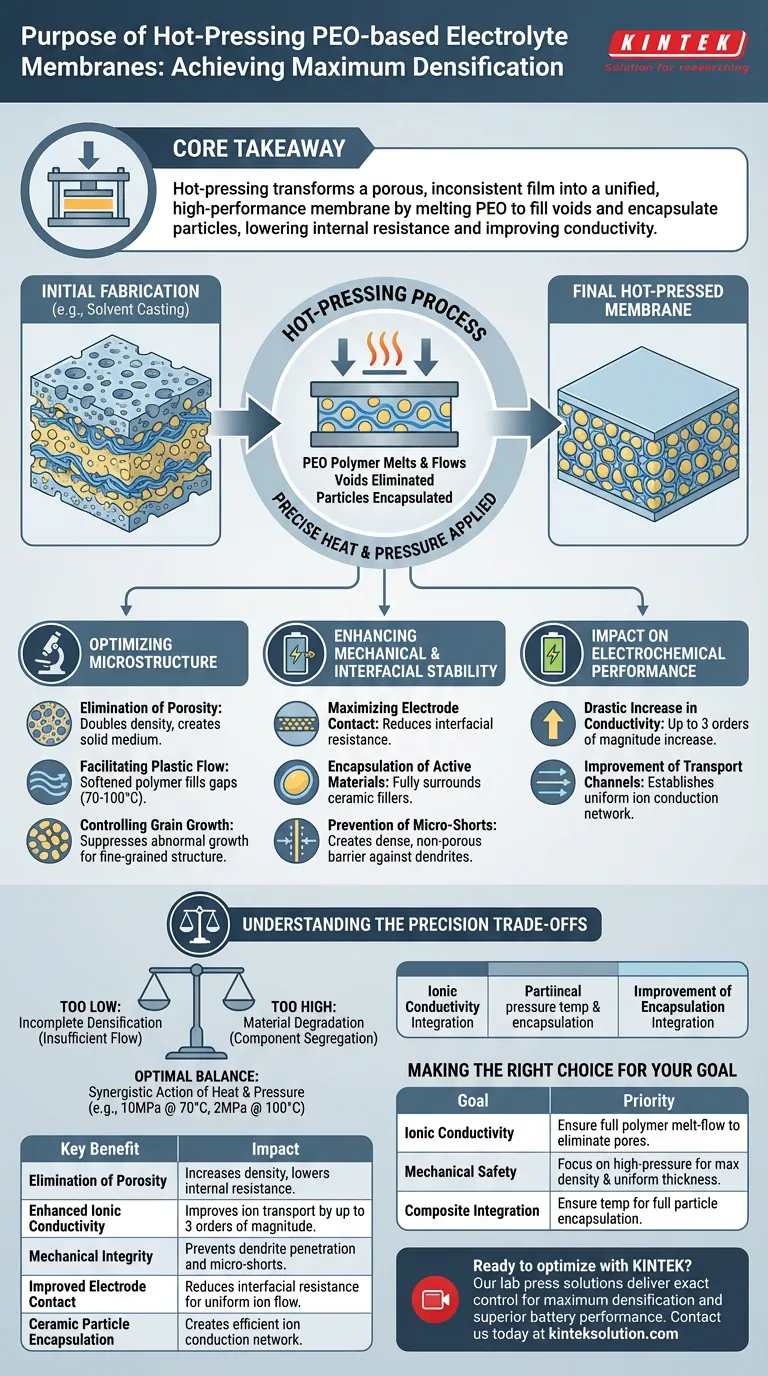
The primary purpose of hot-pressing PEO-based electrolytes is to achieve maximum densification. By applying precise heat and pressure, you eliminate internal defects such as microscopic pores and density inconsistencies that inevitably occur during solvent casting or spray coating.
Core Takeaway: Hot-pressing transforms a porous, potentially inconsistent film into a unified, high-performance membrane. By melting the PEO polymer to fill voids and encapsulate particles, this process significantly lowers internal resistance, improves ionic conductivity, and ensures the mechanical integrity required to prevent battery failure.
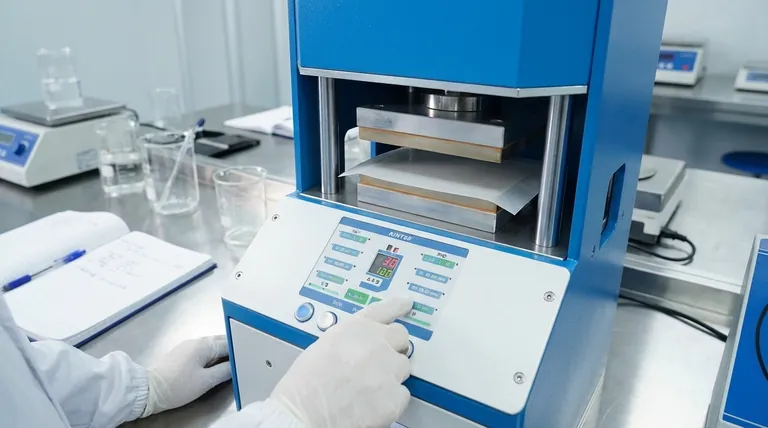
Optimizing the Microstructure
The fundamental goal of hot-pressing is to correct the structural flaws left behind by initial fabrication methods like solvent evaporation.
Elimination of Porosity
Solvent casting and spray coating often leave microscopic pores between layers or particles. Hot-pressing applies force to eliminate these voids, effectively doubling the membrane's density in some cases. This ensures the electrolyte is a solid, continuous medium rather than a porous sieve.
Facilitating Plastic Flow
At elevated temperatures (e.g., 70°C - 100°C), the PEO polymer melts and softens. The simultaneous application of pressure forces this softened polymer to flow, filling gaps between ceramic particles (like LLZTO) or spray-coated layers. This plastic flow is essential for achieving a defect-free structure.
Controlling Grain Growth
In ceramic-heavy composite electrolytes, hot-pressing assists in particle rearrangement. This synergistic action suppresses abnormal grain growth, resulting in a fine-grained microstructure. A finer grain structure is directly linked to superior mechanical strength and lower grain boundary resistance.
Enhancing Mechanical and Interfacial Stability
Beyond the internal structure of the membrane, hot-pressing is critical for how the electrolyte interacts with other battery components.
Maximizing Electrode Contact
A major challenge in solid-state batteries is the high resistance at the interface between the electrolyte and the electrode. Hot-pressing ensures tight physical contact, reducing interfacial resistance and enabling uniform ion transport channels.
Encapsulation of Active Materials
For composite membranes, the polymer must fully surround the ceramic fillers. The hot-pressing process forces the molten PEO to fully encapsulate ceramic particles, creating an efficient ion conduction network. This is superior to traditional methods where "dead zones" of poor contact often remain.
Prevention of Micro-Shorts
By creating a dense, non-porous film with uniform thickness (e.g., 100-120 micrometers), hot-pressing effectively blocks the pathways that lead to internal shorts. A mechanically robust membrane acts as a reliable barrier, preventing dendrite penetration and internal micro-circuit failures.
The Impact on Electrochemical Performance
The physical changes induced by hot-pressing translate directly into measurable performance metrics.
Drastic Increase in Conductivity
The densification process significantly reduces the resistance to ion transport. In specific spray-coated applications, this densification has been shown to increase room-temperature ionic conductivity by up to three orders of magnitude.
Improvement of Transport Channels
Reliable electrochemical performance relies on uniform pathways for ions to travel. By fusing the lithium salt with the polymer and eliminating voids, hot-pressing establishes a uniform ion conduction network that is consistent throughout the entire membrane volume.
Understanding the Precision Trade-offs
While hot-pressing provides immense benefits, it is not a blunt instrument; it requires exacting control.
The Necessity of Precise Parameters
The references highlight that temperature and pressure must be precisely controlled. If the temperature is too low, the polymer will not flow sufficiently to fill voids; if the pressure is inadequate, densification will be incomplete.
Balancing Flow and Integrity
The process relies on the "synergistic action" of heat and pressure. The goal is to induce plastic flow without degrading the material. Achieving the optimal balance—such as 10 MPa at 70°C or 2 MPa at 100°C depending on the specific composition—is critical to avoid damaging the membrane or causing component segregation.
Making the Right Choice for Your Goal
To maximize the effectiveness of your PEO-based electrolyte, align your processing parameters with your specific performance targets.
- If your primary focus is Ionic Conductivity: Prioritize temperatures that ensure full polymer melt-flow to eliminate all microscopic pores, as this can increase conductivity by orders of magnitude.
- If your primary focus is Mechanical Safety: Focus on high-pressure parameters to ensure maximum density and uniform thickness, which are the key factors in preventing internal micro-shorts.
- If your primary focus is Composite Integration: Ensure the temperature is sufficient to allow the PEO to fully encapsulate the ceramic particles (LLZTO/NASICON) to lower grain boundary resistance.
Hot-pressing is the definitive step that bridges the gap between a raw chemical mixture and a functional, reliable solid-state battery component.
Summary Table:
| Key Benefit of Hot-Pressing | Impact on PEO-Based Electrolyte |
|---|---|
| Elimination of Porosity | Increases density, lowers internal resistance |
| Enhanced Ionic Conductivity | Improves ion transport by up to 3 orders of magnitude |
| Mechanical Integrity | Prevents dendrite penetration and micro-shorts |
| Improved Electrode Contact | Reduces interfacial resistance for uniform ion flow |
| Ceramic Particle Encapsulation | Creates efficient ion conduction network |
Ready to optimize your PEO-based electrolyte membranes with precision hot-pressing? KINTEK specializes in laboratory press machines (including automatic lab press, isostatic press, and heated lab press) designed to deliver the exact temperature and pressure control required for maximum densification and superior battery performance. Our equipment helps researchers like you achieve defect-free membranes with enhanced ionic conductivity and mechanical stability. Contact us today to discuss how our lab press solutions can accelerate your solid-state battery development!
Visual Guide
Related Products
- Automatic High Temperature Heated Hydraulic Press Machine with Heated Plates for Lab
- Heated Hydraulic Press Machine with Heated Plates for Vacuum Box Laboratory Hot Press
- Automatic Heated Hydraulic Press Machine with Hot Plates for Laboratory
- Heated Hydraulic Press Machine With Heated Plates For Vacuum Box Laboratory Hot Press
- Laboratory Split Manual Heated Hydraulic Press Machine with Hot Plates
People Also Ask
- Function of a Laboratory Hydraulic Press with Heated Platens in SSE? Enhance Battery Density & Conductivity
- What are the requirements for electrode pressing with high-viscosity ionic liquids like EMIM TFSI? Optimize Performance
- How does a laboratory heated hydraulic press facilitate PBN sample prep for WAXS? Achieve Precise X-Ray Scattering
- What are the industrial applications of heated hydraulic presses? Master Heat & Force for Precision Manufacturing
- Why is a laboratory hydraulic press with heating plates required for PLA/TEC films? Achieve Precise Sample Integrity



















