
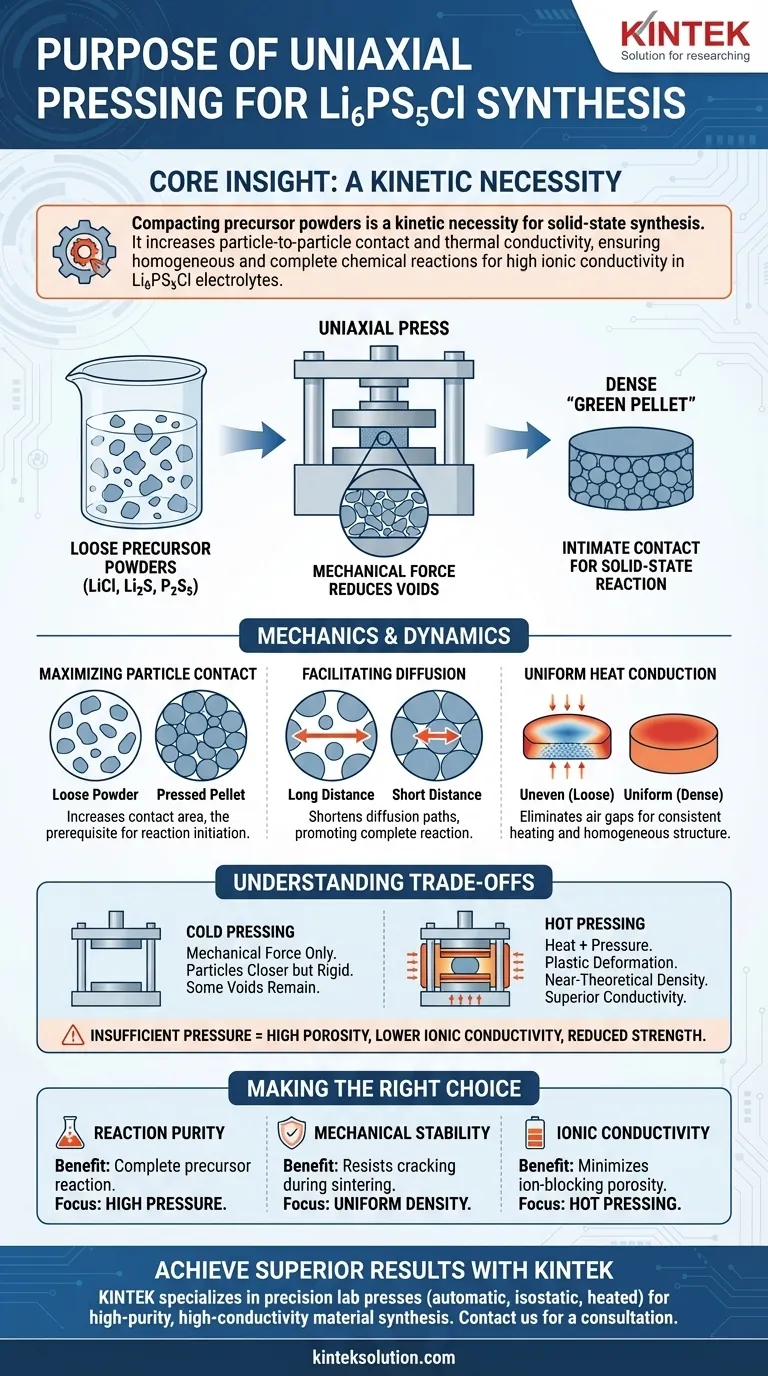
The primary purpose of using a uniaxial press in this context is to mechanically force precursor particles into intimate contact, creating a dense "green pellet" prior to sintering. This step is essential because solid-state reactions rely on direct particle-to-particle interfaces to facilitate atomic diffusion; without this compaction, the reactants (typically LiCl, Li2S, and P2S5) remain too distant to react completely or uniformly.
Core Insight Compacting precursor powders is not merely about shaping; it is a kinetic necessity for solid-state synthesis. By increasing particle-to-particle contact and thermal conductivity, pressing ensures the chemical reaction is homogeneous and complete, directly resulting in the high ionic conductivity required for Li6PS5Cl electrolytes.
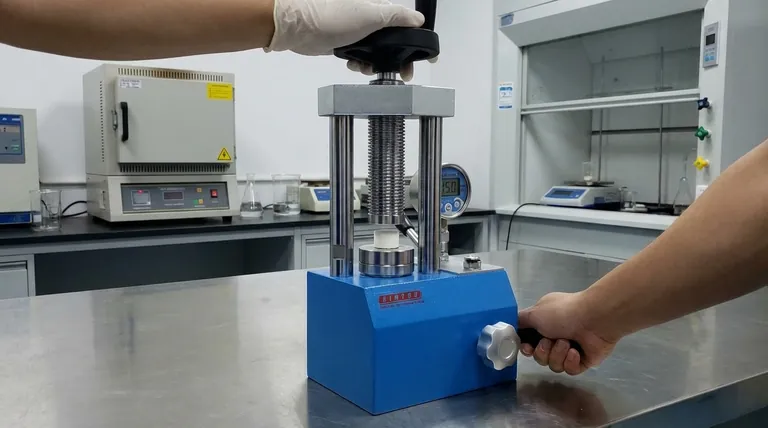
The Mechanics of Solid-State Synthesis
Maximizing Particle Contact Area
Unlike liquid reactions where ingredients mix freely, solid-state synthesis is restricted by geometry. The chemical reaction can only occur where particle surfaces physically touch.
Using a uniaxial press significantly increases the contact area between the individual precursor particles. This mechanical intimacy is the fundamental prerequisite for the reaction to initiate and sustain itself throughout the material.
Facilitating Solid-State Diffusion
For Li6PS5Cl to form, atoms must physically move (diffuse) from one particle to another. Loose powder creates vast "diffusion distances" that atoms cannot bridge effectively.
Compaction reduces the void space between particles, shortening the distance atoms must travel. This promotes a more complete reaction, preventing unreacted raw materials from contaminating the final product.
Thermal Dynamics and Structural Integrity
Ensuring Uniform Heat Conduction
Loose powder contains air gaps, which act as thermal insulators. This can lead to uneven heating, where the outside of the sample cooks faster than the inside.
A dense pellet ensures uniform heat transfer throughout the material. This thermal consistency guarantees that the entire sample undergoes the same reaction conditions, leading to a homogeneous crystal structure.
Creating a Stable "Green Pellet"
The pressed powder form, often called a "green pellet," provides necessary mechanical strength. It transforms a pile of loose dust into a cohesive solid that can be handled and processed.
Achieving a uniform density at this stage helps prevent macroscopic defects. A well-formed green pellet minimizes the risk of cracking or deformation during the high-stress environment of high-temperature sintering.
Understanding the Trade-offs
Cold Pressing vs. Hot Pressing
While standard cold pressing relies on mechanical force to reduce voids, it has limits. It brings particles closer, but they remain rigid distinct entities.
Hot pressing (applying heat and pressure simultaneously) softens the particle surfaces, allowing for plastic deformation. This method can eliminate almost all voids, achieving near-theoretical density and superior ionic conductivity, but requires significantly more complex equipment.
The Cost of Insufficient Pressure
If the pressure applied is too low, the pellet will retain high porosity. These voids persist after sintering, acting as roadblocks to ion movement.
Consequently, a pellet pressed with insufficient pressure will exhibit lower ionic conductivity and reduced mechanical strength, rendering it unsuitable for high-performance battery applications.
Making the Right Choice for Your Goal
The pressing parameters you choose determine the quality of your final electrolyte.
- If your primary focus is Reaction Purity: Prioritize high pressure to maximize particle contact, ensuring all precursor materials (LiCl, Li2S, P2S5) fully react without leaving impurities.
- If your primary focus is Mechanical Stability: Ensure your green pellet is pressed to a uniform density to prevent the final ceramic from cracking or warping during the sintering phase.
- If your primary focus is Ionic Conductivity: Consider hot pressing techniques to achieve maximum density, as reducing porosity is the most effective way to lower resistance.
The uniaxial press is not just a shaping tool; it is the bridge that transforms raw chemical potential into a functional, high-performance conductor.
Summary Table:
| Pressing Goal | Key Benefit | Parameter Focus |
|---|---|---|
| Reaction Purity | Ensures complete precursor reaction, minimizing impurities. | High Pressure |
| Mechanical Stability | Creates a uniform green pellet that resists cracking during sintering. | Uniform Density |
| Ionic Conductivity | Maximizes density to minimize ion-blocking porosity. | Hot Pressing (Heat + Pressure) |
Ready to achieve superior results in your solid-state electrolyte synthesis? The right lab press is the bridge between raw chemical potential and a high-performance conductor. KINTEK specializes in precision lab press machines, including automatic, isostatic, and heated lab presses, designed to meet the exacting demands of laboratory research and development. Our equipment ensures the uniform compaction and thermal control necessary for synthesizing high-purity, high-conductivity materials like Li6PS5Cl. Contact us today to discuss how our solutions can enhance your lab's efficiency and accelerate your battery development projects.
Contact KINTEK for a consultation
Visual Guide
Related Products
- Lab Round Bidirectional Press Mold
- Lab Polygon Press Mold
- Lab Cylindrical Press Mold with Scale
- Split Automatic Heated Hydraulic Press Machine with Heated Plates
- Lab Cylindrical Press Mold for Laboratory Use
People Also Ask
- What is the purpose of incorporating cartridge heaters into a lab press mold for MLCC block compression? Optimize Results
- What is the function of a pressing tool in thermoplastic panels? Master Precision Shaping & Fusion Bonding
- Why is precise cooling management of the lab press mold necessary? Protect Core Integrity in Thermoforming
- Why is a high-performance laboratory molding press critical for in-situ electrolyte formation? Unlock Battery Success
- How do the design and geometric precision of pressing molds and mandrels affect the quality of PTFE composite samples?



















