
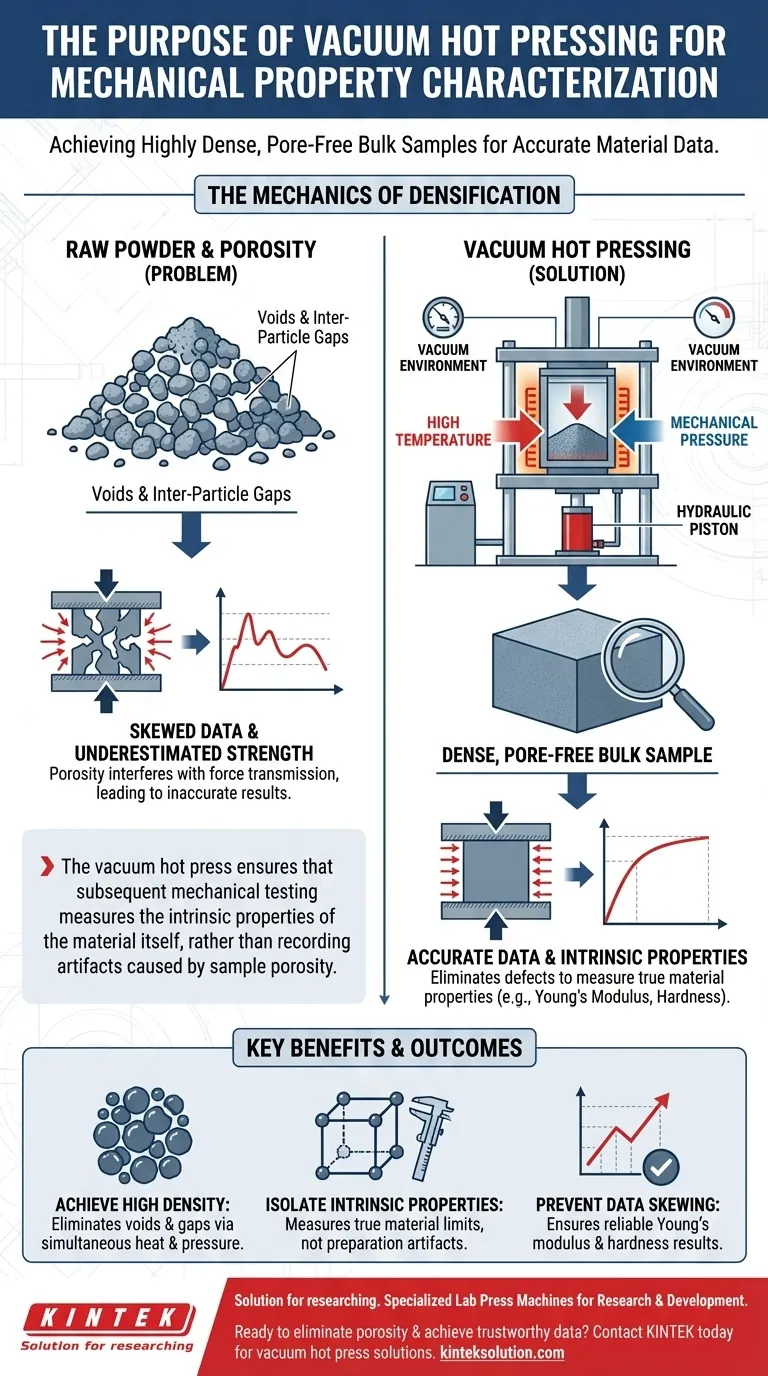
The primary purpose of using a vacuum hot press is to fabricate highly dense, nearly pore-free bulk samples from powdered materials. By simultaneously applying mechanical pressure and high temperature, this technique effectively eliminates voids and inter-particle gaps that typically exist in loose powder forms.
The vacuum hot press ensures that subsequent mechanical testing measures the intrinsic properties of the material itself, rather than recording artifacts caused by sample porosity.
The Mechanics of Densification
Simultaneous Heat and Pressure
The core function of a vacuum hot press is to subject raw powders to two physical forces at once.
By combining high temperature with mechanical pressure, the machine forces particles together more effectively than heat alone.
Eliminating Microstructural Defects
The ultimate goal of this process is the creation of a "bulk" sample.
This requires the total elimination of voids and inter-particle gaps. Removing these spaces is critical to achieving a solid, continuous structure.
Why Density Matters for Characterization
Isolating Intrinsic Properties
When characterizing a material, you generally want to know the properties of the substance, not the structure of the sample.
A vacuum hot press allows you to measure properties like Young's modulus and hardness as they exist in the pure material.
Preventing Data Skewing
If a sample retains porosity, mechanical tests will return inaccurate results.
The presence of air pockets or gaps interferes with the transmission of force. This results in data that is skewed by sample porosity, rather than reflecting the true capability of the material.
The Pitfalls of Porosity
How Voids Interfere with Testing
It is vital to understand that a porous sample behaves differently under load than a dense one.
If voids are not eliminated during preparation, they act as stress concentrators or weak points. This leads to testing results that underestimate the material's strength or stiffness.
The Necessity of "Pore-Free" Samples
For high-precision characterization, "nearly pore-free" is the standard requirement.
Without the densification provided by vacuum hot pressing, it is difficult to distinguish between the failure of the material and the failure of the sample preparation method.
Making the Right Choice for Your Goal
To ensure your mechanical characterization yields valid data, consider your specific analytical needs.
- If your primary focus is determining intrinsic material limits: Use a vacuum hot press to eliminate all porosity, ensuring measurements like Young's modulus represent the material's true physical laws.
- If your primary focus is avoiding experimental error: Rely on this method to remove inter-particle gaps that would otherwise introduce unpredictable variables into your hardness testing.
By prioritizing sample density today, you ensure the reliability of your material data tomorrow.
Summary Table:
| Purpose | Key Action | Outcome for Characterization |
|---|---|---|
| Achieve High Density | Apply heat and pressure simultaneously | Eliminates voids and inter-particle gaps |
| Isolate Intrinsic Properties | Create a pore-free bulk sample | Measures true material strength/stiffness, not preparation artifacts |
| Prevent Data Skewing | Remove microstructural defects | Ensures accurate Young's modulus and hardness results |
Ensure your material characterization data is accurate and reliable.
Porosity in samples can lead to significant errors in mechanical testing, skewing results for critical properties like Young's modulus and hardness. KINTEK's vacuum hot press machines are engineered to solve this exact problem. By applying precise heat and pressure in a vacuum environment, our lab presses help you fabricate highly dense, nearly pore-free bulk samples from powdered materials. This guarantees that your subsequent testing measures the intrinsic properties of the material itself, not the artifacts of poor sample preparation.
KINTEK specializes in lab press machines (including automatic lab presses, isostatic presses, and heated lab presses) designed to meet the rigorous demands of laboratory research and development.
Ready to eliminate porosity from your testing process and achieve trustworthy data? Contact KINTEK today to discuss how our vacuum hot press solutions can enhance your material characterization workflow.
Visual Guide
Related Products
- Heated Hydraulic Press Machine with Heated Plates for Vacuum Box Laboratory Hot Press
- Heated Hydraulic Press Machine With Heated Plates For Vacuum Box Laboratory Hot Press
- Automatic High Temperature Heated Hydraulic Press Machine with Heated Plates for Lab
- Automatic Heated Hydraulic Press Machine with Hot Plates for Laboratory
- Laboratory Manual Heated Hydraulic Press Machine with Hot Plates
People Also Ask
- How does a laboratory heated hydraulic press facilitate PBN sample prep for WAXS? Achieve Precise X-Ray Scattering
- What are the requirements for electrode pressing with high-viscosity ionic liquids like EMIM TFSI? Optimize Performance
- What are the industrial applications of heated hydraulic presses? Master Heat & Force for Precision Manufacturing
- Function of a Laboratory Hydraulic Press with Heated Platens in SSE? Enhance Battery Density & Conductivity
- How are heated hydraulic presses utilized in the preparation of thin films? Key Mechanisms and Applications



















