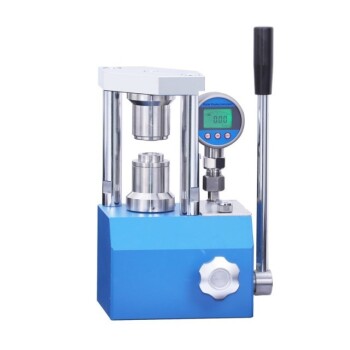
The primary purpose of an automatic crimper machine is to generate a standardized, airtight seal for CR2032 coin cells.
By applying precisely controlled mechanical force, the machine crimps the positive and negative battery cases together. This process creates a hermetic environment that locks liquid electrolyte inside and prevents atmospheric air from contaminating the cell, ensuring a stable environment for electrochemical testing.
Core Takeaway While sealing the casing is the visible action, the machine’s critical function is establishing repeatable internal pressure. This pressure is required to minimize electrical resistance between internal components and ensure that experimental data reflects the battery's chemistry, not assembly variables.
1. Ensuring Hermetic Integrity
The most immediate function of the crimper is isolation. Without a proper seal, the delicate chemistry of a lithium-ion battery is compromised immediately.
Controlled Plastic Deformation
The crimper applies hydraulic or mechanical power to compress the coin cell's sealing gasket.
This force causes the gasket to undergo plastic deformation, filling microscopic gaps between the casing parts. This creates an absolute physical barrier between the battery's internals and the outside world.
Preventing Environmental Contamination
The seal must prevent the ingress of external impurities, specifically moisture and oxygen.
Even trace amounts of atmospheric air can react with lithium components or electrolytes, degrading performance. The crimper ensures the cell remains chemically isolated for the duration of long-cycle testing.
Electrolyte Containment
Simultaneously, the seal prevents the leakage of volatile liquid electrolytes.
Keeping the electrolyte contained is essential for safety and for maintaining the ionic conductivity required for the battery to function.
2. Optimizing Internal Performance
Beyond the external seal, the crimper plays a decisive role in the internal physics of the battery. The mechanical pressure applied during crimping is functional, not just structural.
Reducing Contact Resistance
The crimper compresses the internal "stack" of the battery—the cathode, separator, anode, and current collectors.
This tight physical contact significantly reduces interfacial contact resistance. By eliminating gaps between layers, the machine establishes a low-resistance conductive pathway necessary for electron flow.
Enhancing Solid-State Performance
For advanced applications like solid-state batteries, this pressure is even more critical.
Uniform mechanical pressure suppresses the growth of lithium dendrites and reduces electrochemical interface impedance. This is vital for stabilizing the interface between lithium metal anodes and composite polymer electrolytes.
Enabling Accurate Impedance Testing
Tests such as Electrochemical Impedance Spectroscopy (EIS) are highly sensitive to internal contact quality.
The crimper eliminates internal voids that cause poor contact. This ensures that the data collected represents the true kinetics of the electrode materials, rather than artifacts of poor assembly.
3. The Necessity of Standardization
Manual assembly methods introduce human error, leading to variable results. An automatic crimper removes this variable.
Repeatability of Data
An automatic machine applies the exact same pressure profile to every cell.
This ensures that performance differences observed between cells are due to the materials being tested, not inconsistencies in how tightly the case was closed.
Understanding the Trade-offs
While automatic crimpers are essential, they rely entirely on correct pressure settings and tooling alignment.
The Risk of Over-Crimping Applying excessive pressure can crush the internal separator or deform the active materials. This often leads to internal short circuits or damaged electrode structures, rendering the cell useless before testing begins.
The Risk of Under-Crimping Insufficient pressure fails to deform the gasket correctly. This results in "slow leaks" where electrolyte evaporates over time, or high internal resistance due to poor contact, causing the cell to appear chemically inferior when it is actually just poorly assembled.
Making the Right Choice for Your Goal
The specific role of the crimper changes slightly depending on your research focus.
- If your primary focus is Electrolyte Stability: The crimper's ability to deform the gasket is paramount to prevent leakage and atmospheric contamination over long cycles.
- If your primary focus is Solid-State or Kinetic Studies: The crimper's ability to apply high, uniform internal pressure is the key factor to minimize impedance and suppress dendrites.
Ultimately, the automatic crimper transforms a loose collection of chemical components into a singular, unified electrochemical system capable of yielding high-quality scientific data.
Summary Table:
| Feature | Function in CR2032 Assembly | Impact on Battery Performance |
|---|---|---|
| Hermetic Sealing | Compresses gasket via plastic deformation | Prevents electrolyte leakage & air contamination |
| Internal Pressure | Compacts the internal electrode stack | Reduces contact resistance & suppresses dendrites |
| Standardization | Applies consistent pressure profiles | Ensures data repeatability & eliminates assembly variables |
| Structural Integrity | Mechanical casing deformation | Creates a unified electrochemical system for testing |
Elevate Your Battery Research with KINTEK Precision
At KINTEK, we understand that your data is only as reliable as your cell assembly. We specialize in comprehensive laboratory pressing solutions, offering a versatile range of manual, automatic, heated, and multifunctional crimpers, as well as glovebox-compatible models and isostatic presses.
Our advanced automatic crimper machines ensure the precise, repeatable pressure needed to minimize interfacial resistance and secure hermetic seals for your CR2032 research. Whether you are studying electrolyte stability or high-performance solid-state batteries, our tools provide the consistency your laboratory demands.
Ready to standardize your assembly process? Contact KINTEK Today to Find Your Pressing Solution
Related Products
People Also Ask
- Why is a laboratory hydraulic press or battery sealing machine essential? Ensure Coin Cell Data Integrity
- What role does a laboratory press perform for CR2032 coin cell assembly? Ensure Precision in Battery Research
- Why is a high-pressure manual or automatic coin cell crimper required? Optimize Solid-State Battery Performance
- How does a high-precision lab press or coin cell crimper affect the performance of assembled lithium-metal batteries?
- How does the mechanical pressure provided by a laboratory crimper affect the performance of assembled 2032-type coin cells?