
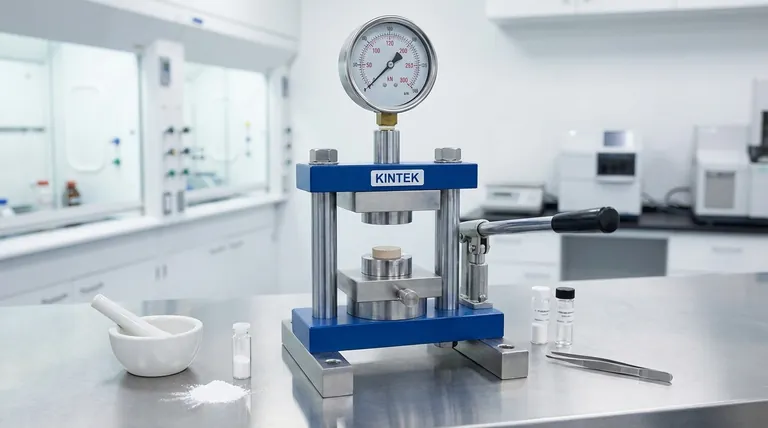
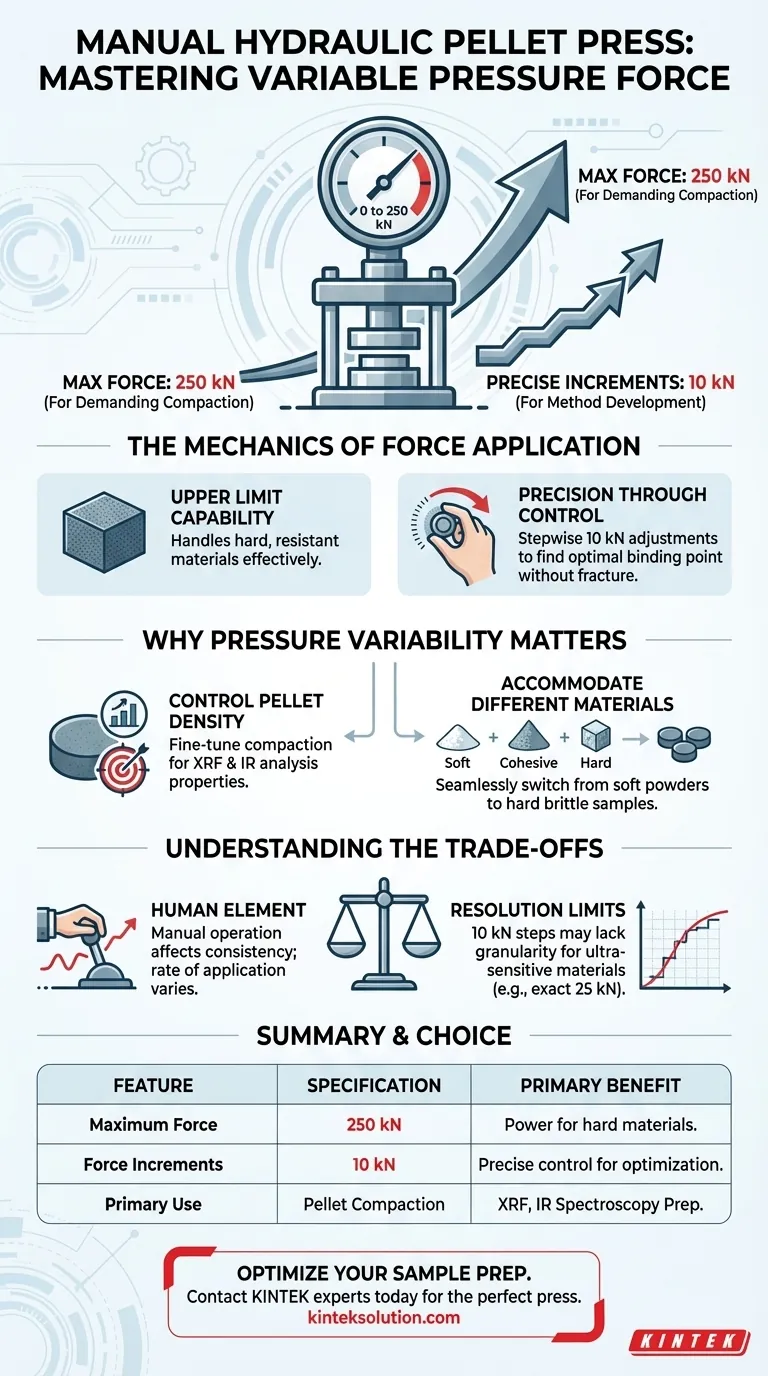
A manual hydraulic pellet press typically delivers a variable pressure force ranging up to 250 kN. This high upper limit allows the equipment to handle demanding compaction tasks. However, the system is designed for precision, typically offering adjustments in 10 kN increments to tailor the force to the specific requirements of your sample.
While the maximum force of 250 kN is significant, the true utility of these presses lies in their variable control. The ability to modulate pressure in specific increments ensures you can achieve exact density targets without compromising sample integrity.
The Mechanics of Force Application
To understand if this equipment fits your needs, you must look beyond the maximum rating and understand how that force is applied and controlled.
The Upper Limit Capability
The press is engineered to withstand and deliver a maximum load of 250 kN.
This level of force is sufficient for compacting a wide variety of powdered materials into solid pellets. It ensures that even hard or resistant materials can be formed effectively.
Precision Through Incremental Control
Raw power is rarely useful without control. These manual presses generally allow you to adjust the pressure in 10 kN increments.
This stepwise adjustment is critical for method development. It allows you to increase pressure gradually to find the optimal point where the sample binds effectively without fracturing.
Why Pressure Variability Matters
The range of force determines the versatility of the laboratory. A variable press transforms a single piece of equipment into a multi-purpose tool.
Controlling Pellet Density
The primary goal of a pellet press is to achieve a specific density.
By utilizing the variable pressure range, you can fine-tune the compaction level. This ensures the resulting pellet has the necessary physical properties for analysis, such as X-ray fluorescence (XRF) or Infrared spectroscopy (IR).
Accommodating Different Materials
Not all samples react to pressure in the same way.
Soft, cohesive powders may require significantly less than the full 250 kN capacity. Conversely, hard, brittle materials may require the maximum force. Variable pressure allows you to switch between these sample types seamlessly.
Understanding the Trade-offs
While manual hydraulic presses are versatile, relying on manual operation and incremental steps introduces specific limitations you should consider.
The Human Element in Consistency
Because the system is manual, the consistency of the pressure application relies heavily on the operator.
While the gauge may read 250 kN, the rate at which that pressure is applied can vary between users. This can occasionally lead to slight variations in pellet microstructure.
Resolution Limitations
The 10 kN increment is effective for general applications, but it may lack the resolution required for ultra-sensitive materials.
If your protocol requires a very specific force that falls between these increments (e.g., exactly 25 kN), a manual press with this specific step-size may not offer the necessary granularity.
Making the Right Choice for Your Goal
When evaluating if a manual hydraulic press with these specifications suits your lab, consider your primary output requirements.
- If your primary focus is heavy-duty compaction: The 250 kN maximum capacity ensures you have the power required for hard, resistant materials.
- If your primary focus is method development: The 10 kN adjustable increments provide the necessary control to experiment with different pressures and optimize your binding protocols.
By matching the variable force range to your specific material needs, you ensure both the quality of your pellets and the longevity of your equipment.
Summary Table:
| Feature | Specification |
|---|---|
| Maximum Force | 250 kN |
| Force Increments | 10 kN |
| Primary Use | Pellet compaction for XRF, IR spectroscopy |
| Key Benefit | Precise density control for various materials |
Optimize your sample preparation with KINTEK's precision lab presses. Our manual hydraulic pellet presses, including automatic and heated models, deliver the exact force control (up to 250 kN in 10 kN steps) you need for consistent, high-quality pellets. Whether you're compacting soft powders or hard materials for XRF analysis, our presses ensure accurate density targets and sample integrity.
Contact our experts today to find the perfect press for your laboratory's specific compaction requirements!
Visual Guide
Related Products
- Manual Laboratory Hydraulic Pellet Press Lab Hydraulic Press
- Automatic Laboratory Hydraulic Press Lab Pellet Press Machine
- Automatic Laboratory Hydraulic Press for XRF and KBR Pellet Pressing
- Manual Laboratory Hydraulic Press Lab Pellet Press
- Laboratory Hydraulic Press 2T Lab Pellet Press for KBR FTIR
People Also Ask
- What is the primary purpose of a manual lab hydraulic pellet press? Ensure Accurate Sample Prep for XRF and FTIR
- What is the primary purpose of manual lab hydraulic pellet presses? Achieve High-Precision Sample Preparation for Spectroscopy
- What is the primary function of a laboratory hydraulic press in evaluating the ionic conductivity of Li6PS5X (LMSX)?
- What is the purpose of initial axial molding using a lab hydraulic press? Optimizing Electrolyte Green Bodies
- What role does a lab hydraulic press play in researching squishy granular matter? Expert Insights into Material Physics



















