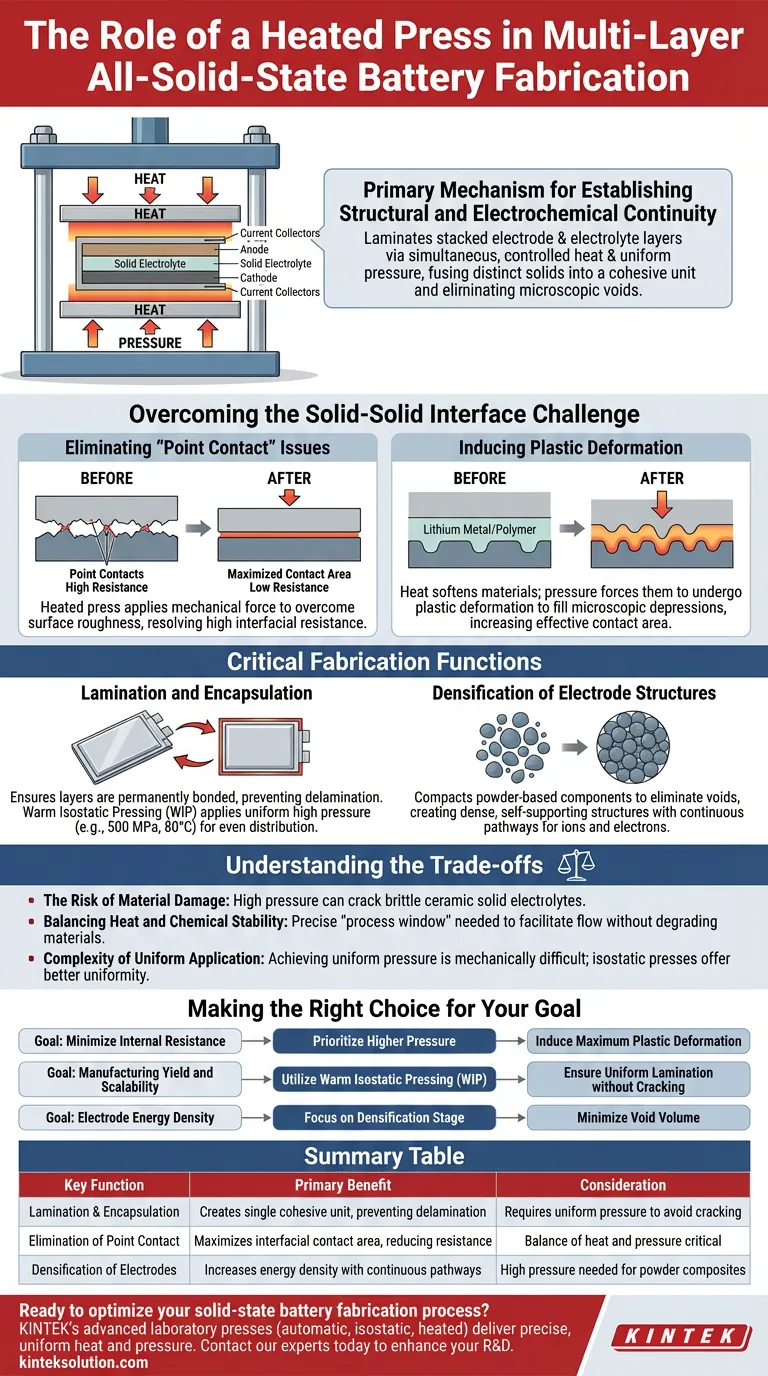
The heated press serves as the primary mechanism for establishing structural and electrochemical continuity. In the fabrication of multi-layer all-solid-state batteries, it functions to laminate stacked electrode and electrolyte layers by applying simultaneous, controlled heat and uniform pressure. This process is mandatory to fuse distinct solid materials into a single cohesive unit, eliminating the microscopic voids that otherwise create high resistance and block ion transport.
Because solid electrolytes cannot flow into pores like liquid electrolytes, the heated press is the only tool available to force intimate physical contact. It drives the plastic deformation required to maximize the active contact area between layers, directly determining the battery's internal resistance and cycle life.
Overcoming the Solid-Solid Interface Challenge
Eliminating "Point Contact" Issues
In solid-state systems, rigid materials—such as garnet electrolytes and lithium metal electrodes—struggle to form natural connections. Without intervention, these surfaces only touch at specific microscopic peaks, creating "point contacts."
This limited contact area results in extremely high interfacial resistance, which severely throttles battery performance. The heated press resolves this by applying sufficient mechanical force to overcome the surface roughness of the materials.
Inducing Plastic Deformation
The combination of heat and pressure is not merely about sticking layers together; it is about altering their physical state. Heat softens the softer materials (typically lithium metal or polymer binders), while pressure forces them to undergo plastic deformation.
This deformation pushes the material to flow into and fill the microscopic depressions on the surface of the harder electrolyte. By filling these gaps, the effective contact area is significantly increased, allowing ions to pass uniformly through the interface.
Critical Fabrication Functions
Lamination and Encapsulation
The heated press is used after the electrode and electrolyte layers are stacked to perform final encapsulation or lamination. This step ensures the layers are permanently bonded, preventing delamination during battery operation.
Techniques like Warm Isostatic Pressing (WIP) apply uniform high pressure (e.g., 500 MPa) at moderate temperatures (e.g., 80°C) to ensure pressure is distributed evenly across the entire pouch cell, distinct from simple uniaxial pressing.
Densification of Electrode Structures
Beyond joining layers, the press is often used to compact powder-based components, such as cathode composites or electrolyte separators. High pressure eliminates voids between particles, creating a dense, self-supporting structure.
This densification creates continuous pathways for both ions and electrons. Without this tight packing, the "dead space" between particles would interrupt conductivity and degrade energy density.
Understanding the Trade-offs
The Risk of Material Damage
While high pressure is necessary for contact, it presents a significant risk to brittle components. Ceramic solid electrolytes are prone to cracking if the pressure is applied unevenly or aggressively, which creates internal short circuits.
Balancing Heat and Chemical Stability
Applying heat aids in softening materials for better bonding, but excessive temperatures can degrade active materials or binders. The process requires a precise "process window" where the temperature is high enough to facilitate flow but low enough to maintain chemical stability.
Complexity of Uniform Application
Achieving perfectly uniform pressure across a large-format multi-layer battery is mechanically difficult. Standard hydraulic presses may apply uneven force leading to pressure gradients, whereas isostatic presses offer better uniformity but come with higher cost and complexity.
Making the Right Choice for Your Goal
To maximize the effectiveness of a heated press in your fabrication line, consider your specific material constraints:
- If your primary focus is minimizing internal resistance: Prioritize higher pressure settings to induce maximum plastic deformation at the lithium-electrolyte interface.
- If your primary focus is manufacturing yield and scalability: Utilize Warm Isostatic Pressing (WIP) to ensure uniform lamination across larger pouch cells without cracking brittle ceramic layers.
- If your primary focus is electrode energy density: Focus on the densification stage of powder composites to minimize void volume before the final stack lamination.
Success in solid-state fabrication relies not just on the materials used, but on the precise calibration of heat and pressure to merge them into a seamless, low-impedance system.
Summary Table:
| Key Function | Primary Benefit | Consideration |
|---|---|---|
| Lamination & Encapsulation | Creates a single cohesive unit, preventing delamination | Requires uniform pressure to avoid cracking brittle materials |
| Elimination of Point Contact | Maximizes interfacial contact area, drastically reducing resistance | Balance of heat and pressure is critical to avoid material damage |
| Densification of Electrodes | Increases energy density by creating continuous ion/electron pathways | High pressure is needed to compact powder composites effectively |
Ready to optimize your solid-state battery fabrication process?
KINTEK's advanced laboratory presses, including automatic lab presses, isostatic presses, and heated lab presses, are engineered to deliver the precise, uniform heat and pressure required for high-performance multi-layer all-solid-state batteries. Our equipment helps you achieve seamless layer bonding, minimize internal resistance, and maximize manufacturing yield.
Contact our experts today to discuss how our lab press solutions can enhance your research and development.
Visual Guide
Related Products
- Warm Isostatic Press for Solid State Battery Research Warm Isostatic Press
- Laboratory Hydraulic Press Lab Pellet Press Button Battery Press
- Button Battery Sealing Press Machine for Lab
- Lab Infrared Press Mold for Laboratory Applications
- Cylindrical Lab Electric Heating Press Mold for Laboratory Use
People Also Ask
- Why must composite cathodes be sealed in vacuum lamination bags for WIP? Ensure Battery Stability and Density
- What is the function of elastic molds in warm isostatic pressing? Achieve Uniform Density in Composite Particles
- How do sacrificial volume materials (SVM) maintain microchannels in isostatic pressing? Ensure Structural Integrity
- What are the advantages of using a Warm Isostatic Press (WIP) for batteries? Achieve Superior Interface Contact
- What is the mechanism of a Warm Isostatic Press (WIP) on cheese? Master Cold Pasteurization for Superior Safety