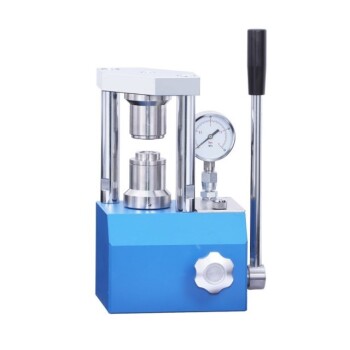
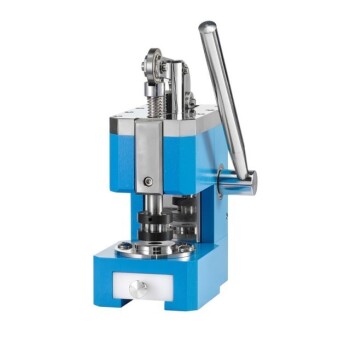
A high-precision manual punching machine serves as the critical geometric gatekeeper in the fabrication of all-solid-state batteries. Its primary function is to mechanically cut continuous dry-pressed films into discrete electrode sheets with exacting dimensional consistency. By utilizing ultra-sharp cutting components, it ensures the structural integrity of the electrode edges prior to final assembly.
Core Takeaway While often viewed simply as a cutting tool, the high-precision punching machine is actually a preventative safety device. By eliminating microscopic edge defects like burrs and delamination, it prevents these imperfections from becoming fatal internal short circuits when the battery stack is subjected to the immense pressures required for solid-state operation.
Preserving Structural Integrity
Minimizing Mechanical Defects
The physical act of cutting a dry-pressed film introduces mechanical stress to the material. A standard cutter can cause the material layers to separate or the edges to fray.
High-precision manual punching machines utilize sharp, calibrated cutting edges to slice through the film cleanly. This specific mechanical action minimizes burrs (rough ridges) and prevents delamination (layer separation) at the perimeter of the electrode sheet.
Preventing Internal Short Circuits
The role of edge quality extends far beyond aesthetics. All-solid-state batteries undergo high-pressure assembly to ensure contact between solid layers.
If an electrode sheet has edge burrs, the subsequent high-pressure step can drive those sharp imperfections through the electrolyte layer. This creates a direct pathway for internal short circuits. The punching machine neutralizes this risk by ensuring the edges are smooth before pressure is ever applied.
Ensuring Experimental Validity
Consistency in Mass Loading
To accurately determine battery performance, researchers must know the exact amount of active material involved.
Precision punching dies ensure that every electrode disk has a highly consistent diameter. Because the surface area is strictly controlled, scientists can calculate the mass loading of active materials with high confidence, reducing variables in their data.
Reproducibility of Results
Scientific rigor requires that experiments be repeatable. Variations in electrode size can lead to irregular internal current distribution.
By standardizing the dimensions of the electrode discs (e.g., exactly 14 mm), the punching machine minimizes assembly errors. This ensures that operando experimental results are reproducible and that performance data reflects the chemistry, not geometric inconsistencies.
Understanding the Trade-offs
Manual Operation vs. Throughput
As a "manual" device, this equipment is optimized for precision over volume. It relies on the operator to position the film and actuate the cut. While this allows for careful inspection of each sample in a laboratory setting, it lacks the speed required for mass production contexts.
Maintenance of Cutting Dies
The value of the machine is entirely dependent on the condition of its die. Over time, cutting dry-pressed ceramics and metal foils will dull the edges. If the die is not maintained, the machine effectively loses its primary utility—instead of preventing delamination, a dull punch will cause it.
Making the Right Choice for Your Goal
Whether you are conducting fundamental research or prototyping cells, the punching machine plays a specific role in your success.
- If your primary focus is Cell Safety and Longevity: Prioritize the sharpness of the cutting die to eliminate burrs that cause short circuits during high-pressure stacking.
- If your primary focus is Data Accuracy and Research: Focus on the dimensional tolerance of the die to ensure exact area consistency for precise mass loading calculations.
Ultimately, the high-precision punching machine bridges the gap between a raw material film and a functional, testable battery component.
Summary Table:
| Feature | Role in Battery Assembly | Research Benefit |
|---|---|---|
| Clean Edge Cutting | Eliminates burrs and delamination | Prevents internal short circuits during high-pressure stacking |
| Dimensional Precision | Standardizes electrode surface area | Ensures accurate mass loading and current distribution |
| Manual Control | Allows for individual sample inspection | Ideal for R&D and low-volume experimental prototyping |
| Sharp Cutting Dies | Preserves structural integrity | Maintains film quality without layer separation |
Elevate Your Battery Research with KINTEK Precision
Precision at the cutting stage is the foundation of battery safety and data reliability. KINTEK specializes in comprehensive laboratory pressing and preparation solutions, offering everything from manual and automatic presses to specialized glovebox-compatible models and isostatic presses designed for the rigors of battery innovation.
Don't let edge defects compromise your solid-state assembly. Our high-precision tools ensure your research is backed by consistent, burr-free electrode sheets and exact mass loading.
Ready to optimize your lab's workflow? Contact KINTEK today to find the perfect punching and pressing solution for your specific research needs!
References
- Dong Ju Lee, Zheng Chen. Robust interface and reduced operation pressure enabled by co-rolling dry-process for stable all-solid-state batteries. DOI: 10.1038/s41467-025-59363-4
This article is also based on technical information from Kintek Solution Knowledge Base .
Related Products
- Manual Cold Isostatic Pressing CIP Machine Pellet Press
- Automatic High Temperature Heated Hydraulic Press Machine with Heated Plates for Lab
- Automatic Laboratory Hydraulic Press Lab Pellet Press Machine
- Laboratory Split Manual Heated Hydraulic Press Machine with Hot Plates
- Laboratory Manual Heated Hydraulic Press Machine with Hot Plates
People Also Ask
- Why is Cold Isostatic Pressing (CIP) necessary for SBN ceramics? Achieve High-Density and Crack-Free Sintering
- What are the process advantages of using Cold Isostatic Pressing (CIP) for LSMO? Achieve Defect-Free Density
- Why is Cold Isostatic Pressing (CIP) applied after uniaxial pressing? Optimize Superconductor Precursor Density
- What types of equipment are available for cold isostatic pressing? Explore CIP Solutions for Labs and Production
- What are the technical advantages of cold isostatic pressing equipment compared to uniaxial compression equipment? Learn More!