
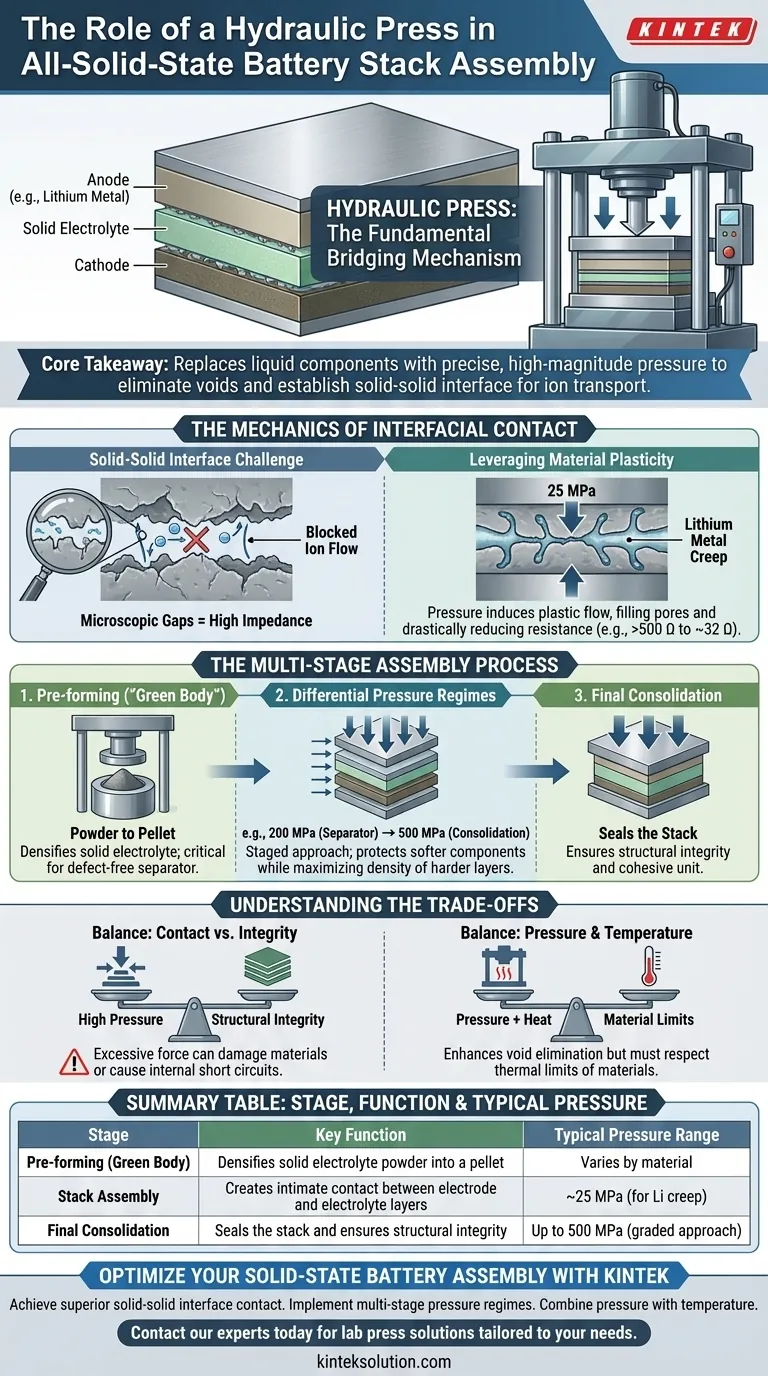
The hydraulic press acts as the fundamental bridging mechanism in solid-state battery assembly, compensating for the lack of liquid components. Its primary role is to apply precise, high-magnitude pressure to the stacked anode, solid electrolyte, and cathode, ensuring these distinct layers function as a single, cohesive electrochemical unit.
Core Takeaway Unlike traditional batteries where liquid electrolytes naturally "wet" surfaces to create contact, solid-state batteries rely entirely on mechanical force to close gaps. The hydraulic press eliminates microscopic voids and establishes the solid-solid interface necessary for ion transport, directly determining the cell's internal resistance and long-term cycling stability.
The Mechanics of Interfacial Contact
Solving the Solid-Solid Interface Challenge
In a solid-state system, the boundary between the electrode and the electrolyte is a physical barrier. Without sufficient pressure, microscopic gaps remain between these layers, creating high impedance that blocks ion flow.
The hydraulic press applies force to mechanically interlock these surfaces. This eliminates interfacial gaps, ensuring the continuous pathway required for lithium ions to move from the anode, through the separator, to the cathode.
Leveraging Material Plasticity
Pressure is not just about holding parts together; it is about changing the material's physical state. For example, applying specific pressures (such as 25 MPa) can leverage the plastic nature of lithium metal.
Under this pressure, the metal "creeps" or flows, filling microscopic pores and uneven textures on the solid electrolyte's surface. This process creates intimate, void-free contact, capable of reducing interfacial impedance drastically—in some cases dropping resistance from over 500 Ω to approximately 32 Ω.
The Multi-Stage Assembly Process
Pre-forming the "Green Body"
Before the final stack is assembled, the press is often used to fabricate the solid electrolyte component itself. By cold-pressing synthesized powders within a die, the press creates a "green body" with specific mechanical strength.
The magnitude of pressure and hold time during this stage dictate the initial density of the pellet. This step is a critical prerequisite for creating a defect-free ceramic separator that can withstand subsequent processing or sintering.
Differential Pressure Regimes
Assembly is rarely a one-step action; it often requires a graded pressure strategy. For instance, in Lithium-Sulfur assemblies, a lower pressure (e.g., 200 MPa) may be used first to form the separator.
Subsequently, a significantly higher pressure (e.g., 500 MPa) is applied to consolidate the cathode and anode against that separator. This staged approach ensures that softer components are not damaged while harder ceramic layers achieve maximum density.
Understanding the Trade-offs
The Balance Between Contact and Integrity
While high pressure is necessary to reduce resistance, excessive force poses risks. Applying too much pressure during the consolidation phase can damage the structural integrity of the active materials or the casing.
Furthermore, if the pressure is not uniform, it can lead to internal short circuits. This occurs if electrode materials are forced physically through the electrolyte separator, bridging the anode and cathode and destroying the cell.
Pressure Duration and Temperature
The press does not always operate in isolation; it often functions as a hot press. Combining pressure with temperature helps eliminate voids more effectively than pressure alone.
However, this adds complexity. The operator must balance the thermal limits of the battery materials against the mechanical benefits of the press, as excessive heat combined with pressure can degrade chemically sensitive electrolytes.
Making the Right Choice for Your Goal
To utilize a hydraulic press effectively in solid-state assembly, you must tailor the pressure regime to the specific stage of development.
- If your primary focus is reducing internal resistance: Prioritize pressures that induce plastic deformation (creep) in your anode material to fill microscopic surface voids.
- If your primary focus is separator fabrication: Focus on the initial cold-press stage to maximize the density of the electrolyte powder "green body" before stacking.
- If your primary focus is structural integrity: Use a multi-step pressure gradient, starting low to position components and finishing high to seal the casing and layers.
Ultimately, the hydraulic press is not just a manufacturing tool, but a critical variable that dictates the electrochemical efficiency of the final battery cell.
Summary Table:
| Stage | Key Function | Typical Pressure Range |
|---|---|---|
| Pre-forming (Green Body) | Densifies solid electrolyte powder into a pellet | Varies by material |
| Stack Assembly | Creates intimate contact between electrode and electrolyte layers | ~25 MPa (for Li creep) |
| Final Consolidation | Seals the stack and ensures structural integrity | Up to 500 MPa (graded approach) |
Optimize Your Solid-State Battery Assembly with KINTEK
Are you developing all-solid-state batteries and struggling with high interfacial resistance or structural integrity? The precise pressure control of a hydraulic press is critical for eliminating microscopic voids and ensuring efficient ion transport. KINTEK specializes in high-performance lab press machines, including automatic and heated presses, designed to meet the exacting demands of battery research and development.
Our expertise can help you:
- Achieve superior solid-solid interface contact to drastically reduce internal resistance.
- Implement multi-stage pressure regimes tailored to your specific assembly process.
- Combine pressure with temperature using our heated lab presses for enhanced void elimination.
Let KINTEK’s reliable equipment be the foundation of your next breakthrough. Contact our experts today to discuss your specific application and find the perfect press for your laboratory needs.
Visual Guide
Related Products
- Automatic High Temperature Heated Hydraulic Press Machine with Heated Plates for Lab
- Manual Heated Hydraulic Lab Press with Integrated Hot Plates Hydraulic Press Machine
- Heated Hydraulic Press Machine with Heated Plates for Vacuum Box Laboratory Hot Press
- Laboratory Hydraulic Press 2T Lab Pellet Press for KBR FTIR
- Laboratory Hydraulic Press Lab Pellet Press Machine for Glove Box
People Also Ask
- Function of a Laboratory Hydraulic Press with Heated Platens in SSE? Enhance Battery Density & Conductivity
- What are the requirements for electrode pressing with high-viscosity ionic liquids like EMIM TFSI? Optimize Performance
- How does a laboratory heated hydraulic press facilitate PBN sample prep for WAXS? Achieve Precise X-Ray Scattering
- What are the industrial applications of heated hydraulic presses? Master Heat & Force for Precision Manufacturing
- Why is a laboratory hydraulic press with heating plates required for PLA/TEC films? Achieve Precise Sample Integrity



















