
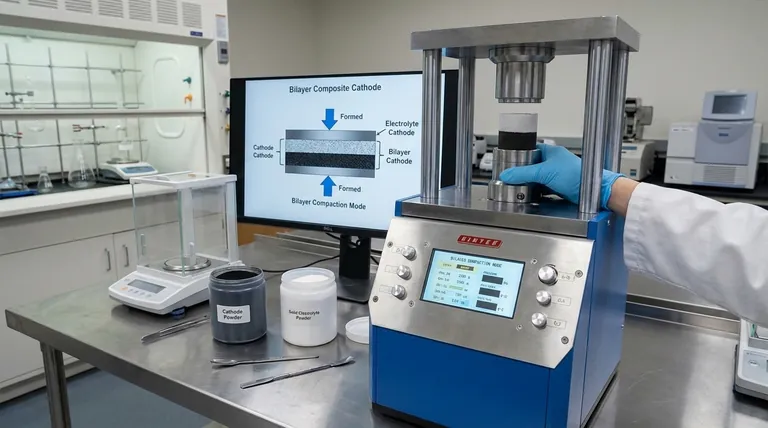
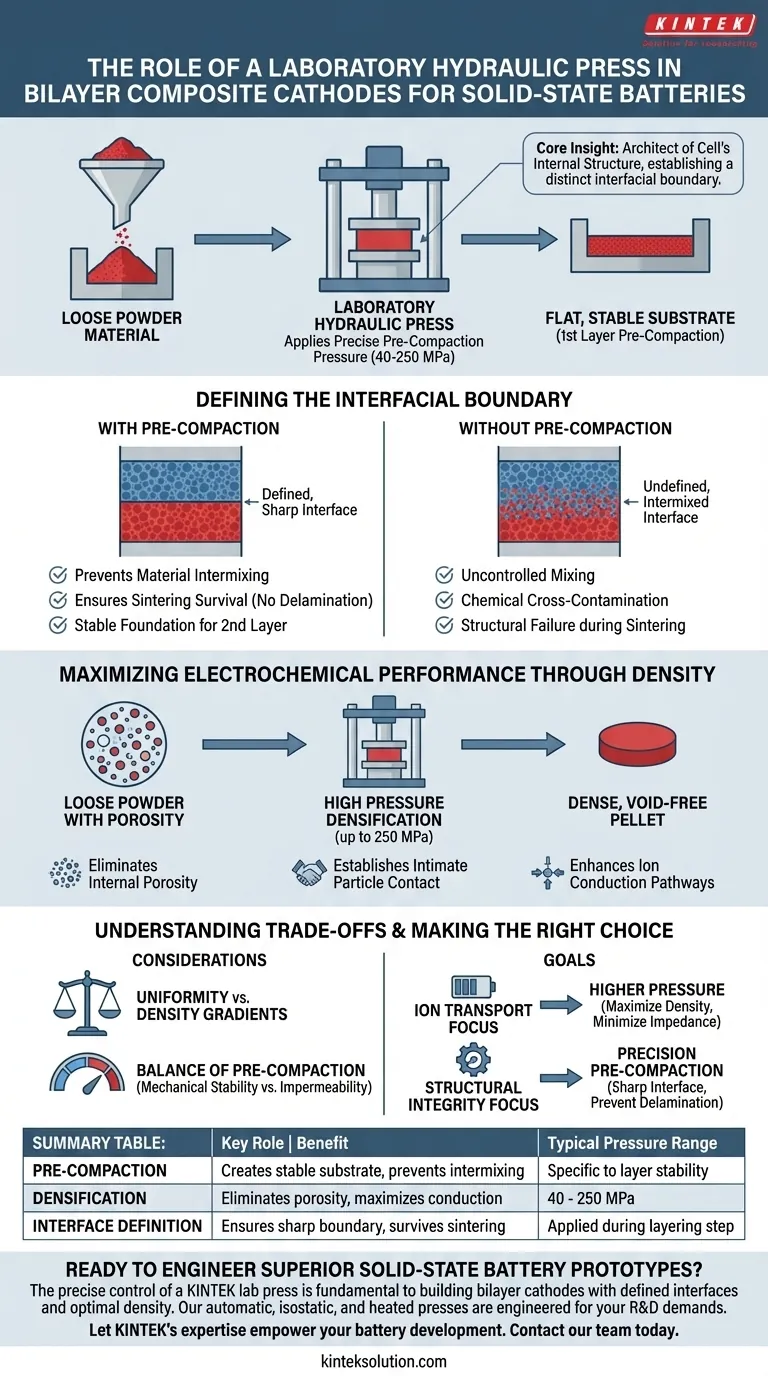
The primary role of a laboratory hydraulic press in preparing bilayer composite cathodes is to apply precise pre-compaction pressure to the initial powder layer. This mechanical force transforms loose material into a flat, mechanically stable substrate, establishing a defined foundation before the second layer is introduced. Without this step, the interface between the cathode and the solid electrolyte would be undefined, leading to structural and electrochemical failure.
Core Insight: The hydraulic press serves as the architect of the cell’s internal structure. By densifying the initial layer, it ensures a distinct interfacial boundary that prevents material intermixing and delamination during subsequent high-temperature sintering, directly enabling efficient ion transport.
Defining the Interfacial Boundary
The most critical function of the press during the layering process is managing the physical interface between the composite cathode and the solid electrolyte.
Creating a Stable Substrate
When fabricating a bilayer structure, you cannot simply stack loose powders on top of one another. The press applies a specific pre-compaction force to the first layer to create a flat and cohesive surface. This prevents the first layer from shifting or deforming when the second powder layer is added on top.
Preventing Material Intermixing
A lack of pre-compaction leads to uncontrolled mixing of the two distinct powder layers. By solidifying the first layer, the press ensures a well-defined interface. This separation is vital to prevent chemical cross-contamination that could degrade battery performance.
Ensuring Sintering Survival
The structural integrity established by the press is a prerequisite for the high-temperature sintering process. A properly compacted bilayer resists delamination (layer separation) when subjected to thermal stress. This ensures the cell remains a single, integrated unit rather than separating into two distinct pellets.
Maximizing Electrochemical Performance through Density
Beyond simple shaping, the hydraulic press is the primary tool for determining the microstructural density of the battery components.
Eliminating Internal Porosity
Laboratory presses typically apply high pressures, often ranging from 40 to 250 MPa, to cold-press the materials. This intense force significantly reduces the voids and porosity inherent in loose powder. A denser pellet translates directly to a higher volumetric energy density.
Establishing Intimate Contact
For a solid-state battery to function, ions must move physically from particle to particle. The press forces materials into intimate, void-free contact. This physical closeness minimizes interfacial impedance, which is the resistance ions face when moving between materials.
Enhancing Ion Conduction Pathways
By compacting the cathode composite—which often includes active materials like sulfur alongside the electrolyte—the press maximizes ion conduction pathways. A highly densified structure ensures that the active material is fully utilized, rather than being isolated by air gaps.
Understanding the Trade-offs
While pressure is essential, the application of force via a hydraulic press requires precision and understanding of material limits.
Uniformity vs. Density Gradients
A laboratory press must apply uniform uniaxial pressure. If the pressure application is uneven, it can create density gradients within the pellet. This inhomogeneity can lead to localized "hotspots" of high resistance or mechanical weak points where cracks may initiate.
The Balance of Pre-Compaction
There is a delicate balance in the pre-compaction step. The pressure must be high enough to create a flat surface, but not so high that the layer becomes glassy or impermeable, which might hinder adhesion with the second layer. The goal is mechanical stability, not necessarily final density, during the initial layering step.
Making the Right Choice for Your Goal
The way you utilize the hydraulic press should be dictated by the specific failure modes you are trying to prevent in your solid-state battery prototypes.
- If your primary focus is Ion Transport: Prioritize higher pressure ranges (up to 250 MPa) to maximize density and minimize internal porosity for the lowest possible interfacial impedance.
- If your primary focus is Structural Integrity: Focus on the precision of the pre-compaction step to ensure a sharp, flat interface that prevents delamination during sintering.
Ultimately, the laboratory hydraulic press is not just a shaping tool; it is a critical instrument for engineering the microstructural contact required for high-performance solid-state electrochemistry.
Summary Table:
| Key Role | Benefit | Typical Pressure Range |
|---|---|---|
| Pre-Compaction | Creates a stable substrate for the second layer, preventing intermixing. | Specific to layer stability. |
| Densification | Eliminates porosity, maximizes ion conduction pathways, and reduces impedance. | 40 - 250 MPa |
| Interface Definition | Ensures a sharp boundary between layers, critical for surviving sintering. | Applied during layering step. |
Ready to Engineer Superior Solid-State Battery Prototypes?
The precise control of a KINTEK lab press is fundamental to building bilayer cathodes with defined interfaces and optimal density. Our automatic lab presses, isostatic presses, and heated lab presses are engineered for the repeatability and precision your R&D demands.
Let KINTEK's expertise empower your battery development. Contact our team today to find the perfect press for your laboratory's needs.
Visual Guide
Related Products
- Laboratory Hydraulic Press Lab Pellet Press Button Battery Press
- Laboratory Hydraulic Press 2T Lab Pellet Press for KBR FTIR
- Laboratory Hydraulic Press Lab Pellet Press Machine for Glove Box
- 24T 30T 60T Heated Hydraulic Lab Press Machine with Hot Plates for Laboratory
- Automatic Laboratory Hydraulic Press Lab Pellet Press Machine
People Also Ask
- How is a laboratory hydraulic press used for HAP composite gels? Master Mineral Substrate Standardization
- What role does a laboratory hydraulic press play in the preparation of piezoelectric ceramic discs for DC-PG? | KINTEK
- What role does a laboratory hydraulic press play in reaction pellets? Optimizing Lunar Soil and Metal Fuel Density
- Why is a laboratory hydraulic press required for PBAT and PLA sample preparation? Achieve Flawless Characterization
- What role does a laboratory hydraulic press play in the assembly of all-solid-state battery test cells? Expert Guide



















