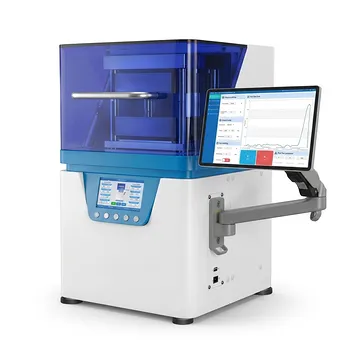
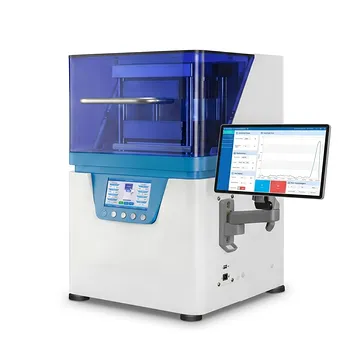
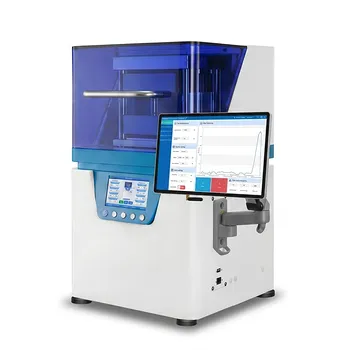
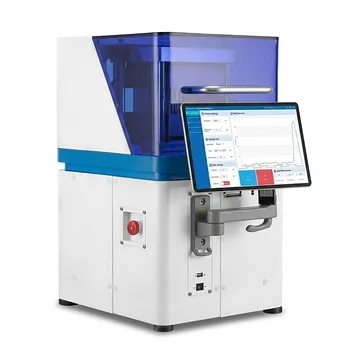
The laboratory hydraulic press is the foundational tool for transforming loose Multi-Principal Element Alloy (MPEA) powders into viable solid structures. It applies high-precision vertical pressure to alloy powders within a mold, forcing particles to rearrange, mechanically interlock, and undergo plastic deformation to create a "green body."
Core Takeaway: A laboratory hydraulic press acts as the critical bridge between raw powder and a cohesive alloy, ensuring the uniform density and structural integrity required for successful sintering. Without its precise pressure control, MPEA samples are prone to internal cracking, uneven diffusion, and catastrophic deformation during high-temperature processing.
Facilitating the Transition from Powder to Solid
Mechanical Interlocking and Rearrangement
The primary role of the hydraulic press is to apply constant, axial pressure to force mixed metal powders into a precision mold. This force causes the loose particles to rearrange and mechanically interlock, effectively expelling internal air. The result is the creation of a green body, a compacted sample that possesses enough structural strength to be handled before the final firing stage.
Plastic Deformation and Green Strength
Under the vertical pressure of the press, MPEA powder particles undergo plastic deformation. This deformation ensures that the particles pack closely together, maximizing the surface contact between different elements. This "green strength" is vital for maintaining the sample's geometric shape and preventing it from crumbling during the transition to the furnace.
Ensuring Precise Density and Microstructural Uniformity
Eliminating Internal Porosity and Gaps
Precise pressure control is necessary to eliminate internal gaps and density gradients within the mold. By providing a uniform distribution of force, the hydraulic press ensures that the internal porosity is minimized and consistent throughout the sample. A stable and predictable porosity level is often required to ensure the final product reaches its intended mechanical performance.
Setting the Foundation for Sintering and Diffusion
The density of the green body directly dictates the shrinkage rates and diffusion behavior during subsequent high-temperature sintering. In MPEAs, uniform density is critical for the even diffusion of elements—such as nickel within an iron matrix—and the stable distribution of carbides. A high-quality compaction stage prevents the formation of micro-cracks that can occur due to uneven stress gradients when the material is subjected to heat.
Understanding the Trade-offs and Limitations
Uniformity vs. Geometric Complexity
While hydraulic presses are excellent at creating highly dense, standardized samples, they are primarily designed for specific geometric shapes. Complex designs may suffer from non-uniform pressure distribution, leading to sections of the green body that are weaker or more porous than others.
Precise Control vs. Material Stress
Applying too much pressure can lead to excessive internal stress or the fracturing of refractory metal particles before they can interlock. Conversely, insufficient pressure results in a fragile green body that may collapse during the sintering or hot isostatic pressing (HIP) phases. Researchers must identify the exact pressure "dwelling time" and force required for each specific MPEA composition to avoid these pitfalls.
Making the Right Choice for Your Research Goal
The use of a laboratory hydraulic press should be tailored to the specific metallurgical outcome you intend to study.
- If your primary focus is high-temperature densification: Ensure the press is calibrated for high-precision repeatability to maintain a stable starting porosity, which is critical for consistent sintering results.
- If your primary focus is mechanical property characterization: Use the press to eliminate internal density gradients, as even minor variations in green density can lead to structural flaws in the finished alloy.
- If your primary focus is high-entropy alloy (HEA) development: Focus on the press's ability to facilitate tight contact between diverse elemental powders to promote uniform chemical diffusion during heat treatment.
The laboratory hydraulic press remains the indispensable gatekeeper of quality in the powder metallurgy workflow, determining the ultimate viability of advanced alloy research.
Summary Table:
| Research Stage | Role of Hydraulic Press | Impact on MPEA Samples |
|---|---|---|
| Compaction | Mechanical interlocking & air expulsion | Creation of handleable "green bodies" |
| Microstructure | Plastic deformation & surface contact | Maximizes elemental diffusion and bonding |
| Density Control | Minimizing internal porosity | Prevents shrinkage & cracking during sintering |
| Quality Prep | Uniform axial pressure distribution | Ensures mechanical performance & alloy stability |
Elevate Your MPEA and Battery Research with KINTEK
Precision starts with the press. KINTEK specializes in comprehensive laboratory pressing solutions tailored for advanced metallurgy and battery research. Whether your workflow requires manual, automatic, heated, or multifunctional models, our equipment delivers the high-precision pressure control essential for high-entropy alloy development.
We also offer specialized glovebox-compatible systems and cold/warm isostatic presses (CIP/WIP) to meet your most demanding structural requirements. Ensure the integrity of your green bodies and optimize your sintering results—contact KINTEK today for a custom solution!
References
- Chenze Li, Xiaopeng Li. Review: Multi-principal element alloys by additive manufacturing. DOI: 10.1007/s10853-022-06961-y
This article is also based on technical information from Kintek Solution Knowledge Base .
Related Products
- Laboratory Hydraulic Press Lab Pellet Press Machine for Glove Box
- Laboratory Hydraulic Press 2T Lab Pellet Press for KBR FTIR
- 24T 30T 60T Heated Hydraulic Lab Press Machine with Hot Plates for Laboratory
- Laboratory Hydraulic Press Lab Pellet Press Button Battery Press
- Laboratory Hydraulic Pellet Press for XRF KBR FTIR Lab Press
People Also Ask
- How does a laboratory hydraulic press contribute to the preparation of Li3-3xScxSb samples? Optimize Ionic Conductivity
- What is the function of a laboratory hydraulic press in FT-IR of curcumin-coated MWCNTs? Achieve Optical Clarity.
- Why is a laboratory hydraulic press required for compression molding boron-siloxane? Solve High-Loading Density Challenges
- What role does a laboratory hydraulic press play in the preparation of piezoelectric ceramic discs for DC-PG? | KINTEK
- What role does a laboratory hydraulic press play in reaction pellets? Optimizing Lunar Soil and Metal Fuel Density