
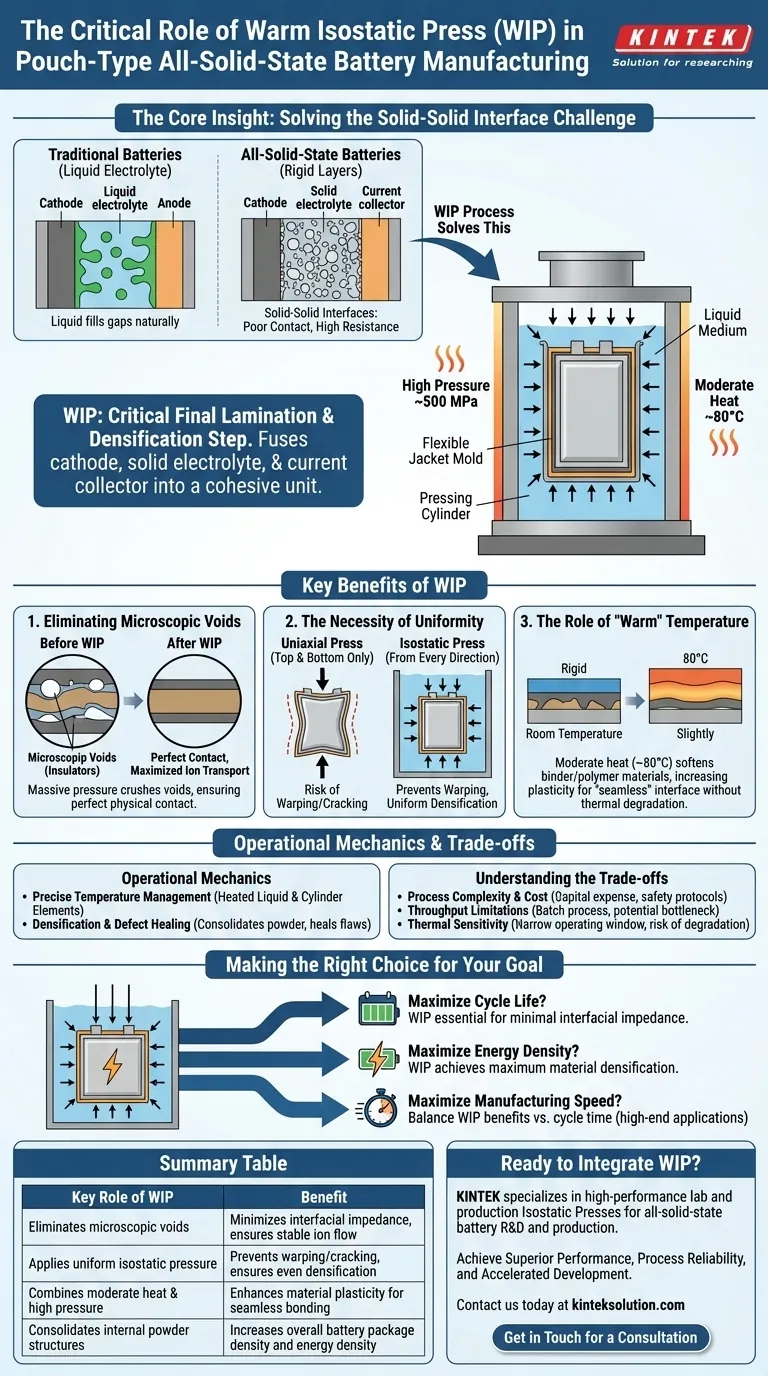
The Warm Isostatic Press (WIP) serves as the critical final lamination and densification step in the manufacturing of pouch-type all-solid-state batteries. By subjecting the sealed battery assembly to simultaneous, uniform high pressure (typically around 500 MPa) and moderate heat (approximately 80°C), the WIP process forces the cathode, solid electrolyte, and current collector to fuse into a cohesive unit. This step is functionally required to eliminate microscopic voids and establish the intimate contact necessary for the battery to operate.
The Core Insight: In traditional batteries, liquid electrolytes naturally fill gaps between components. In all-solid-state batteries, the layers are rigid, creating "solid-solid" interfaces that suffer from poor contact and high resistance. The WIP process mechanically forces these solid layers to bond at a microscopic level, minimizing interfacial impedance to ensure stable cycling and high energy density.
Solving the Solid-Solid Interface Challenge
Eliminating Microscopic Voids
When solid battery layers are simply stacked, microscopic gaps remain at the interfaces. These air pockets act as insulators, blocking the flow of ions and increasing electrical resistance.
The WIP process applies massive pressure to crush these voids. This ensures that the active materials in the cathode and the solid electrolyte are in perfect physical contact, maximizing the active area for ion transport.
The Necessity of Uniformity
Unlike a standard mechanical press that applies force from only the top and bottom (uniaxial), an isostatic press applies pressure from every direction.
This is achieved by submerging the pouch—often protected by a flexible jacket mold—into a pressing cylinder filled with a liquid medium. The liquid transfers pressure equally to every square millimeter of the pouch's surface, preventing the warping or cracking that often occurs with rigid, unidirectional pressing.
The Role of "Warm" Temperature
Pressure alone is often insufficient to bond varying materials like ceramics and composites. The "Warm" aspect of WIP involves heating the liquid medium to a moderate temperature, such as 80°C.
This heat slightly softens the binder materials or polymer electrolytes, increasing their plasticity. This allows the materials to flow into surface irregularities more effectively than they would at room temperature, creating a "seamless" interface without thermally degrading the sensitive battery chemistry.
Operational Mechanics
Precise Temperature Management
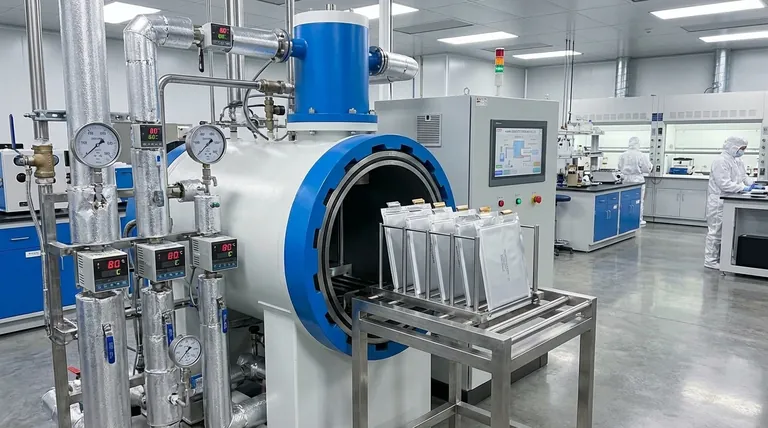
To maintain consistency, the liquid medium is heated before injection, and the pressing cylinder is equipped with its own heating elements.
This dual-heating approach ensures accurate temperature management throughout the cycle. It prevents thermal gradients that could lead to uneven densification across the battery pouch.
Densification and Defect Healing
Beyond just bonding layers, the WIP consolidates the internal powder structures of the electrodes. This increases the overall density of the battery package.
Historically used to heal defects in castings and ceramics, this technology effectively "heals" internal structural flaws in the battery layers before they can become failure points during operation.
Understanding the Trade-offs
Process Complexity and Cost
Implementing WIP adds a significant capital expense and complexity to the production line compared to simple calendering (roll pressing). The equipment must safely contain extreme pressures (500 MPa) while handling heated fluids, requiring robust safety protocols and maintenance.
Throughput Limitations
Isostatic pressing is inherently a batch process, or at best, a semi-continuous one. Unlike roll-to-roll manufacturing which is continuous and fast, loading pouches into a pressure vessel takes time. This can create a bottleneck in high-volume mass production scenarios.
Thermal Sensitivity
While heat aids bonding, there is a narrow operating window. Excessive heat can degrade the solid electrolyte or the separator materials. The process requires precise thermal control to stay within the "warm" range (e.g., 80°C) without crossing into temperatures that damage the cell chemistry.
Making the Right Choice for Your Goal
The decision to utilize WIP is driven by the specific performance requirements of the solid-state architecture you are developing.
- If your primary focus is maximizing cycle life: The WIP is essential to minimize interfacial impedance, which prevents the resistance growth that typically causes early cell failure.
- If your primary focus is energy density: Use WIP to achieve maximum material densification, reducing the total volume of the cell while maintaining active material loading.
- If your primary focus is manufacturing speed: You must balance the benefits of WIP against the cycle time; consider it only for high-end applications where performance justifies the slower throughput.
The Warm Isostatic Press transforms a stack of loose layers into a unified, high-performance electrochemical device.
Summary Table:
| Key Role of WIP | Benefit |
|---|---|
| Eliminates microscopic voids | Minimizes interfacial impedance, ensures stable ion flow |
| Applies uniform isostatic pressure | Prevents warping/cracking, ensures even densification |
| Combines moderate heat (e.g., 80°C) with high pressure (e.g., 500 MPa) | Enhances material plasticity for seamless bonding |
| Consolidates internal powder structures | Increases overall battery package density and energy density |
Ready to Integrate WIP into Your Battery Manufacturing Process?
KINTEK specializes in high-performance lab press machines, including advanced Isostatic Presses designed for the precise demands of all-solid-state battery R&D and production. Our equipment delivers the uniform pressure and controlled heating essential for creating high-density, long-life pouch cells.
Let us help you achieve:
- Superior Battery Performance: Minimize interfacial resistance and maximize energy density.
- Process Reliability: Benefit from our expertise in precise temperature and pressure management.
- Accelerated Development: From laboratory-scale automatic lab presses to production-ready systems.
Contact us today to discuss how our solutions can meet your specific solid-state battery manufacturing challenges.
Get in Touch for a Consultation
Visual Guide
References
- Seung Ho Choi, Jang Wook Choi. Silver exsolution from Li-argyrodite electrolytes for initially anode-free all-solid-state batteries. DOI: 10.1038/s41467-025-61074-9
This article is also based on technical information from Kintek Solution Knowledge Base .
Related Products
- Warm Isostatic Press for Solid State Battery Research Warm Isostatic Press
- Lab Isostatic Pressing Molds for Isostatic Molding
- Button Battery Sealing Press Machine for Lab
- Laboratory Hydraulic Press Lab Pellet Press Button Battery Press
- Electric Lab Cold Isostatic Press CIP Machine
People Also Ask
- Why must composite cathodes be sealed in vacuum lamination bags for WIP? Ensure Battery Stability and Density
- How do sacrificial volume materials (SVM) maintain microchannels in isostatic pressing? Ensure Structural Integrity
- What is the function of elastic molds in warm isostatic pressing? Achieve Uniform Density in Composite Particles
- What is the significance of temperature control in Warm Isostatic Pressing? Unlock Uniform Densification and Process Stability
- How does Warm Isostatic Pressing differ from traditional pressing methods? Unlock Uniform Density for Complex Parts



















