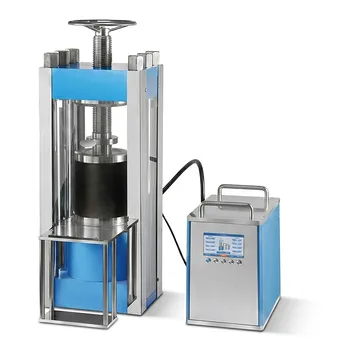
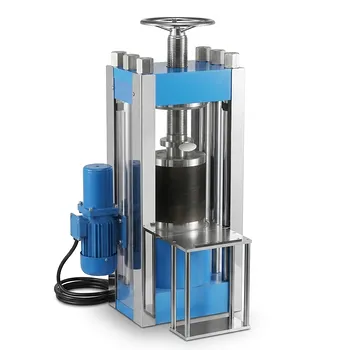
The primary role of heated lab presses in X-ray fluorescence (XRF) spectroscopy is to standardize sample preparation. These devices are used to compress powdered materials into solid, uniform pellets or briquettes. By applying a specific combination of heat and pressure, the press creates a dense, flat surface that is critical for accurate X-ray irradiation and subsequent analysis.
The quality of your XRF data is largely determined by the physical state of your sample. Heated lab presses transform loose powders into homogeneous, stable pellets, thereby reducing particle scattering and ensuring the high sensitivity required for precise elemental composition analysis.
The Physics of Sample Integrity
Achieving Critical Homogeneity
For XRF to provide a representative analysis of a material, the sample must be uniform throughout.
Heated lab presses utilize thermal energy during compression to promote better homogeneity. This ensures that the elemental distribution within the pellet is consistent, preventing localized inconsistencies that could skew results.
Minimizing Particle Scattering
One of the main challenges in analyzing powder samples is the scattering of X-rays caused by void spaces and irregular particle shapes.
By compressing the material into a solid briquette, the press significantly reduces particle scattering. This results in a cleaner signal and improves the instrument's ability to detect trace elements.
Ensuring Surface Flatness
The distance between the sample surface and the X-ray detector is a critical variable in spectroscopy.
Pressed pellets create a perfectly flat surface. This eliminates geometric variations that would otherwise alter the intensity of the X-ray fluorescence, ensuring that changes in signal strength are due to composition, not surface texture.
The Function of Heat and Pressure
The Role of Pressure
The hydraulic component of the press applies high force to squeeze the sample material.
This ensures complete compaction, maintaining the structural integrity of the sample so it does not crumble or shift during the analysis process.
The Role of Heat
While pressure consolidates the material, heat assists in the binding process.
The application of heat helps to fuse the particles more effectively than pressure alone. This is particularly useful for difficult samples, creating a robust pellet that enhances the accuracy and sensitivity of the measurement.
Understanding the Trade-offs
Equipment Complexity vs. Data Quality
Using a heated press adds a variable (temperature) to the preparation workflow compared to simple cold pressing.
However, this added complexity is often necessary for high-precision work. Without heat, certain powders may not bind sufficiently, leading to lower density pellets that yield less reliable spectroscopic data.
Sample Integrity Risks
While presses are designed to maintain integrity, incorrect settings can damage the sample.
Excessive heat or pressure on sensitive materials can alter their chemical structure before analysis. It is vital to balance the mechanical needs of the pellet with the thermal stability of the specific material being tested.
Making the Right Choice for Your Goal
To maximize the effectiveness of your XRF analysis, consider your specific analytical requirements:
- If your primary focus is maximum sensitivity: Utilize the heated function to achieve the highest possible density, which minimizes scattering and improves the signal-to-noise ratio.
- If your primary focus is reproducibility: Standardize your temperature and pressure settings to ensure that every pellet has the exact same physical characteristics, allowing for valid comparisons between batches.
Ultimately, the heated lab press is not just a shaping tool, but a calibration device that establishes the baseline accuracy for your entire analytical process.
Summary Table:
| Feature | Role in XRF Sample Preparation | Impact on Analytical Results |
|---|---|---|
| Homogeneity | Uniformly distributes elements within the pellet | Prevents localized inconsistencies and skewed data |
| Particle Sizing | Compresses loose powders into solid briquettes | Minimizes X-ray scattering and improves trace detection |
| Surface Flatness | Creates a perfectly planar sample surface | Ensures consistent X-ray intensity and geometric precision |
| Thermal Binding | Fuses difficult particles using heat and pressure | Increases pellet density and structural integrity |
Elevate Your XRF Analysis with KINTEK Precision Solutions
Don't let poor sample preparation compromise your research results. KINTEK specializes in comprehensive laboratory pressing solutions designed to meet the rigorous demands of spectroscopy and battery research. Whether you require manual, automatic, heated, multifunctional, or glovebox-compatible models, our equipment ensures the homogeneity and stability your analysis deserves. We also offer advanced cold and warm isostatic presses for specialized material applications.
Ready to achieve superior sample integrity? Contact KINTEK today to find the perfect press for your lab's specific needs and experience the difference in your data precision.
Related Products
- 24T 30T 60T Heated Hydraulic Lab Press Machine with Hot Plates for Laboratory
- Automatic Heated Hydraulic Lab Press 120x120mm Plate Fully Automated Material Research Press
- Automatic Heated Hydraulic Lab Press with Programmable Touch Screen Controls and Precision Temperature Regulation
- Automatic Heated Hydraulic Lab Press Machine 200x200 Plate Size for Battery Research and Materials Science
- Manual Heated Hydraulic Lab Press with Integrated Hot Plates Hydraulic Press Machine
People Also Ask
- Function of a Laboratory Hydraulic Press with Heated Platens in SSE? Enhance Battery Density & Conductivity
- Why is a laboratory hydraulic press with heating plates required for PLA/TEC films? Achieve Precise Sample Integrity
- What role does a laboratory heated hydraulic press play in LTCC? Essential for High-Density Ceramic Lamination
- What is the primary function of a laboratory heated hydraulic press? Mastering Thermoplastic Carbon Fiber Composites
- What is the critical role of a laboratory heated hydraulic press? Mastering PVC Sample Prep for Testing