
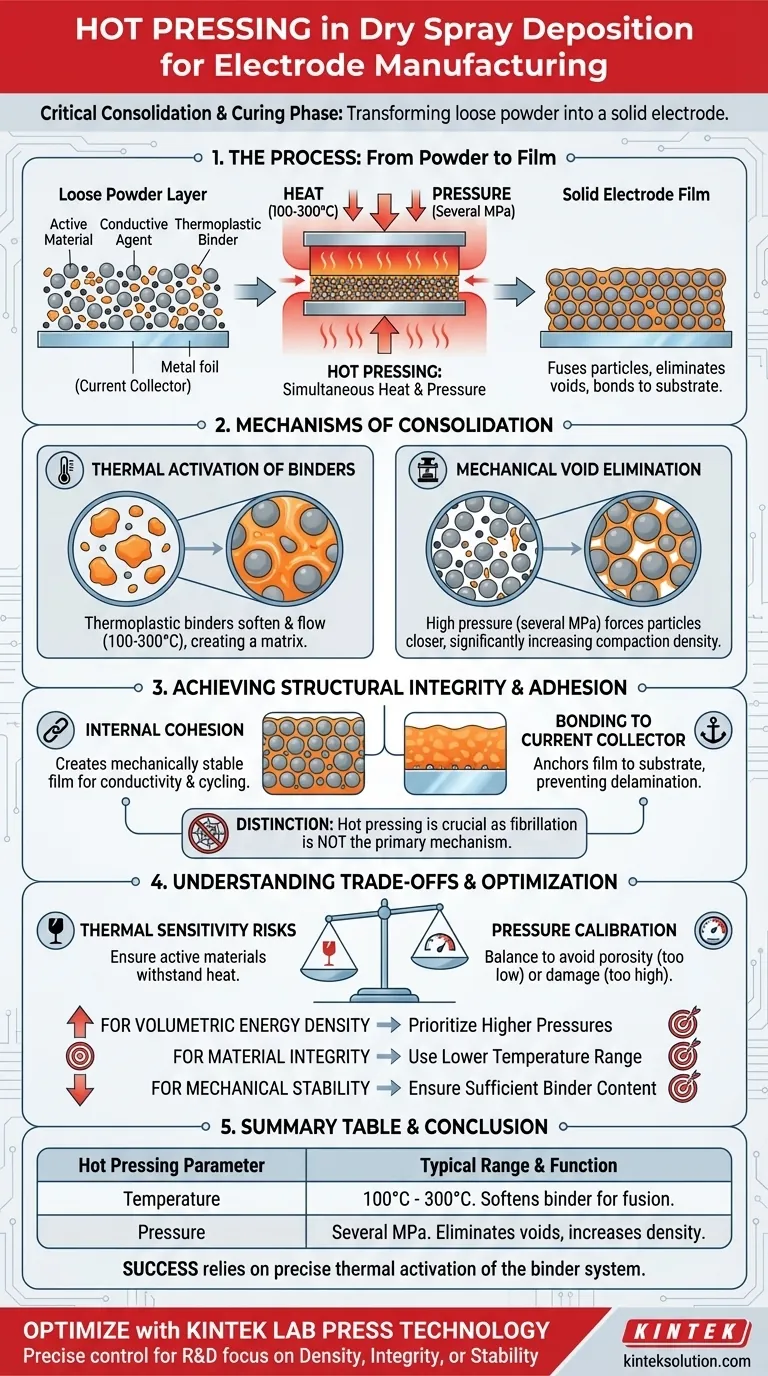
Hot pressing serves as the critical consolidation and curing phase in dry spray deposition, transforming loose powder into a solid electrode. It applies simultaneous heat (typically 100-300°C) and pressure (several MPa) to fuse particles together and bond them to the current collector.
Core Takeaway: In dry spray deposition, hot pressing replaces solvent evaporation as the primary solidification step. It relies on the thermal softening of thermoplastic binders to eliminate voids and achieve high compaction density, making it essential for systems that do not rely on binder fibrillation.

The Mechanisms of Consolidation
Thermal Activation of Binders
The process relies heavily on the specific behavior of thermoplastic binders mixed into the dry powder.
When heated between 100°C and 300°C, these binders soften and become pliable. This allows the binder to flow around the active materials and conductive agents, creating a matrix that holds the structure together upon cooling.
Mechanical Void Elimination
While heat prepares the binder, the application of high pressure (several MPa) performs the physical work of densification.
This pressure forces the particles closer together, mechanically eliminating the air gaps and voids inherent in a sprayed powder layer. The result is a significant increase in the compaction density of the final electrode film.
Structural Integrity and Adhesion
Creating Internal Cohesion
Without hot pressing, the deposited material is merely a layer of loose, pre-mixed powder.
The combination of heat and pressure ensures firmly bonded particles, creating a mechanically stable film. This internal cohesion is vital for maintaining electrical conductivity and structural integrity during battery cycling.
Bonding to the Current Collector
Hot pressing does not just bond particles to one another; it anchors the entire film to the substrate.
The process ensures the electrode material is firmly adhered to the current collector. This prevents delamination, a common failure mode where the electrode material peels away from the metal foil.
Distinction from Fibrillation Methods
A Different Binding Philosophy
It is critical to distinguish this approach from dry electrode methods that rely on fibrillation.
In fibrillation-based processes (often using PTFE), a roller press stretches the binder to create web-like structures. In dry spray deposition, hot pressing is the crucial step precisely because fibrillation is not the primary binding mechanism.
Understanding the Trade-offs
Thermal Sensitivity Risks
Because this process requires temperatures up to 300°C, it introduces thermal stress to the system.
Engineers must verify that the active materials and conductive agents can withstand these temperatures without degrading or altering their electrochemical properties.
Pressure Calibration
Balancing the pressure applied during hot pressing is a delicate operational requirement.
Insufficient pressure results in a porous, weak electrode with poor conductivity. Conversely, excessive pressure can crush fragile active material particles or damage the current collector foil.
Making the Right Choice for Your Goal
To optimize your dry spray deposition process, you must tune the hot press parameters to your specific material chemistry.
- If your primary focus is volumetric energy density: Prioritize higher pressures to minimize porosity and maximize the compaction density of the film.
- If your primary focus is material integrity: Utilize the lower end of the 100-300°C temperature range to prevent thermal degradation of sensitive active components.
- If your primary focus is mechanical stability: Ensure the thermoplastic binder content is sufficient to create a continuous matrix when heated, preventing delamination.
Success in dry spray deposition depends on using the hot press not just as a compactor, but as a precise thermal activation tool for your binder system.
Summary Table:
| Hot Pressing Parameter | Typical Range | Primary Function |
|---|---|---|
| Temperature | 100°C - 300°C | Softens thermoplastic binder for particle fusion. |
| Pressure | Several MPa | Eliminates voids, increases compaction density. |
| Key Outcome | High-density, cohesive electrode film firmly bonded to the current collector. |
Optimize your dry spray deposition process with precision lab press technology from KINTEK.
Is your R&D focused on maximizing electrode density, ensuring material integrity, or preventing delamination? Our specialized lab presses, including heated and automatic models, are engineered to deliver the precise temperature and pressure control required to activate your specific binder system and achieve optimal electrode consolidation.
KINTEK specializes in lab press machines (automatic lab press, isostatic press, heated lab press, etc.), serving the precise needs of battery and advanced materials laboratories.
Contact our experts today to discuss how our presses can enhance your electrode manufacturing process and bring your battery innovations to life.
Visual Guide
Related Products
- Automatic High Temperature Heated Hydraulic Press Machine with Heated Plates for Lab
- Heated Hydraulic Press Machine with Heated Plates for Vacuum Box Laboratory Hot Press
- Automatic Heated Hydraulic Press Machine with Hot Plates for Laboratory
- Heated Hydraulic Press Machine With Heated Plates For Vacuum Box Laboratory Hot Press
- Laboratory Split Manual Heated Hydraulic Press Machine with Hot Plates
People Also Ask
- Function of a Laboratory Hydraulic Press with Heated Platens in SSE? Enhance Battery Density & Conductivity
- What are the requirements for electrode pressing with high-viscosity ionic liquids like EMIM TFSI? Optimize Performance
- How does a laboratory heated hydraulic press facilitate PBN sample prep for WAXS? Achieve Precise X-Ray Scattering
- What are the industrial applications of heated hydraulic presses? Master Heat & Force for Precision Manufacturing
- Why is a laboratory hydraulic press with heating plates required for PLA/TEC films? Achieve Precise Sample Integrity



















