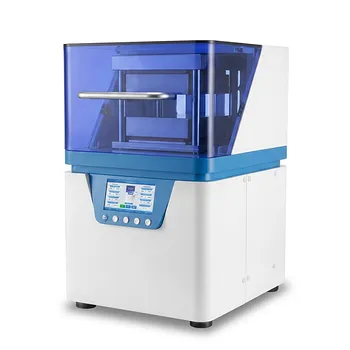
Hydraulic presses serve as the foundational mechanism for transforming loose ceramic powders into solid, workable forms. Their primary role is to apply immense pressure—often ranging from 20 to 250 MPa—to compact raw materials into "green bodies." This process creates the necessary density and structural integrity required before the ceramic undergoes high-temperature sintering or further processing.
Core Takeaway: The hydraulic press does not just shape the material; it mechanically rearranges powder particles to increase density and overcome friction. This compaction is the critical "bridge" step that converts raw powder into a cohesive solid capable of withstanding the rigors of sintering without collapsing.
The Mechanics of Powder Compaction
Overcoming Particle Friction
At the microscopic level, ceramic powders are resistant to compaction due to friction between particles.
Hydraulic presses apply sufficient force to overcome this inter-particle friction. This forces the particles to rearrange and displace one another, reducing void spaces and creating a tighter internal structure.
Achieving Target Density
The goal of this compression is to achieve a specific theoretical density, typically between 50% and 55%.
Reaching this density threshold is vital. If the density is too low, the material may crack or shrink unpredictably during the firing process.
Creating the "Green Body"
Establishing Structural Integrity
The immediate output of a hydraulic press is a "green body"—a solid ceramic object that has not yet been fired.
While these bodies are not yet fully hardened, the pressing process gives them sufficient mechanical strength to be handled, measured, and moved to a furnace without crumbling.
Geometric Precision and Standardization
Presses allow for the creation of samples with precise dimensions and flat surfaces.
This geometric control is essential for consistency. For example, in flash sintering, perfectly flat surfaces are required to ensure excellent physical contact with electrodes.
The Role in the Processing Workflow
Preliminary Uniaxial Pressing
In many workflows, a laboratory uniaxial press performs the initial compaction at lower pressures (around 20 MPa).
This step transforms loose mixed powders into a basic geometric shape. It provides the physical foundation necessary for more intensive densification methods.
Preparation for Cold Isostatic Pressing (CIP)
Hydraulic pressing is often the prerequisite for Cold Isostatic Pressing.
Once the hydraulic press establishes the basic shape and structural integrity, the green body can be subjected to CIP for final, uniform densification before sintering.
Understanding the Trade-offs
The Limit of Uniaxial Pressure
While hydraulic presses are effective, uniaxial pressing (pressure from one direction) has limitations regarding density uniformity.
It is generally used for simple shapes. For complex geometries or higher density requirements, the green body may require secondary processing like CIP.
The Necessity of Sintering
It is critical to remember that a hydraulic press creates shape and density, not final hardness.
The pressed component is still a "green" material. It requires thermal treatment (sintering) to achieve the final mechanical and thermal properties associated with high-performance ceramics.
Making the Right Choice for Your Goal
To maximize the utility of a hydraulic press in your ceramic workflow, consider your specific objective:
- If your primary focus is Initial Forming: Use the press to establish the basic geometry and a density of roughly 50-55% to ensure the green body survives handling.
- If your primary focus is Advanced Sintering (e.g., Flash Sintering): Prioritize the press's ability to create perfectly flat, parallel surfaces to ensure optimal electrode contact.
- If your primary focus is Material Testing: Use the press to create standardized pellets to ensure consistency when analyzing mechanical or thermal properties.
Successful ceramic preparation relies on using the press not just to shape the powder, but to precisely control the internal density that dictates the quality of the final product.
Summary Table:
| Stage of Process | Primary Function of Press | Typical Outcome/Requirement |
|---|---|---|
| Powder Compaction | Overcoming inter-particle friction | Rearranged particles with reduced void space |
| Green Body Formation | Establishing structural integrity | 50% - 55% theoretical density; handleable solid |
| Geometric Control | Defining shape and surface flatness | Precise dimensions; optimal contact for flash sintering |
| Pre-CIP Preparation | Initial uniaxial forming | Standardized shape ready for final densification |
| Workflow Integration | Bridging raw powder to sintering | Cohesive solids capable of surviving thermal treatment |
Elevate Your Ceramic Research with KINTEK Precision
Ready to transform your powder processing? KINTEK specializes in comprehensive laboratory pressing solutions tailored for advanced material science. Whether you are developing next-generation batteries or high-performance ceramics, our range of manual, automatic, heated, and glovebox-compatible models, as well as cold and warm isostatic presses, ensures optimal density and structural integrity for every sample.
Don't let inconsistent green bodies compromise your sintering results. Contact KINTEK today to find the perfect hydraulic solution for your laboratory needs!
Related Products
- Automatic Hydraulic Hot Press with Large Plate and Precision Temperature Control for Advanced Material Sample Preparation and Industrial Research
- Automatic Hydraulic Heat Press Machine with Multi Stage Programmable Control and Integrated Water Cooling Plate Size 180x180mm
- Automatic High Temperature Heated Hydraulic Press Machine with Heated Plates for Lab
- Automatic Heated Hydraulic Lab Press with Programmable Touch Screen Controls and Precision Temperature Regulation
- Manual Heated Hydraulic Lab Press with Integrated Hot Plates Hydraulic Press Machine
People Also Ask
- What are the specific features and applications of hydraulic hot press machines? Precision Solutions for Modern Labs
- How does an automatic hydraulic press operate? Achieve Precision and Consistency in Lab Pelleting
- What are the advantages and common applications of an automatic hydraulic press? Elevate Your Lab's Precision
- What is the technical significance of setting a precise dwell time? Achieve Peak Material Density and Stability
- When is an automatic hydraulic press more suitable than a manual press? Scale Your Lab with Precision & Speed