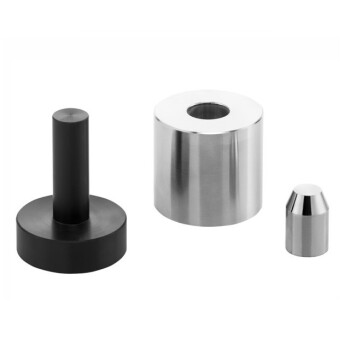
The 10 mm tablet die functions as the primary molding component in the Omeprazole tableting process. It defines the tablet's physical geometry and ensures that compression pressure is transmitted uniformly throughout the powder bed to prevent structural failure.
The significance of this die extends beyond simple shaping; it is the critical control point for internal density. By ensuring uniform pressure distribution, the 10 mm die minimizes density gradients, directly preventing common defects like cracking and lamination while ensuring weight consistency.
The Role of Die Geometry in Formation
Defining Dimensions and Shape
The fundamental purpose of the 10 mm die is to establish the geometry and dimensions of the final product. It acts as the precise confinement vessel for the powder during the compression phase.
Facilitating Pressure Transmission
For a tablet to hold together, force must be applied evenly. The die works in conjunction with punches to ensure uniform pressure transmission throughout the powder volume. This uniformity is essential for binding the ingredients into a solid mass.
Quality Assurance and Defect Prevention
Reducing Internal Density Gradients
Uneven pressure leads to density gradients, where some parts of the tablet are denser than others. The 10 mm die design is engineered to reduce these internal density gradients. This homogeneity is vital for the structural integrity of the medication.
Eliminating Structural Defects
When density is inconsistent, tablets often fail post-compression. The use of this specific die prevents defects such as cracking or lamination (separation of layers).
Ensuring Surface Finish
A precision-machined die contributes to the aesthetic and functional quality of the tablet. It ensures the production of tablets with smooth surfaces, which is important for subsequent coating or packaging steps.
Understanding the Trade-offs
The Requirement for Precision
The benefits of the 10 mm die—specifically weight consistency and defect prevention—rely entirely on it being precision-machined. Any deviation in the die bore smoothness or diameter will compromise the pressure transmission.
Sensitivity to Wear
Because the die is responsible for ensuring consistent weight, it is highly sensitive to wear over time. If the die bore loses its precise tolerance, weight variation and surface defects will immediately reappear, negating the component's value.
Making the Right Choice for Your Goal
To maximize the effectiveness of the 10 mm die in your Omeprazole production, consider your specific manufacturing priorities:
- If your primary focus is Physical Durability: Ensure the die bore is perfectly smooth to maintain uniform pressure transmission, which prevents cracking and lamination.
- If your primary focus is Regulatory Compliance: Regularly inspect the die dimensions to guarantee that tablet weight remains consistent across every batch.
The 10 mm die is the foundational hardware that transforms loose powder into a uniform, defect-free pharmaceutical product.
Summary Table:
| Feature | Significance in Omeprazole Tableting |
|---|---|
| Geometry Control | Establishes precise 10 mm dimensions and confinement for powder. |
| Pressure Distribution | Ensures uniform transmission to prevent density gradients. |
| Defect Prevention | Specifically eliminates cracking, lamination, and capping. |
| Surface Quality | Precision machining produces smooth finishes for easier coating. |
| Weight Consistency | Minimizes variation to meet strict pharmaceutical standards. |
Optimize Your Pharmaceutical Pressing with KINTEK
Precision is the difference between a high-quality pharmaceutical batch and costly manufacturing failures. KINTEK specializes in comprehensive laboratory pressing solutions, offering manual, automatic, heated, multifunctional, and glovebox-compatible models. Whether you are conducting initial battery research or refining Omeprazole formulations, our precision-machined dies and advanced presses—including cold and warm isostatic options—ensure the structural integrity and weight consistency your lab requires.
Ready to eliminate structural defects and enhance your lab's efficiency?
Contact KINTEK Today for a Tailored Solution
References
- Georgios Agapakis, Νatassa Pippa. A Thermal-Analysis-Technique-Based Mechanistic Approach toward the Release of Omeprazole from Solid Dosage Forms. DOI: 10.3390/scipharm92010008
This article is also based on technical information from Kintek Solution Knowledge Base .
Related Products
People Also Ask
- How does a sealed battery mold facilitate the assembly and testing of asymmetric supercapacitors using VO2?
- Why use standardized CR2032 components & high-precision presses? Ensure reliability in lithium metal battery research.
- Why is a laboratory battery sealing press essential for desolvation energy testing? Ensure Reliable Kinetic Data
- What is the function of specialized battery molds and sealing consumables? Optimize Your In-situ XRD Testing Today
- What role does a laboratory sealing press play in thermal analysis of solid dispersion films? Ensure Data Integrity