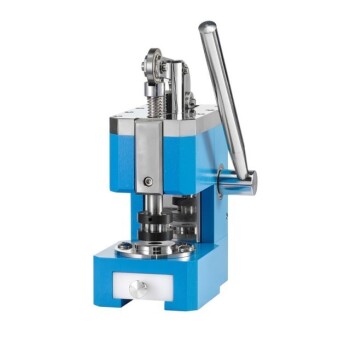
Precision pressure application is the critical variable in ensuring signal integrity for large-scale detector arrays. A laboratory press or precision laminating equipment is technically essential for creating uniform contact across high-density matrices, such as 64x64 pixel arrays. By applying consistent force to interconnects like Anisotropic Conductive Films (ACF), this equipment ensures every pixel maintains a stable electrical link to the readout circuitry.
High-density detector arrays rely on uniform electrical impedance across thousands of connections. Precision laminating equipment guarantees the exact pressure required to activate conductive films, eliminating local contact failures that cause signal distortion.
The Mechanics of Reliable Interconnection
Mastering Anisotropic Conductive Films (ACF)
Large-scale arrays frequently utilize Anisotropic Conductive Films (ACF) or flexible interconnects to bridge the gap between the detector and external circuits.
To function correctly, these materials require a specific, uniform pressure threshold to become conductive in the Z-axis while remaining insulated in the X and Y axes.
Achieving Uniformity Across the Matrix
In a standard 64x64 pixel matrix, the assembly process must manage over 4,000 individual connection points simultaneously.
Precision equipment ensures that pressure is distributed evenly across the entire surface area, preventing force from concentrating at specific points and leaving others loose.
The Impact on Signal Quality and Performance
Reducing Electrical Impedance
Proper pressure application results in stable, low-impedance electrical connections for every pixel in the array.
This stability minimizes resistance variations between pixels, ensuring that the electrical output accurately reflects the physical input detected by the sensor.
Preventing Signal Distortion
Uneven pressure inevitably leads to local contact failures, resulting in "dead" pixels or noisy data transmission.
By eliminating these mechanical inconsistencies, the equipment prevents signal distortion that would otherwise compromise the integrity of the data stream.
The Cost of Inconsistency: Why Precision Matters
The Risk to Image Recognition Accuracy
For advanced applications, such as optoelectronic synaptic arrays, the system relies heavily on precise pattern matching and data fidelity.
Signal distortion caused by poor interconnects directly degrades image recognition accuracy, rendering the array ineffective for high-precision computing tasks.
The Pitfall of Manual or low-grade Assembly
Without precision equipment, it is nearly impossible to apply the uniform force required for high-density arrays.
Relying on less accurate methods introduces a high risk of variable impedance, where some pixels respond faster or stronger than others simply due to connection quality, not data reality.
Making the Right Choice for Your Assembly Process
To ensure the success of your detector array fabrication, consider your specific performance requirements:
- If your primary focus is Signal Integrity: Prioritize equipment that guarantees uniform pressure distribution to prevent distortion and contact failure.
- If your primary focus is Application Accuracy: Use precision lamination to ensure the low impedance necessary for complex tasks like image recognition in synaptic arrays.
Ultimately, precision equipment transforms a collection of pixels into a reliable, high-performance instrument.
Summary Table:
| Assembly Challenge | Technical Solution | Impact on Performance |
|---|---|---|
| High-Density Connectivity | Precision ACF Lamination | Ensures stable Z-axis conductivity for 4,000+ pixels |
| Signal Distortion | Uniform Pressure Distribution | Eliminates local contact failures and "dead" pixels |
| High Electrical Impedance | Controlled Lab Pressing | Maintains low, consistent resistance across the matrix |
| Pattern Recognition Errors | Precision Equipment | Guarantees data fidelity for optoelectronic synaptic arrays |
Elevate Your Detector Array Research with KINTEK
Precision is non-negotiable when assembling high-density matrices. KINTEK specializes in comprehensive laboratory pressing solutions designed to meet the rigorous demands of advanced materials research. Whether you are developing next-generation battery technologies or sophisticated detector arrays, our range of manual, automatic, heated, and multifunctional presses—including cold and warm isostatic models—provides the uniform force distribution required for maximum signal integrity.
Don't let inconsistent pressure compromise your data. Contact us today to discover how KINTEK’s precision equipment can optimize your assembly process and enhance your laboratory's research capabilities.
References
- Meng‐Cheng Yen, Ya‐Ju Lee. Color‐Filter‐Free Image Sensor Using CsPbBr <sub>3</sub> Quantum‐Dot‐Based Tamm Plasmon Photodetector for Photonic Synapse Facial Recognition. DOI: 10.1002/advs.202503464
This article is also based on technical information from Kintek Solution Knowledge Base .
Related Products
- Warm Isostatic Press for Solid State Battery Research Warm Isostatic Press
- Lab Polygon Press Mold
- Automatic Heated Hydraulic Press Machine with Heated Plates for Laboratory
- Electric Lab Cold Isostatic Press CIP Machine
- Laboratory Hydraulic Press Lab Pellet Press Machine for Glove Box
People Also Ask
- Why must composite cathodes be sealed in vacuum lamination bags for WIP? Ensure Battery Stability and Density
- What is the function of elastic molds in warm isostatic pressing? Achieve Uniform Density in Composite Particles
- How do sacrificial volume materials (SVM) maintain microchannels in isostatic pressing? Ensure Structural Integrity
- What is the process involved in warm isostatic pressing? Mastering Uniform Density with WIP Technology
- What is the function of hydraulic pressure in warm isostatic pressing? Achieve Uniform Material Density