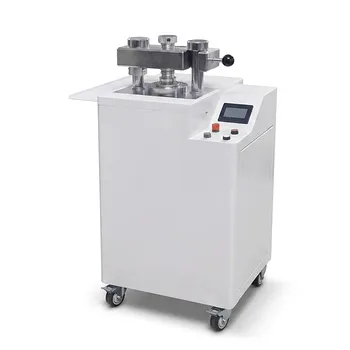
PTFE film is the industry standard for melt pressing because its unique combination of low surface energy and high thermal stability prevents molten polymers from bonding to press plates. This lack of adhesion ensures that samples can be demolded without tearing, while the film's chemical inertness protects delicate nanostructures and maintains the purity of the polymer melt.
Core Takeaway: PTFE film acts as a critical non-stick barrier that preserves the structural integrity and surface morphology of polymer films during high-temperature compression molding. It is essential for ensuring experimental repeatability and preventing the contamination or destruction of thin-film samples.
The Superior Non-Stick Properties of PTFE
Low Surface Energy and Adhesion Prevention
The primary function of PTFE in a heated press is to create an interface that the molten polymer cannot wet or bond to. Its extremely low surface energy ensures that even highly adhesive resins, such as polyurethane or epoxy, can be separated from the press plates effortlessly after cooling.
Maintaining Sample Integrity During Demolding
Without a PTFE barrier, the polymer melt would solidify directly onto the metal platens, leading to surface tears or total sample loss during removal. By using PTFE sheets, researchers ensure the molded product is demolded intact, which is vital for maintaining the precise dimensions required for mechanical testing.
Thermal Stability and Surface Quality
Resistance to High Processing Temperatures
Melt pressing often requires temperatures that would cause standard plastic films to melt or degrade. PTFE’s exceptionally high melting point and thermal stability allow it to remain functional throughout long-duration curing or sintering cycles without losing its release properties.
Surface Leveling and Optical Clarity
PTFE film serves as a surface leveling layer, producing an extremely smooth finish on the resulting polymer film. This smoothness is not merely aesthetic; it reduces surface roughness interference, which is critical for accurate dielectric strength measurements and optical transmittance tests.
Enhancing Experimental Accuracy and Consistency
Protecting Sensitive Nanolayers
In advanced composite manufacturing, PTFE protects conductive nanolayers from being crushed or contaminated by the metal mold. This preservation of the microstructure ensures that the electrical and thermal properties of the material remain representative of the intended design.
Ensuring Uniform Pressure Distribution
Placing PTFE sheets between the sample and the hydraulic press helps provide uniform pressure distribution across the entire surface area. This consistency prevents localized thinning and helps achieve a regulated final porosity, which is essential for normalizing data in stress-strain or photoluminescence evaluations.
Understanding the Trade-offs and Limitations
Potential for Surface Texture Transfer
While PTFE is excellent for release, its relative softness means that any scratches or imperfections on the PTFE sheet itself can be embossed onto the polymer film. To maintain high-quality surfaces, the release sheets must be inspected regularly and replaced if they show signs of wear or deformation.
Comparison with Alternative Materials
In some specific cases, materials like Polyethylene Terephthalate (PET) may be used for their superior flatness. However, PET lacks the high-temperature resistance of PTFE, making PTFE the only viable choice for high-melting-point polymers like PHBV or certain interpenetrating polymer networks (IPNs).
How to Apply This to Your Project
Recommendations Based on Your Goals
- If your primary focus is high-temperature stability: Utilize high-grade PTFE sheets to ensure the release material does not degrade or bond to the sample at temperatures exceeding 200°C.
- If your primary focus is precise electrical measurements: Use fresh, unwrinkled PTFE film to achieve the flattest possible surface, minimizing dielectric interference caused by roughness.
- If your primary focus is thickness control: Combine PTFE release layers with metal spacers to define a fixed gap, ensuring the film thickness is consistent for cross-sectional area calculations.
By leveraging the non-stick and thermal properties of PTFE, you can ensure that your polymer films are produced with the structural and surface integrity required for rigorous scientific analysis.
Summary Table:
| Key Property | Benefit for Melt Pressing | Research Impact |
|---|---|---|
| Low Surface Energy | Prevents polymer bonding to plates | Ensures damage-free demolding and sample preservation |
| High Thermal Stability | Resists degradation at high heat | Ideal for high-melting-point polymers and long curing cycles |
| Surface Leveling | Produces extremely smooth finishes | Critical for accurate dielectric and optical measurements |
| Pressure Distribution | Ensures uniform thickness | Prevents localized thinning and achieves regulated porosity |
Elevate Your Thin-Film Research with KINTEK Solutions
Maximize the quality and repeatability of your polymer films with KINTEK’s comprehensive laboratory pressing solutions. From manual and automatic heated presses to multifunctional and glovebox-compatible models, our equipment is engineered to work seamlessly with high-performance PTFE materials to protect your delicate nanostructures.
Whether you are conducting battery research or developing advanced composites, our cold and warm isostatic presses provide the uniform pressure distribution your projects demand.
Ready to achieve superior surface integrity? Contact KINTEK today for a tailored laboratory solution!
References
- Emily A. Ryan, Meisha L. Shofner. Surface-Localized Chemically Modified Reduced Graphene Oxide Nanocomposites as Flexible Conductive Surfaces for Space Applications. DOI: 10.1021/acsapm.3c00588
This article is also based on technical information from Kintek Solution Knowledge Base .
Related Products
- Lab Cylindrical Press Mold for Laboratory Use
- Warm Isostatic Press for Solid State Battery Research Warm Isostatic Press
- Lab Infrared Press Mold for No Demolding
- Automatic Laboratory Hydraulic Press for XRF and KBR Pellet Pressing
- XRF KBR Plastic Ring Lab Powder Pellet Pressing Mold for FTIR
People Also Ask
- What is the purpose of incorporating cartridge heaters into a lab press mold for MLCC block compression? Optimize Results
- What is the function of a pressing tool in thermoplastic panels? Master Precision Shaping & Fusion Bonding
- Why is precise cooling management of the lab press mold necessary? Protect Core Integrity in Thermoforming
- Why is a high-performance laboratory molding press critical for in-situ electrolyte formation? Unlock Battery Success
- How does the geometry of laboratory molds influence mycelium-based composites? Optimize Density and Strength