
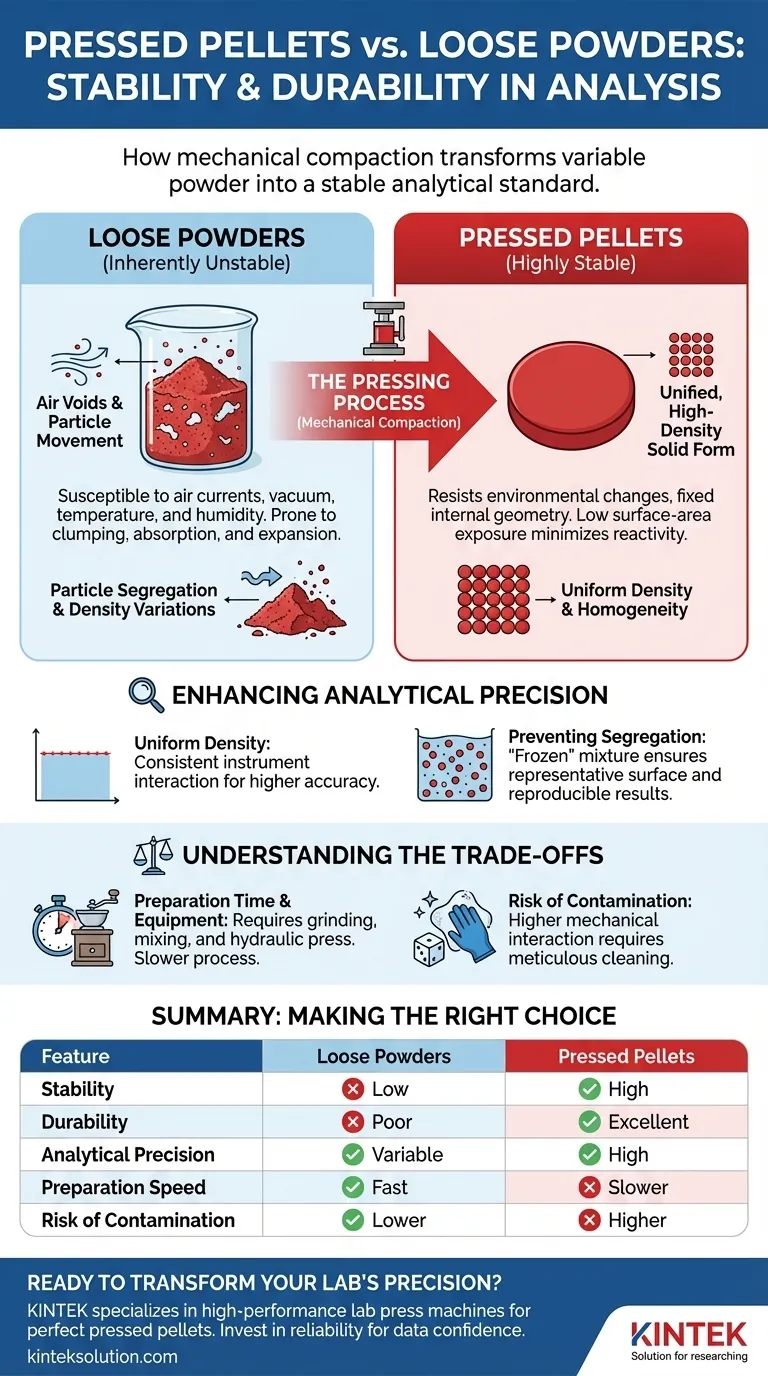
The primary driver of stability in pressed pellets is the mechanical compaction of sample particles into a unified, high-density solid form. By eliminating the air voids found in loose powders, the pressing process creates a sample that physically resists environmental changes while maintaining a fixed internal geometry for consistent analysis.
While loose powders are convenient, they are inherently unstable due to particle movement and air gaps. Pressed pellets resolve this by locking the sample matrix into a homogeneous, dense solid, ensuring that the analyzed volume remains consistent over time and across repeated measurements.

The Mechanics of Physical Durability
Resistance to Environmental Disturbances
Loose powders are highly susceptible to movement caused by air currents or the vacuum environment often used in analytical instruments.
Pressed pellets eliminate this risk by bonding particles into a rigid disc. This ensures the sample geometry remains fixed throughout the analysis, preventing material loss or surface deformation.
Mitigating Temperature and Humidity Effects
Changes in laboratory temperature and humidity can cause loose powders to clump, absorb moisture, or expand.
Because pellets are compacted, they have a lower surface-area-to-volume ratio exposed to the atmosphere. This makes them significantly less reactive to ambient conditions, preserving the sample's integrity over longer periods.
Enhancing Analytical Precision
Achieving Uniform Density
A critical flaw in analyzing loose powders is variable density caused by random air pockets between particles.
Pressing the sample creates a uniform density across the entire pellet. This consistency ensures that the instrument interacts with the same amount of material per unit volume, leading to higher accuracy.
Preventing Particle Segregation
In loose powders, particles of different sizes or weights often separate, leading to a non-representative surface measurement.
The pressing process "freezes" the mixture in place, improving sample homogeneity. This minimizes segregation and ensures the elements are evenly distributed, which is essential for reproducible results.
Understanding the Trade-offs
Preparation Time and Equipment
The durability of a pressed pellet comes at the cost of preparation complexity. Unlike loose powders, which can be poured directly into a cup, pellets require grinding, mixing with a binder, and the use of a hydraulic press.
Risk of Contamination
Because the process involves more mechanical interaction, there is a slightly higher risk of contamination. The dies used for pressing must be meticulously cleaned between samples to prevent cross-contamination, a step not required for loose powders.
Making the Right Choice for Your Goal
Deciding between loose powders and pressed pellets depends on your requirements for precision versus speed.
- If your primary focus is high precision and repeatability: Invest in pressed pellets to eliminate particle segregation and density variations for the most accurate data.
- If your primary focus is rapid screening: Utilize loose powders to maximize throughput, accepting that minor variances in stability may occur.
The investment in creating a pressed pellet pays dividends in data confidence, transforming a variable powder into a reliable, permanent analytical standard.
Summary Table:
| Feature | Loose Powders | Pressed Pellets |
|---|---|---|
| Stability | Low (susceptible to movement, clumping) | High (rigid, fixed geometry) |
| Durability | Poor (affected by humidity/temperature) | Excellent (low surface-area exposure) |
| Analytical Precision | Variable (due to density inconsistencies) | High (uniform density, no segregation) |
| Preparation Speed | Fast (direct pouring) | Slower (requires pressing equipment) |
| Risk of Contamination | Lower | Higher (requires meticulous cleaning) |
Ready to transform your lab's analytical precision and data confidence?
At KINTEK, we specialize in high-performance lab press machines, including automatic lab presses, isostatic presses, and heated lab presses, designed to create the perfect pressed pellets for your specific laboratory needs. Our equipment ensures uniform density, eliminates particle segregation, and delivers the stability required for reproducible, accurate results.
Don't let variable powders compromise your analysis—invest in reliability. Contact us today to learn how KINTEK can enhance your sample preparation process and deliver the precision you demand.
Visual Guide
Related Products
- Manual Laboratory Hydraulic Pellet Press Lab Hydraulic Press
- Laboratory Hydraulic Split Electric Lab Pellet Press
- Laboratory Hydraulic Pellet Press for XRF KBR FTIR Lab Press
- Automatic Laboratory Hydraulic Press Lab Pellet Press Machine
- XRF KBR Plastic Ring Lab Powder Pellet Pressing Mold for FTIR
People Also Ask
- What is the primary purpose of a manual lab hydraulic pellet press? Ensure Accurate Sample Prep for XRF and FTIR
- What is the primary purpose of manual lab hydraulic pellet presses? Achieve High-Precision Sample Preparation for Spectroscopy
- What is the purpose of initial axial molding using a lab hydraulic press? Optimizing Electrolyte Green Bodies
- What is the primary function of a laboratory hydraulic press in evaluating the ionic conductivity of Li6PS5X (LMSX)?
- What role does a lab hydraulic press play in researching squishy granular matter? Expert Insights into Material Physics



















