
Periodic maintenance of a KBr Pellet Press requires a focused inspection of four critical components: the condition of the die set seals, the accuracy of the pressure gauge, the alignment and surface integrity of the anvils, and the efficiency of the vacuum evacuation system. These checks ensure the mechanical application of force remains precise and the vacuum seal remains tight enough to eliminate moisture.
Core Takeaway: The quality of a KBr pellet relies heavily on removing air and moisture under high pressure. Therefore, maintenance is not just about preserving the machine, but about protecting the vacuum integrity required to produce transparent, stable samples.
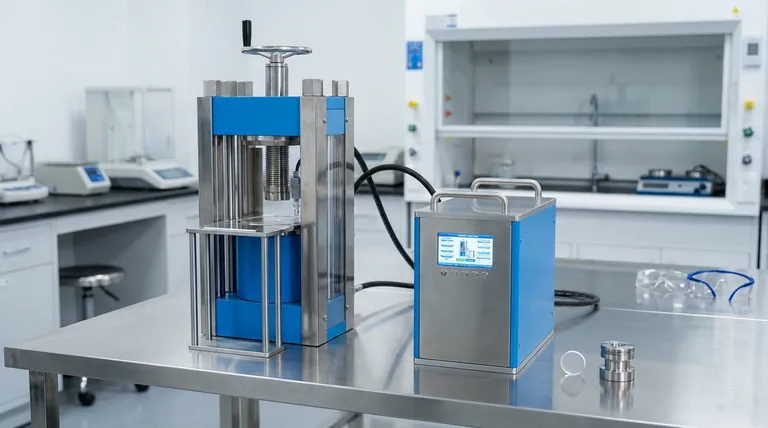
Maintaining Die Set Integrity
The die set is the heart of the operation. Its condition directly dictates the optical quality of your final pellet.
Inspecting the Seals
You must regularly check the die set seals for signs of wear, drying, or cracking.
To form a transparent pellet, the system must hold a vacuum of several mm Hg. Compromised seals prevent this, leading to opaque or unstable pellets caused by trapped air.
Verifying Anvil Condition
Ensure the anvils are free of surface damage and are correctly aligned within the press.
Even microscopic scratches on the anvil face can transfer to the pellet, causing scattering of the IR beam. Misalignment can lead to uneven pressure distribution, resulting in cracked or wedged pellets.
Verifying System Performance
Beyond the physical components, you must verify that the press is delivering the specific parameters required for KBr formation.
Calibrating the Pressure Gauge
Verify the accuracy of the pressure gauge periodically.
Standard KBr protocols often require maintaining a force of approximately 8 tons for several minutes. If the gauge is drifting, you may inadvertently under-press (causing crumbling) or over-press (causing crystal structure damage) the sample.
Monitoring Evacuation Efficiency
Track the evacuation time required to reach the necessary vacuum level.
If the time to reach the required vacuum increases noticeably, it indicates a leak in the system or a degrading pump. Sufficient evacuation is non-negotiable for eliminating moisture before the pressing phase begins.
The Cleaning Protocol
Regular cleaning prevents cross-contamination and mechanical binding. This process should be performed with care to avoid damaging precision surfaces.
Removing Residual Powder
Disassemble the press by removing the anvils and die set.
Use a soft brush or compressed air to dislodge loose powder. Never use abrasive tools or hard scrapers, as these will permanently damage the polished surfaces.
Chemical Cleaning and Drying
Use a gentle stream of acetone to wash away stubborn residues from the components.
Follow this immediately with thorough air drying. Do not reassemble the press until all parts are completely dry to prevent corrosion or moisture entrapment in the next sample.
Common Pitfalls to Avoid
While maintenance is essential, improper technique can cause more harm than good.
The Trade-off of Aggressive Cleaning
While cleanliness is vital, scrubbing with abrasive materials will ruin the die faces.
Once an anvil is scratched, it must be resurfaced or replaced; no amount of cleaning will fix the optical defects it creates in the pellet.
Neglecting the Vacuum Step
A common error is focusing solely on the hydraulic mechanics (the "press") while ignoring the vacuum system.
Applying 8 tons of force without a sufficient vacuum traps atmospheric moisture. If your maintenance routine ignores the seals and pump, your pellets will consistently fail regardless of the pressure applied.
Ensuring Long-Term Reliability
Consistent maintenance ensures that your KBr press remains a precision instrument rather than just a crushing device.
- If your primary focus is Sample Transparency: Prioritize inspecting the die set seals and evacuation time to ensure air and moisture are fully removed.
- If your primary focus is Equipment Longevity: Focus on cleaning and anvil alignment to prevent mechanical stress and surface abrasion.
Routine attention to these details guarantees that your spectroscopic data remains accurate and reproducible.
Summary Table:
| Maintenance Area | Key Checkpoints | Why It Matters |
|---|---|---|
| Die Set Integrity | Inspect seals for wear/cracks; check anvil alignment & surface. | Ensures a tight vacuum seal and prevents pellet defects. |
| System Performance | Calibrate pressure gauge; monitor vacuum evacuation time. | Guarantees correct pressure application and moisture removal. |
| Cleaning Protocol | Use soft brushes/compressed air and acetone for residue. | Prevents cross-contamination and surface damage. |
| Common Pitfalls | Avoid abrasive cleaning; never neglect the vacuum step. | Protects the precision components and ensures pellet transparency. |
Achieve flawless FT-IR sample preparation every time. Your research depends on the quality of your KBr pellets. KINTEK specializes in precision lab press machines, including automatic, isostatic, and heated lab presses designed for reliability and ease of maintenance. Our experts can help you optimize your press performance and ensure long-term equipment longevity. Contact KINTEK today to discuss your laboratory needs and keep your press operating at its best.
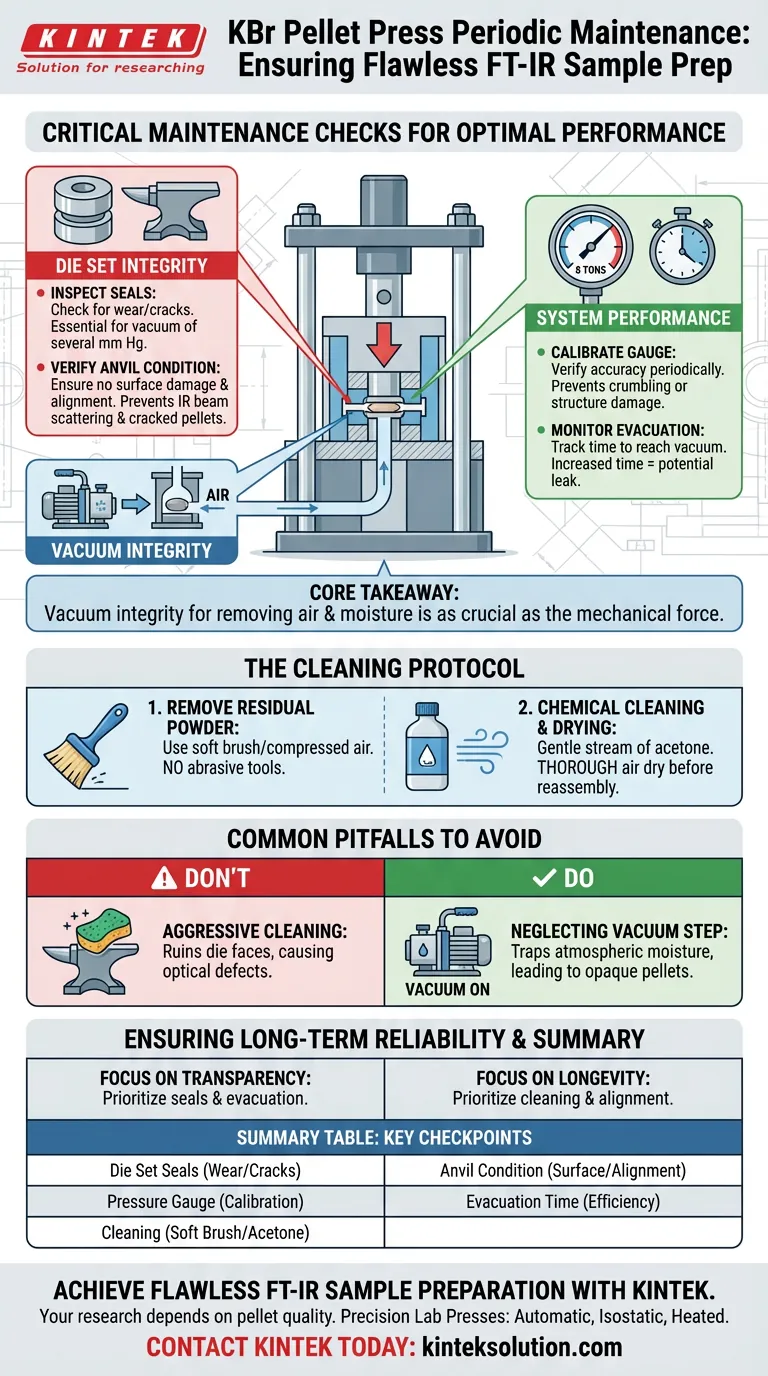
Visual Guide
Related Products
- Laboratory Hydraulic Press 2T Lab Pellet Press for KBR FTIR
- XRF KBR Plastic Ring Lab Powder Pellet Pressing Mold for FTIR
- XRF KBR Steel Ring Lab Powder Pellet Pressing Mold for FTIR
- Laboratory Hydraulic Pellet Press for XRF KBR FTIR Lab Press
- Automatic Laboratory Hydraulic Press for XRF and KBR Pellet Pressing
People Also Ask
- What is the role of a laboratory pressure machine and KBr in FTIR? Master Sample Preparation for Flame Retardants
- What is the role of a laboratory hydraulic press in high-loading NCM811 cathode prep for solid-state batteries?
- Why is a laboratory hydraulic press necessary for sample preparation? Precise Pelleting for Spiro Heterocyclic Analysis
- What role does a laboratory hydraulic press play in reaction pellets? Optimizing Lunar Soil and Metal Fuel Density
- Why Use High-Tonnage Pressure Control for Li4Ti5O12 Electrode Disks? Optimize Your Battery Research



















