
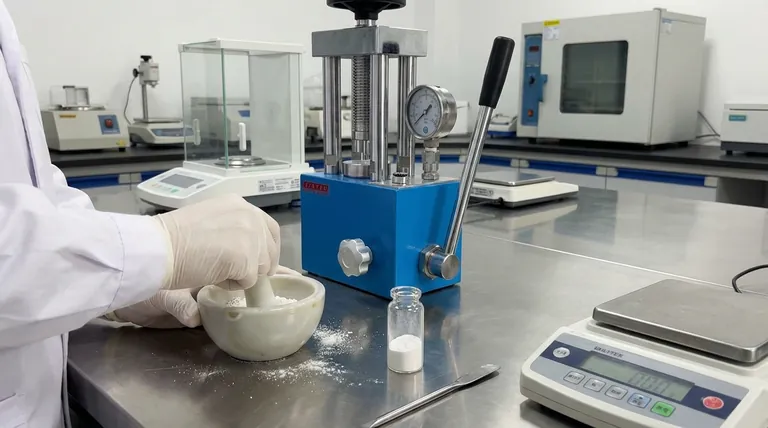
To prepare a sample-KBr mixture for pellet pressing, you must rigorously modify its physical state through fine pulverization and thermal drying. Specifically, the mixture must be ground to a maximum of 200 mesh and dried at approximately 110°C for two to three hours to prevent light scattering and moisture interference.
Success in FTIR analysis is determined before the press is even engaged; without a finely ground, homogeneous, and moisture-free mixture, the resulting pellet will likely be opaque or spectrally inaccurate.
The Critical Preparation Process
Achieving the Correct Particle Size
To prevent the scattering of IR light, the sample and KBr must be mechanically reduced to a very fine powder.
The target consistency is a maximum of 200 mesh. If the particles are larger than the wavelength of the infrared radiation, the resulting spectrum will suffer from artifacts and reduced quality.
Establishing the Correct Ratio
Homogeneity is vital for a clear reading. You typically need to mix the sample material with KBr powder at a ratio of 1-2% sample by weight.
This ensures the sample is dilute enough to allow light transmission while being evenly distributed throughout the matrix.
Thermal Drying and Moisture Removal
Because KBr is hygroscopic, it readily absorbs water from the air, which can ruin the transparency of the pellet and introduce water peaks into your data.
The mixture should be dried at approximately 110°C for two to three hours.
Preventing Oxidation
While heating is necessary, the application of heat must be controlled carefully.
Gradual heating is recommended. Rapid heating can cause KBr to oxidize into potassium bromate (KBrO3), which leads to brown discoloration of the pellet.
Final Steps Before Pressing
Controlling Mixture Quantity
When loading the die set, volume control is as important as the mixture quality.
Use the minimum amount of powder necessary to coat the anvils with a thin, even layer. Using excessive powder often results in "wedging" or the appearance of white spots within the final disc.
Atmospheric Evacuation
Once the mixture is loaded into the die but before full pressure is applied, you must address trapped air.
Apply a vacuum of several mm Hg to the die set. This step is non-negotiable for creating a stable and transparent pellet, as it eliminates air pockets and residual moisture that would otherwise be trapped in the crystal lattice.
Understanding the Trade-offs
Moisture Sensitivity vs. Processing Time
The primary limitation of KBr is its hygroscopic nature. While thorough grinding is necessary for clarity, the longer you process the powder in the open air, the more moisture it absorbs.
You must balance the need for a fine 200-mesh powder with the speed required to keep the material dry, ideally working in a controlled environment.
Pressure Calibration Risks
Achieving a clear pellet requires a delicate balance of force, typically around 8 tons maintained for several minutes.
However, pressure is a double-edged sword. Excessive pressure can crack the pellet, rendering it useless, while insufficient pressure results in an opaque disc that blocks IR light.
Ensuring High-Quality Analysis
If your primary focus is Spectral Clarity:
- Prioritize grinding the mixture to at least 200 mesh to minimize light scattering and ensure the pellet is transparent.
If your primary focus is Baseline Purity:
- Strictly adhere to the drying protocol of 110°C for 2-3 hours and use a vacuum to eliminate water absorption bands.
If your primary focus is Pellet Integrity:
- Use a minimal amount of powder to avoid compression defects like white spots or wedging.
Mastering the sample preparation prevents artifacts and ensures your FTIR data reflects the sample, not the preparation method.
Summary Table:
| Preparation Step | Key Parameter | Purpose |
|---|---|---|
| Particle Size Reduction | Grind to ≤ 200 mesh | Prevents light scattering for a transparent pellet |
| Thermal Drying | 110°C for 2-3 hours | Removes moisture to avoid spectral interference |
| Sample Ratio | 1-2% sample by weight | Ensures homogeneity and proper light transmission |
| Atmospheric Control | Apply vacuum before pressing | Eliminates air pockets for pellet stability |
| Pressure Application | ~8 tons for several minutes | Forms a durable, clear disc without cracking |
Achieve perfect sample preparation every time with KINTEK.
Our specialized lab presses, including automatic and heated models, are engineered to deliver the precise, consistent pressure and environmental control required for high-quality KBr pellets. Whether your priority is spectral clarity, baseline purity, or pellet integrity, our equipment helps you eliminate preparation artifacts and obtain reliable FTIR data.
Ready to enhance your laboratory's capabilities? Contact our experts today to find the perfect press for your specific application.
Visual Guide

Related Products
- Laboratory Hydraulic Press 2T Lab Pellet Press for KBR FTIR
- Laboratory Hydraulic Pellet Press for XRF KBR FTIR Lab Press
- XRF KBR Plastic Ring Lab Powder Pellet Pressing Mold for FTIR
- XRF KBR Steel Ring Lab Powder Pellet Pressing Mold for FTIR
- Automatic Laboratory Hydraulic Press for XRF and KBR Pellet Pressing
People Also Ask
- What is the role of a laboratory pressure machine and KBr in FTIR? Master Sample Preparation for Flame Retardants
- What is the role of a laboratory hydraulic press in high-loading NCM811 cathode prep for solid-state batteries?
- Why is a laboratory hydraulic press necessary for sample preparation? Precise Pelleting for Spiro Heterocyclic Analysis
- What role does a laboratory hydraulic press play in reaction pellets? Optimizing Lunar Soil and Metal Fuel Density
- What role does a laboratory hydraulic press play in perovskite R&D? Essential for High-Density Material Synthesis



















