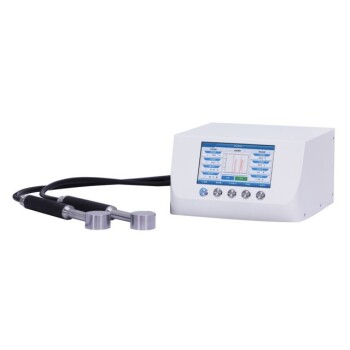
A constant temperature soaking tank serves as the critical control environment for accurately measuring the open porosity of concrete. By immersing dry concrete samples in water of a known density, the tank facilitates precise water absorption tests. This allows researchers to perform non-destructive assessments of the material's internal microstructure without altering the sample's physical integrity.
The data derived from this controlled soaking process is essential for evaluating concrete quality, specifically serving as a key indicator of material compactness, resistance to permeability, and the effectiveness of vibration consolidation.
The Mechanics of Porosity Analysis
Establishing a Controlled Environment
The primary function of the tank is to eliminate environmental variables during testing. By maintaining a constant temperature, researchers ensure that the density of the water remains stable throughout the absorption process.
Non-Destructive Microstructure Assessment
This method allows for the analysis of the concrete's internal structure without damaging the core. By measuring how much fluid of a known density penetrates the sample, analysts can map the open porosity network within the concrete.
Linking Absorption to Concrete Quality
Evaluating Material Compactness
The volume of water absorbed in the tank provides a direct metric for the concrete's density. Lower absorption rates typically indicate a denser, more compact microstructure, which correlates with higher structural integrity.
Assessing Permeability Resistance
The soaking tank mimics the environmental stress of fluid exposure. The resulting data helps engineers predict how well the concrete will resist permeability in real-world applications, a crucial factor for long-term durability.
Verifying Vibration Processes
Construction teams use this data to validate their on-site methods. The porosity metrics serve as a feedback loop, indicating whether vibration processes used during pouring successfully minimized air voids and improved consolidation.
Understanding the Limitations
Focus on Open Porosity
It is important to note that this method specifically measures open porosity—pores that are interconnected and accessible from the surface. It does not account for closed, isolated pores deep within the matrix, which means the total porosity might be slightly higher than the absorption values indicate.
Making the Right Choice for Your Goal
To effectively utilize data from a constant temperature soaking tank, consider your specific objective:
- If your primary focus is Durability: Prioritize low absorption metrics, as these indicate high resistance to permeability and a compact microstructure.
- If your primary focus is Process Optimization: Use the porosity data to adjust vibration duration and intensity, ensuring your construction methods are effectively reducing voids.
Reliable porosity analysis transforms raw absorption data into actionable insights regarding the longevity and quality of your concrete structure.
Summary Table:
| Feature | Function in Porosity Analysis | Benefit to Concrete Quality |
|---|---|---|
| Temperature Control | Maintains stable water density during immersion | Ensures high precision and data repeatability |
| Open Porosity Mapping | Measures fluid penetration into interconnected pores | Evaluates internal microstructure non-destructively |
| Absorption Metrics | Quantifies volume of water absorbed | Indicates material compactness and density |
| Permeability Testing | Simulates real-world fluid exposure | Predicts long-term resistance to environmental stress |
Optimize Your Material Research with KINTEK Precision
Unlock deeper insights into your material's microstructure with laboratory solutions built for accuracy. At KINTEK, we specialize in providing comprehensive laboratory pressing and testing solutions—including manual, automatic, and multifunctional systems—designed to support critical research in concrete durability and battery technology.
Whether you are refining vibration consolidation processes or conducting advanced material science research, our equipment ensures the precision your data demands. Contact us today to discuss how our specialized pressing solutions can enhance your laboratory's efficiency and results.
References
- André Abanda, Emmanuel Yamb Bell. Impact of Vibrations on the Physical and Mechanical Properties of Concrete: Case Study of Constructions in the City of Douala Cameroon. DOI: 10.11648/jccee.20240901.12
This article is also based on technical information from Kintek Solution Knowledge Base .
Related Products
- Lab Double Plate Heating Mold for Laboratory Use
- Split Automatic Heated Hydraulic Press Machine with Heated Plates
- Automatic High Temperature Heated Hydraulic Press Machine with Heated Plates for Lab
- Manual Heated Hydraulic Lab Press with Integrated Hot Plates Hydraulic Press Machine
- 24T 30T 60T Heated Hydraulic Lab Press Machine with Hot Plates for Laboratory
People Also Ask
- How does the geometry of laboratory molds influence mycelium-based composites? Optimize Density and Strength
- Why are precision laboratory molds essential for forming basalt-reinforced lightweight concrete specimens?
- Why are high-precision laboratory molds and specific compaction processes required? Ensure Data Integrity in Soil Research
- What is the purpose of using a laboratory hot plate and weight pressing? Mastering Cellulose Filament Bond Strength
- Why is low-temperature pre-drying on a laboratory hot plate necessary? Stabilize Silver Ink for Better Conductivity