
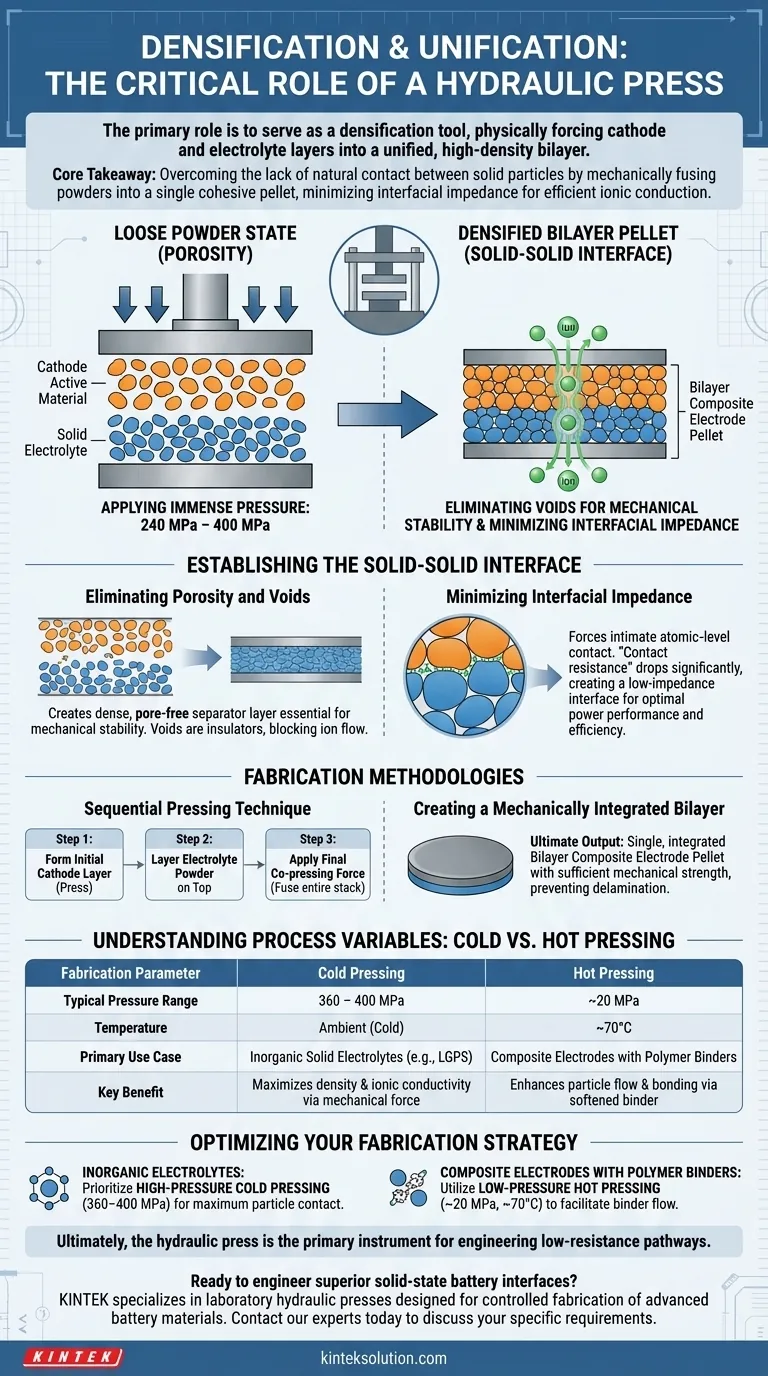
The primary role of a hydraulic press in fabricating all-solid-state batteries is to serve as a critical densification tool that physically forces the cathode and electrolyte layers into a unified, high-density bilayer. By applying immense pressure—typically between 240 MPa and 400 MPa—the press eliminates microscopic voids between particles, ensuring the intimate solid-solid contact required for efficient ionic conduction.
Core Takeaway In solid-state battery fabrication, the fundamental challenge is overcoming the lack of natural contact between solid particles. The hydraulic press solves this by mechanically fusing the cathode and electrolyte powders into a single, cohesive pellet, thereby minimizing interfacial impedance and creating a viable pathway for lithium-ion transport.
Establishing the Solid-Solid Interface
Eliminating Porosity and Voids
The most immediate function of the hydraulic press is the reduction of void space. In a loose powder state, both the cathode active material and the solid electrolyte contain significant air gaps.
By applying high pressure (often exceeding 360 MPa), the press crushes these particles together. This creates a dense, pore-free separator layer that is essential for mechanical stability. Without this densification, voids acts as insulators, blocking the flow of ions and rendering the battery inefficient.
Minimizing Interfacial Impedance
For an all-solid-state battery to function, lithium ions must move freely between the cathode and the electrolyte. This requires intimate atomic-level contact between the two materials.
The hydraulic press forces the materials into such close proximity that the "contact resistance" at the interface drops significantly. This creates a low-impedance solid-solid interface, which is the primary factor determining the battery's power performance and efficiency.
Fabrication Methodologies
The Sequential Pressing Technique
A common fabrication strategy involves a multi-step "sequential" process. First, the press is used to form the initial cathode layer.
Subsequently, the electrolyte powder is layered on top of the pre-formed cathode. The hydraulic press then applies the final "co-pressing" force to the entire stack. This method ensures that the electrolyte does not just sit on top of the cathode but physically fuses with it.
Creating a Mechanically Integrated Bilayer
The ultimate output of the hydraulic press is a single, integrated component often referred to as a bilayer composite electrode pellet.
This pellet must have sufficient mechanical strength to be handled without crumbling. The pressure ensures the two layers are tightly bonded, preventing delamination during battery operation or assembly.
Understanding Process Variables: Cold vs. Hot Pressing
Cold Pressing for Maximum Density
Most standard procedures utilize cold pressing, which relies solely on high mechanical force to achieve density.
References indicate that pressures in the range of 360 MPa to 400 MPa are standard for this method. This approach is ideal for crushing inorganic solid electrolyte powders (like LGPS or LPSCl) into a dense frame without altering their chemical structure through heat.
Hot Pressing for Binder-Assisted Flow
When the composite structure includes polymer binders, hot pressing becomes a valuable alternative strategy.
This involves significantly lower pressures (around 20 MPa) combined with moderate heat (typically ~70°C). The heat softens the polymer binder, allowing the particles to rearrange and "flow" into a uniform structure. This enhances mechanical strength and ionic pathways without requiring the extreme forces of cold pressing.
Optimizing Your Fabrication Strategy
To achieve the best results for your specific battery architecture, you must match the pressing parameters to your material composition.
- If your primary focus is maximizing ionic conductivity in inorganic electrolytes: Prioritize high-pressure cold pressing (360–400 MPa) to mechanically eliminate all voids and maximize particle-to-particle contact.
- If your primary focus is processing composite electrodes with polymer binders: Utilize hot pressing at lower pressures (approx. 20 MPa) to facilitate binder flow and particle rearrangement without crushing the microstructure.
Ultimately, the hydraulic press is not just a shaping tool; it is the primary instrument for engineering the low-resistance pathways that allow a solid-state battery to operate.
Summary Table:
| Fabrication Parameter | Cold Pressing | Hot Pressing |
|---|---|---|
| Typical Pressure Range | 360 - 400 MPa | ~20 MPa |
| Temperature | Ambient (Cold) | ~70°C |
| Primary Use Case | Inorganic Solid Electrolytes (e.g., LGPS) | Composite Electrodes with Polymer Binders |
| Key Benefit | Maximizes density & ionic conductivity via mechanical force | Enhances particle flow & bonding via softened binder |
Ready to engineer superior solid-state battery interfaces?
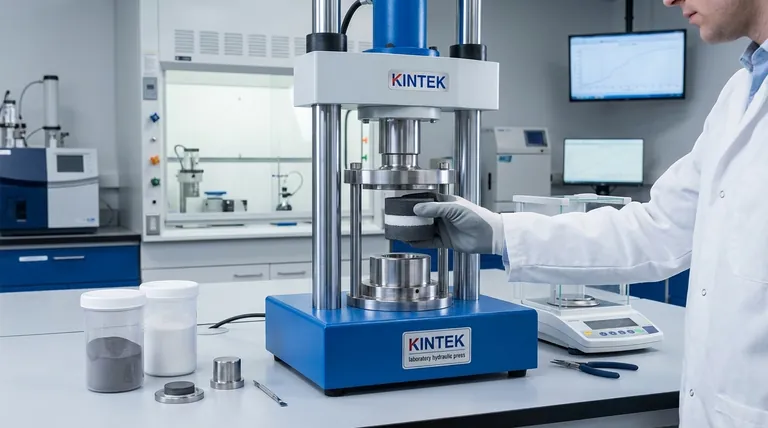
The precise application of pressure is critical for creating the high-density, low-impedance bilayers your research demands. KINTEK specializes in laboratory hydraulic presses—including automatic, isostatic, and heated models—designed specifically for the controlled fabrication of advanced battery materials.
Our presses provide the reliability and precision you need to eliminate voids and achieve the intimate solid-solid contact essential for efficient ionic conduction. Let us help you optimize your pressing strategy to accelerate your battery development.
Contact our experts today to discuss your specific requirements and discover the perfect lab press for your solid-state battery fabrication needs.
Visual Guide
Related Products
- Warm Isostatic Press for Solid State Battery Research Warm Isostatic Press
- Laboratory Hydraulic Press Lab Pellet Press Button Battery Press
- Automatic Laboratory Hydraulic Press for XRF and KBR Pellet Pressing
- Laboratory Hydraulic Press 2T Lab Pellet Press for KBR FTIR
- Laboratory Hydraulic Split Electric Lab Pellet Press
People Also Ask
- Why must composite cathodes be sealed in vacuum lamination bags for WIP? Ensure Battery Stability and Density
- What is the function of elastic molds in warm isostatic pressing? Achieve Uniform Density in Composite Particles
- How do sacrificial volume materials (SVM) maintain microchannels in isostatic pressing? Ensure Structural Integrity
- What is the process involved in warm isostatic pressing? Mastering Uniform Density with WIP Technology
- What is the role of the flexible material in warm isostatic pressing? Key to Uniform Density & Precision



















