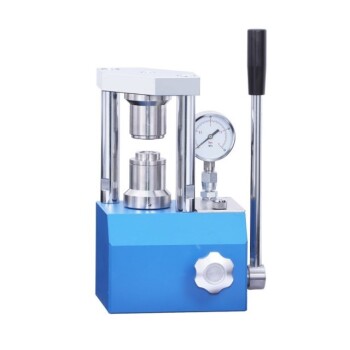
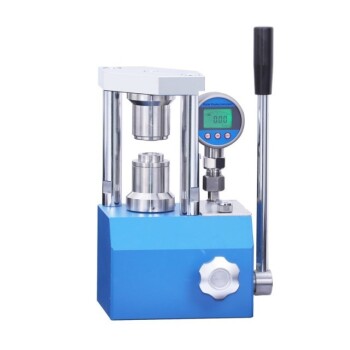
A laboratory hot-press vacuum sealing machine is the critical final gatekeeper in pouch cell assembly, serving as the bridge between component stacking and a functional battery. It utilizes precise temperature and pressure controls—often around 160 °C and 3 MPa—to melt the aluminum-plastic film casing while simultaneously evacuating internal air. This creates a hermetically sealed environment that is essential for the safe operation of lithium-metal batteries.
The machine serves a dual critical function: it ensures structural integrity by preventing leakage and external contamination, and it enhances electrochemical performance by optimizing the physical contact between internal layers to minimize impedance.
Ensuring Hermetic Integrity and Safety
Creating the Physical Seal
The primary mechanical function of the machine is to seal the battery casing. It applies specific heat and pressure to the aluminum-plastic film, melting the sealing layers to form a permanent bond.
Preventing Environmental Contamination
Lithium metal is highly reactive to moisture and oxygen. The vacuum component of the process evacuates air from the cell prior to sealing, preventing the immediate corrosion of the lithium anode and the degradation of the electrolyte.
Eliminating Electrolyte Leakage
A proper seal is vital for safety, particularly during high-pressure cycling. The hot-press process ensures the casing is robust enough to contain the electrolyte, preventing leaks that could lead to equipment damage or safety hazards.
Optimizing Electrochemical Performance
Reducing Interfacial Impedance
Beyond simple packaging, this machine performs a thermo-mechanical treatment on the cell. The combination of heat and pressure forces the cathode, electrolyte, and lithium-metal anode into tight physical contact. This reduces the resistance (impedance) at the interfaces where these layers meet, allowing for smoother ion transport.
Reducing Internal Porosity
The vacuum and pressure application helps remove voids and reduces porosity within the internal structure. By minimizing these gaps, the machine ensures better wetting of the interfaces and a more uniform distribution of active materials.
Suppressing Dendrite Growth
For lithium-metal batteries, consistent pressure is a performance enabler. The machine applies encapsulation pressure that helps suppress the growth of lithium dendrites—sharp metallic projections that can short-circuit the battery. This pressure extends the overall cycle life of the cell.
Understanding the Trade-offs
Thermal Sensitivity Risks
While heat is necessary for sealing, excessive temperature can damage internal components. If the sealing temperature exceeds the thermal stability limit of the separator or the solid-state electrolyte, the battery's internal structure may degrade before it is even used.
Pressure Uniformity
Applying high pressure is beneficial for contact, but it must be uniform. Uneven pressure distribution during the sealing process can lead to localized "hot spots" of current density, which actually accelerates dendrite formation and leads to premature cell failure.
Making the Right Choice for Your Goal
To maximize the utility of your hot-press vacuum sealing process, consider your specific research or production objectives:
- If your primary focus is Safety and Longevity: Prioritize the vacuum level and sealing integrity to ensure zero moisture ingress, which is the primary cause of lithium corrosion.
- If your primary focus is Rate Performance: Focus on optimizing the hot-press pressure to minimize interfacial impedance, ensuring ions can move rapidly between the anode and cathode.
- If your primary focus is Cycle Life: Ensure the applied pressure is perfectly uniform to suppress dendrite growth without damaging the separator structure.
The laboratory hot-press vacuum sealer is not just a packaging tool; it is a precision instrument that defines the initial electrochemical environment of the battery.
Summary Table:
| Feature | Function in Sealing Process | Impact on Battery Performance |
|---|---|---|
| Vacuum Extraction | Removes air and moisture | Prevents lithium corrosion and electrolyte degradation |
| Thermal Sealing | Melts aluminum-plastic film | Ensures zero-leakage hermetic integrity and safety |
| High Pressure | Optimizes layer contact | Reduces interfacial impedance and suppresses dendrite growth |
| Uniform Heat | Precise temperature control | Prevents thermal damage to separators and electrolytes |
Elevate Your Battery Research with KINTEK Precision
Precision at the sealing stage is the difference between a failed prototype and a high-performance cell. KINTEK specializes in comprehensive laboratory pressing solutions, offering a versatile range of manual, automatic, heated, and multifunctional models, including glovebox-compatible designs and advanced isostatic presses.
Whether you are focusing on minimizing interfacial impedance or maximizing cycle life through dendrite suppression, our equipment provides the exact temperature and pressure uniformity your lithium-metal research demands. Contact KINTEK today to find the perfect sealing solution for your lab!
References
- Weijian Xu, Lei Tian. Fluorine-free gel polymer electrolyte for lithium oxide-rich solid electrolyte interphase and stable Li metal batteries. DOI: 10.1038/s41467-025-64345-7
This article is also based on technical information from Kintek Solution Knowledge Base .
Related Products
- Button Battery Sealing Press Machine for Lab
- Heated Hydraulic Press Machine with Heated Plates for Vacuum Box Laboratory Hot Press
- Heated Hydraulic Press Machine With Heated Plates For Vacuum Box Laboratory Hot Press
- Warm Isostatic Press for Solid State Battery Research Warm Isostatic Press
- Manual Button Battery Sealing Machine for Battery Sealing
People Also Ask
- Why use standardized CR2032 components & high-precision presses? Ensure reliability in lithium metal battery research.
- Why is a laboratory battery sealing press essential for desolvation energy testing? Ensure Reliable Kinetic Data
- Why is a laboratory hydraulic press or battery sealing machine essential? Ensure Coin Cell Data Integrity
- How do laboratory battery sealing machines ensure performance consistency? Master Your Lithium and LFP Battery Assembly
- What role does a laboratory sealing press play in thermal analysis of solid dispersion films? Ensure Data Integrity