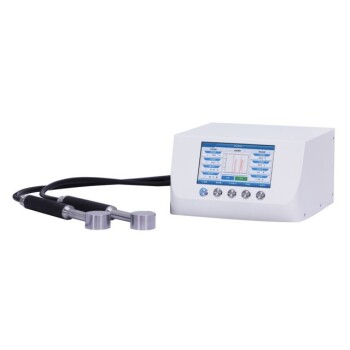
A precision heating and temperature control system serves as the analytical foundation for evaluating perovskite-type hydrides by strictly regulating thermal input during experimentation. This control is vital for pinning down exact dissociation temperatures—such as the ~821.1 K threshold required for CaTiO3H6—which enables the accurate characterization of hydrogen release mechanisms.
By maintaining rigorous temperature gradients, these systems allow researchers to move beyond simple observation to the calculation of hydrogen binding enthalpy and reaction kinetics. This data is the prerequisite for validating a material's cycle stability and its thermodynamic feasibility for real-world industrial energy applications.
The Science of Thermal Characterization
Pinpointing Dissociation Thresholds
To evaluate a hydride, you must know exactly when the chemical bonds break to release hydrogen. Precision systems allow for the identification of specific dissociation temperatures, such as the ~821.1 K point for CaTiO3H6.
Without this granular control, thermal fluctuations would obscure the exact moment of release. This would render the data useless for distinguishing between similar perovskite structures.
Analyzing Hydrogen Binding Enthalpy
Binding enthalpy measures the strength of the bond between the hydrogen and the host lattice.
A precision heating system maintains accurate temperature gradients, which provides the stable environment needed to calculate this energy value. Understanding this enthalpy is critical to determining how much energy is required to release the hydrogen during practical operation.
Evaluating Kinetic and Industrial Viability
Measuring Reaction Kinetics
While enthalpy tells you the energy required, kinetics tells you the speed of the reaction.
Precision temperature control allows researchers to measure how fast hydrogen is released at specific, stable temperatures. This data helps model how the material will perform under dynamic load conditions in an energy system.
Verifying Cycle Stability
For a material to be industrially viable, it must perform consistently over many charge and discharge cycles.
Controlled thermal cycling tests whether the material degrades or maintains its properties over time. This confirms the long-term reliability of the hydride for commercial energy storage.
Understanding the Constraints
Equipment Complexity vs. Data Fidelity
Achieving the high precision necessary for measuring parameters like binding enthalpy requires sophisticated feedback loops.
While this complexity ensures data accuracy, it increases the strictness of the experimental setup. Minor calibration errors in the temperature control system can lead to significant miscalculations in thermodynamic feasibility.
The Cost of Precision
Running experiments with strict thermal gradients often requires slower temperature ramping or extended holding times to ensure equilibrium.
This focus on accuracy can lengthen the characterization process. It is a necessary trade-off to ensure the resulting kinetic data is robust enough for industrial scaling.
Applying Thermal Precision to Material Selection
To effectively evaluate perovskite-type hydrides, you must align your thermal control strategy with your specific end-goal.
- If your primary focus is fundamental thermodynamics: Prioritize the system's ability to maintain static temperature gradients to accurately calculate hydrogen binding enthalpy.
- If your primary focus is industrial application: Focus on the system's ability to perform repeatable thermal cycling to verify long-term stability and kinetic performance.
The difference between a theoretical material and a practical energy solution often lies in the fidelity of the thermal data used to validate it.
Summary Table:
| Key Evaluation Metric | Role of Precision Heating | Impact on Research |
|---|---|---|
| Dissociation Threshold | Regulates thermal input to pinpoint exact release points | Identifies specific temperatures (e.g., 821.1 K for CaTiO3H6) |
| Binding Enthalpy | Maintains stable gradients for energy calculations | Determines energy requirements for hydrogen release |
| Reaction Kinetics | Ensures stable environments for speed measurements | Models performance under dynamic load conditions |
| Cycle Stability | Provides controlled thermal cycling | Verifies long-term reliability for industrial storage |
Elevate Your Material Research with KINTEK
Ready to achieve the granular thermal control necessary for next-generation energy solutions? KINTEK specializes in comprehensive laboratory pressing and thermal processing solutions tailored for advanced battery and hydride research. Whether you need manual, automatic, or multifunctional systems, our equipment ensures the precision required to validate thermodynamic feasibility and kinetic performance.
Unlock the full potential of your perovskite-type hydrides. Contact KINTEK today to find the perfect solution for your lab!
References
- Mudassir Ur Rahman, Aditya Kashyap. Advancing hydrogen storage and exploring the potential of perovskite hydrides and metal hydrides. DOI: 10.1515/revic-2025-0006
This article is also based on technical information from Kintek Solution Knowledge Base .
Related Products
- Infrared Heating Quantitative Flat Plate Mold for Precise Temperature Control
- Lab Double Plate Heating Mold for Laboratory Use
- Automatic High Temperature Heated Hydraulic Press Machine with Heated Plates for Lab
People Also Ask
- How do precision temperature-controlled heating plates function in electrolyte thermal stability storage experiments?
- What is the importance of a precision temperature-controlled heating module? Ensure Aluminum-Cadmium Thermal Stability
- How does heating platen precision affect rubber specimens? Achieve uniform density and reliable testing results.
- How are thin polymer films produced for spectroscopic analysis? Expert Guide to Heat and Low-Pressure Methods
- What accessories and field services can be used to optimize the capabilities of presses? Maximize Your Lab Performance