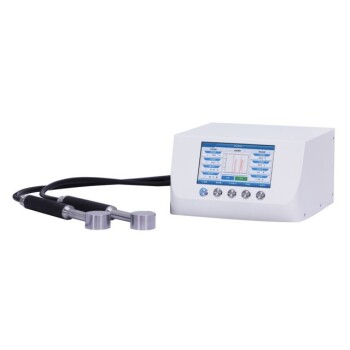
A precision temperature-controlled heat treatment furnace serves as the critical validation tool for transforming pressed LaCl3-xBrx green bodies into functional, high-performance electrolytes. By applying exacting thermal profiles, the furnace anneals the material to eliminate mechanical stress and drives the complete formation of the solid solution. This process is the physical mechanism that verifies whether a theoretical composition strategy can be successfully translated into a tangible material structure.
Precise thermal control is the key to converting isolated one-dimensional channels into an interconnected three-dimensional network, directly determining the ionic conductivity of the final material.
Establishing Material Integrity
The first role of the furnace is to stabilize the physical structure of the electrolyte.
Relieving Mechanical Stress
The starting material exists as pressed "green bodies," which are compacted powders. The furnace uses annealing to relax and eliminate the mechanical stress induced during this pressing phase. Without this step, the material would lack the structural stability required for accurate experimental validation.
Promoting Solid Solution Formation
Composition optimization relies on the successful integration of Bromine (Br) into the structure. Heat treatment ensures the complete formation of the solid solution, merging the components into a unified phase. This homogeneity is essential for the material to exhibit consistent properties throughout the sample.
Engineering the Ionic Transport Network
Beyond basic structural integrity, the furnace dictates the microscopic behavior of ions within the electrolyte.
Regulating Lanthanum Vacancies
The furnace allows researchers to manipulate the material at the atomic level by varying heating temperature and holding time. These variables directly regulate the distribution and concentration of Lanthanum (La) vacancies. Control over these vacancies is the primary lever for tuning the electrochemical performance of the optimized composition.
Connecting One-Dimensional Channels
Raw LaCl3-based structures often contain isolated pathways that limit movement. Proper thermal treatment facilitates the effective interconnection of these one-dimensional (1D) channels. This results in the construction of an ideal three-dimensional (3D) ionic transport network, drastically improving the electrolyte's efficiency.
Critical Process Constraints
While heat treatment enables high performance, it introduces specific dependencies that must be managed.
The Sensitivity of Vacancy Distribution
The formation of the 3D network is not automatic; it is highly sensitive to process parameters. Inaccurate temperatures or incorrect holding times can fail to produce the ideal vacancy concentration. Therefore, the "precision" of the furnace is not a luxury but a requirement to avoid creating a suboptimal transport network.
Validating Your Optimization Strategy
To ensure your experimental results accurately reflect your composition strategy, apply the following principles:
- If your primary focus is structural stability: Ensure the annealing cycle is sufficient to fully eliminate mechanical stress in the green bodies.
- If your primary focus is maximizing conductivity: Prioritize the precise regulation of temperature and holding time to interconnect 1D channels into a 3D network.
Success in validating LaCl3-xBrx strategies ultimately depends on using thermal precision to engineer the specific atomic vacancies that drive ionic transport.
Summary Table:
| Process Objective | Mechanism | Outcome |
|---|---|---|
| Structural Integrity | Annealing & Stress Relief | Eliminates mechanical stress in pressed green bodies |
| Phase Homogeneity | Solid Solution Promotion | Merges components into a unified, stable material phase |
| Atomic Engineering | Vacancy Distribution Control | Regulates La-vacancies via temperature and holding time |
| Conductivity Boost | Channel Interconnection | Converts 1D channels into an efficient 3D transport network |
Elevate Your Battery Research with KINTEK Precision
To successfully validate LaCl3-xBrx composition strategies, your laboratory requires more than just heat—it requires absolute thermal precision. KINTEK specializes in comprehensive laboratory pressing and thermal solutions designed specifically for advanced material research.
Our range includes:
- High-Precision Furnaces: Master temperature and holding times to engineer perfect 3D ionic networks.
- Laboratory Presses: Manual, automatic, and isostatic models for creating high-density green bodies.
- Glovebox-Compatible Solutions: Ideal for moisture-sensitive electrolyte preparation.
Don't let suboptimal thermal profiles compromise your experimental results. Contact KINTEK today to discover how our specialized equipment can bridge the gap between theoretical composition and tangible performance.
References
- Xu-Dong Mao, James A. Dawson. Optimizing Li‐Ion Transport in <scp>LaCl<sub>3−<i>x</i></sub>Br<sub><i>x</i></sub></scp> Solid Electrolytes Through Anion Mixing. DOI: 10.1002/eom2.70006
This article is also based on technical information from Kintek Solution Knowledge Base .
Related Products
- Infrared Heating Quantitative Flat Plate Mold for Precise Temperature Control
- Automatic Laboratory Hydraulic Press for XRF and KBR Pellet Pressing
People Also Ask
- How do precision temperature-controlled heating plates function in electrolyte thermal stability storage experiments?
- What is the importance of a precision temperature-controlled heating module? Ensure Aluminum-Cadmium Thermal Stability
- How does heating platen precision affect rubber specimens? Achieve uniform density and reliable testing results.
- How are thin polymer films produced for spectroscopic analysis? Expert Guide to Heat and Low-Pressure Methods
- What accessories and field services can be used to optimize the capabilities of presses? Maximize Your Lab Performance