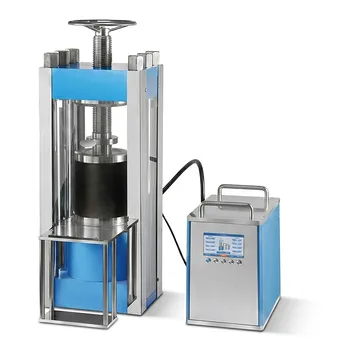
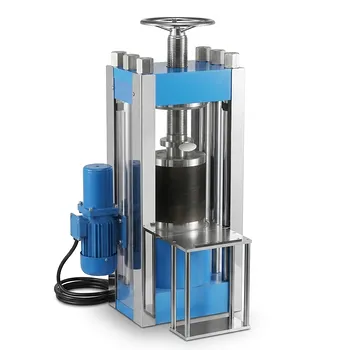
Computer control acts as the central nervous system for modern heated lab presses, transforming manual operation into a precision-driven process. By integrating user-friendly interfaces, these systems allow researchers to program, monitor, and execute complex cycles involving temperature, pressure, and time with high accuracy.
Modern automated presses shift the burden of consistency from the operator to the machine. The core advantage is not just ease of use, but the ability to store and replicate specific experimental conditions indefinitely, ensuring that data remains comparable across different test runs.
Enhancing Precision and Usability
Intuitive Operation
Modern presses utilize computer interfaces to simplify the interaction between the researcher and the machine. These user-friendly dashboards lower the learning curve, allowing operators to navigate complex settings without the steep requirement of manual mechanical adjustments.
Total Parameter Control
The computer governs the three critical variables of pressing: temperature, pressure, and time. Digital control ensures these parameters are met with exactitude, reducing the variance often found in manual dial-operated systems.
Real-Time Monitoring
Beyond setting parameters, the interface serves as a live monitor for the entire press cycle. This visibility allows researchers to verify that the equipment is performing exactly as programmed throughout the duration of the experiment.
Streamlining Experimental Workflows
Programmable Cycles
Researchers can input specific sequences of operations rather than adjusting the machine in real-time. This capability enables the execution of complex testing protocols where temperature or pressure must change at specific intervals.
Recipe Storage
One of the most significant efficiency gains is the ability to store multiple programs within the system's memory. This allows a lab to build a library of standardized tests that can be recalled instantly, eliminating setup time for recurring projects.
Consistency in Repetition
Automation excels at the efficient execution of repetitive tasks. By running stored programs, the press ensures that every sample is subjected to identical conditions, guaranteeing consistency regardless of which operator is running the machine.
Considerations for Automated Operation
The Importance of Initial Setup
While computer control automates execution, it relies entirely on the accuracy of the initial programming. The system will faithfully replicate any errors in the setup, making verification of the programmed "recipe" critical before beginning a series of repetitive tasks.
Making the Right Choice for Your Goal
- If your primary focus is consistency: Leverage the program storage feature to ensure every experiment uses identical parameters, regardless of the operator.
- If your primary focus is efficiency: Utilize the programmable interface to automate repetitive tasks, freeing up researcher time for analysis rather than machine operation.
- If your primary focus is complex testing: Use the precise control over temperature and pressure to execute multi-stage cycles that would be difficult to manage manually.
Computer control ultimately elevates the heated press from a simple mechanical tool to a programmable scientific instrument capable of rigorous reproducibility.
Summary Table:
| Feature | Manual Operation | Computer-Controlled Operation |
|---|---|---|
| Parameter Accuracy | Dependent on operator skill | High-precision digital control |
| Cycle Complexity | Difficult to adjust in real-time | Automated multi-stage programmable cycles |
| Consistency | Variable between operators | Exact replication via stored recipes |
| Monitoring | Periodic manual checks | Continuous real-time data visualization |
| Efficiency | High time investment for setup | Instant recall of standardized programs |
Elevate Your Material Research with KINTEK Precision
Consistency is the cornerstone of breakthrough research. At KINTEK, we specialize in comprehensive laboratory pressing solutions tailored to your specific needs—from manual and automatic heated models to multifunctional and glovebox-compatible presses.
Whether you are advancing battery research with our cold and warm isostatic presses or requiring precise control for complex material synthesis, our automated systems ensure your data remains comparable and your workflows efficient.
Ready to transform your lab’s productivity? Contact our experts today to find the perfect pressing solution for your application.
Related Products
- 24T 30T 60T Heated Hydraulic Lab Press Machine with Hot Plates for Laboratory
- Automatic Heated Hydraulic Lab Press 120x120mm Plate Fully Automated Material Research Press
- Automatic Heated Hydraulic Lab Press with Programmable Touch Screen Controls and Precision Temperature Regulation
- Automatic Heated Hydraulic Lab Press Machine 200x200 Plate Size for Battery Research and Materials Science
- Manual Heated Hydraulic Lab Press with Integrated Hot Plates Hydraulic Press Machine
People Also Ask
- Function of a Laboratory Hydraulic Press with Heated Platens in SSE? Enhance Battery Density & Conductivity
- Why is a laboratory hydraulic press with heating plates required for PLA/TEC films? Achieve Precise Sample Integrity
- What role does a laboratory heated hydraulic press play in LTCC? Essential for High-Density Ceramic Lamination
- Why reduce load when applying composite strengthening tabs? Protect Specimen Integrity and Data Accuracy
- Why is a laboratory heated hydraulic press utilized during the lamination stage of NASICON green tapes?