Specialized hot pressing serves as the critical fusion mechanism in solid-state battery manufacturing, moving beyond simple compaction to ensure the structural unity of the cell. By applying precise heat and pressure simultaneously during the compositing of electrodes and solid-state electrolyte layers, this equipment forces materials into atomic-level contact.
The Core Reality Solid-state batteries struggle with high resistance at the interfaces between material layers. Hot pressing solves this by eliminating microscopic gaps and establishing the efficient ion transport channels required for a viable, long-lasting energy storage device.
The Engineering Challenge: Solid-Solid Interfaces
Eliminating Physical Voids
Unlike liquid electrolytes that naturally flow into pores, solid-state electrolytes are rigid. Without intervention, microscopic gaps remain between the electrolyte and the electrodes.
Creating Atomic Contact
Hot pressing applies force and thermal energy to close these gaps. This process is essential for achieving the atomic-level contact necessary to lower interfacial impedance.
Establishing Ion Highways
By fusing these layers, the equipment creates continuous pathways. These pathways allow lithium ions to move freely between the cathode, electrolyte, and anode, directly dictating the battery's power capability.
Mechanisms of Material Enhancement
Promoting Densification
While cold pressing compacts powders, the addition of heat promotes plastic deformation. This increases the densification rate of green pellets (unfired compacted powder) significantly more effectively than pressure alone.
Controlling Grain Structure
Heated pressing enhances chemical bonding between particles without destroying delicate atomic structures (such as ordered oxygen vacancies). This results in fine-grained structures that align with theoretical performance models, often reducing the time needed for subsequent high-temperature sintering.
Understanding the Trade-offs: Dynamic Stability
Managing Volume Fluctuation
A major pitfall in solid-state battery operation is the "breathing" of the cell—the expansion and contraction of materials during charging and discharging.
The Risk of Delamination
If the pressure is static and rigid, these volume changes can lead to contact loss or delamination, breaking the ion pathways established during manufacturing.
Elastic Compensation
Advanced hot pressing setups often incorporate disc springs or similar mechanisms. These allow the equipment to utilize elastic deformation to compensate for volume fluctuations, maintaining constant stack pressure throughout the battery's life cycle.
Making the Right Choice for Your Goal
To maximize the effectiveness of your production process, align your equipment strategy with your specific material challenges:
- If your primary focus is decreasing internal resistance: Prioritize equipment that delivers high thermal precision to maximize atomic-level contact and eliminate interfacial gaps.
- If your primary focus is extending cycle life: Ensure your setup includes dynamic pressure mechanisms (like disc springs) to compensate for material expansion and prevent delamination.
Success in solid-state battery production relies not just on the materials used, but on the precise thermal and mechanical fusion of those materials into a cohesive unit.
Summary Table:
| Feature | Role in Solid-State Production | Key Benefit |
|---|---|---|
| Thermal Fusion | Combines heat and pressure to eliminate voids | Lowers interfacial impedance for better ion flow |
| Densification | Promotes plastic deformation of green pellets | Achieves higher density than cold pressing alone |
| Grain Control | Enhances chemical bonding between particles | Maintains delicate atomic structures & performance |
| Elastic Compensation | Uses mechanisms like disc springs for volume flux | Prevents delamination during charge/discharge cycles |
Elevate Your Battery Research with KINTEK Specialized Pressing Solutions
Are you struggling with high interfacial resistance or material delamination in your solid-state battery development? KINTEK specializes in comprehensive laboratory pressing solutions designed to bridge the gap between material potential and device performance.
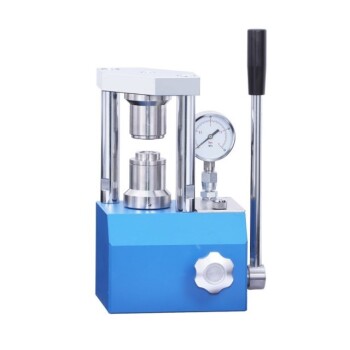
Our range of manual, automatic, heated, and multifunctional models—including glovebox-compatible setups and advanced cold/warm isostatic presses—provides the thermal precision and mechanical stability required for atomic-level material fusion. Whether you need to optimize densification or manage volume fluctuations with elastic compensation, our experts are here to help you select the ideal equipment for your research goals.
Ready to achieve superior structural unity in your cells?
Contact KINTEK Today to Find Your Solution
References
- L. Zhou. Industrial Synergy Among New Productive Forces: Insights from the Evolution of Solid-State Battery Technology for the Development of Green Energy Equipment. DOI: 10.26689/ssr.v7i6.11109
This article is also based on technical information from Kintek Solution Knowledge Base .
Related Products
- Warm Isostatic Press for Solid State Battery Research Warm Isostatic Press
- Laboratory Hydraulic Press Lab Pellet Press Button Battery Press
- Automatic Heated Hydraulic Press Machine with Hot Plates for Laboratory
- Automatic High Temperature Heated Hydraulic Press Machine with Heated Plates for Lab
- Lab Infrared Press Mold for Laboratory Applications
People Also Ask
- Why must composite cathodes be sealed in vacuum lamination bags for WIP? Ensure Battery Stability and Density
- How do sacrificial volume materials (SVM) maintain microchannels in isostatic pressing? Ensure Structural Integrity
- What is the function of elastic molds in warm isostatic pressing? Achieve Uniform Density in Composite Particles
- What is the function of hydraulic pressure in warm isostatic pressing? Achieve Uniform Material Density
- What is the significance of temperature control in Warm Isostatic Pressing? Unlock Uniform Densification and Process Stability