
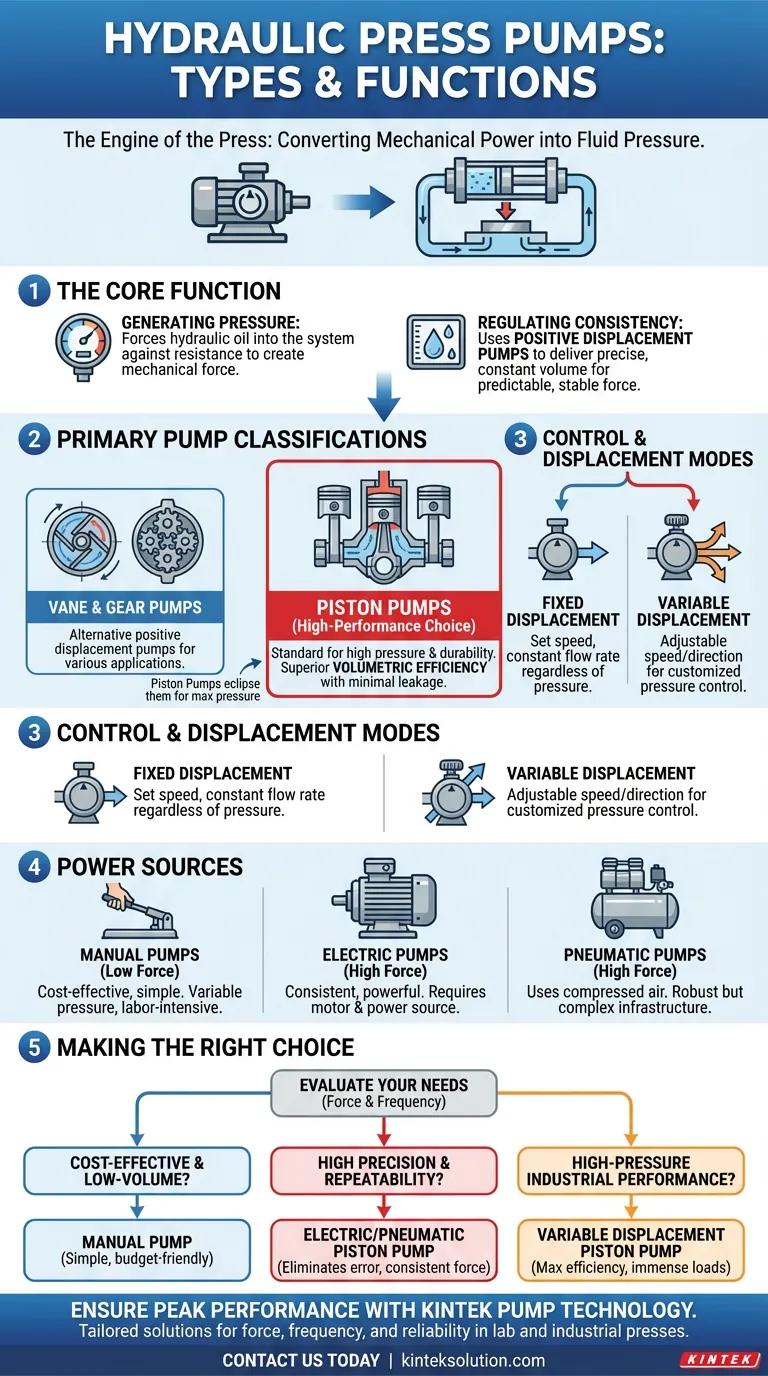
The hydraulic pump serves as the engine of a press system, converting mechanical power into fluid pressure. Its primary function is to force a specific volume of hydraulic oil into the system's cylinders, creating the energy necessary to drive the pistons and apply force to a workpiece. While vane and gear pumps are utilized, positive displacement piston pumps are the standard for high-performance equipment due to their ability to deliver consistent volume under high pressure.
The efficiency of a hydraulic press is directly tied to its pump technology. While manual and simple gear pumps suffice for low-force applications, high-pressure industrial tasks require piston pumps to minimize fluid leakage and ensure volumetric efficiency.
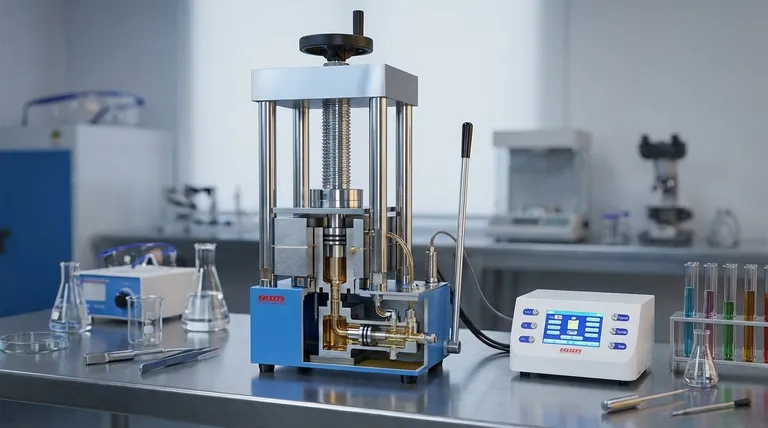
The Core Function of the Pump
Generating Hydraulic Pressure
The pump does not simply hold fluid; it actively forces hydraulic oil into the system against resistance.
By driving fluid into the hydraulic cylinders, the pump creates the pressure that the system converts into mechanical force.
Regulating Consistency
Hydraulic presses almost exclusively use positive displacement pumps.
This means the pump delivers a precise, constant volume of oil with every cycle, ensuring that the force applied to the material remains predictable and stable.
Primary Pump Classifications
Piston Pumps: The High-Performance Choice
Piston pumps are the most prevalent type found in high-performance hydraulic presses.
They are favored for their durability and superior volumetric efficiency, meaning they maintain distinct pressure levels with very little internal fluid leakage.
Vane and Gear Pumps
Alongside piston pumps, systems may utilize vane or gear pumps.
These are alternative forms of positive displacement pumps often used in various hydraulic applications, though piston pumps generally eclipse them when maximum pressure and efficiency are the priorities.
Control and Displacement Modes
Fixed vs. Variable Displacement
Pumps in these systems are categorized by how they manage flow speed.
Fixed pumps operate at a set speed, delivering a constant flow rate regardless of the system's pressure demands.
Variable pumps allow operators to alter the speed and direction of the flow, offering customized control over the pressure applied during a cycle.
Power Sources
The mechanism driving the pump varies based on the force required.
Manual pumps rely on a hand-operated lever, suitable for lower force requirements where speed is not critical.
Electric and pneumatic pumps use motors or compressed air to drive the system, generating significantly larger and more consistent forces.
Operational Trade-offs and Limitations
The Human Factor in Manual Pumps
Manual hydraulic presses are cost-effective and mechanically straightforward, but they introduce variability.
Because they rely on a hand lever, the pressure applied can fluctuate slightly based on the operator's technique, potentially affecting the repeatability of results.
Furthermore, they are labor-intensive, requiring significant physical effort which makes them unsuitable for high-volume, frequent use.
Complexity in Powered Systems
While electric and pneumatic pumps solve the consistency issue, they introduce higher complexity.
These systems require motors and external power sources, making them more robust but also necessitating a more substantial infrastructure compared to the simplicity of a manual lever.
Making the Right Choice for Your Goal
To select the correct pump configuration for your hydraulic press, you must evaluate your specific application needs regarding force and frequency.
- If your primary focus is cost-effectiveness and low-volume tasks: A manual pump provides a robust, budget-friendly solution for simple sample preparation where speed is not critical.
- If your primary focus is high precision and repeatability: An electric or pneumatic piston pump is essential to eliminate operator error and ensure consistent force application across every cycle.
- If your primary focus is high-pressure industrial performance: You require a variable displacement piston pump to handle immense loads with maximum volumetric efficiency and minimal leakage.
By aligning the pump type with your operational volume and precision requirements, you ensure your hydraulic press delivers reliable results for years to come.
Summary Table:
| Pump Type | Primary Function | Best For |
|---|---|---|
| Piston Pump | Delivers consistent volume under high pressure with minimal leakage | High-performance, high-precision tasks |
| Vane/Gear Pump | Provides positive displacement for various hydraulic applications | General hydraulic applications |
| Manual Pump | Hand-operated lever for forcing oil into the system | Low-volume, cost-effective tasks |
| Electric/Pneumatic Pump | Motor or air-driven for consistent, high-force application | High-volume, repeatable processes |
Ensure your hydraulic press operates at peak performance with the right pump technology from KINTEK.
Whether your lab requires the high precision of an electric piston pump for consistent sample preparation or a robust system for industrial-scale tasks, KINTEK's expertise in lab press machines—including automatic, isostatic, and heated lab presses—ensures you get a solution tailored to your specific needs for force, frequency, and reliability.
Contact us today via our [#ContactForm] to discuss your application and discover how our hydraulic press solutions can enhance your efficiency and results.
Visual Guide
Related Products
- Automatic High Temperature Heated Hydraulic Press Machine with Heated Plates for Lab
- Heated Hydraulic Press Machine with Heated Plates for Vacuum Box Laboratory Hot Press
- Manual Heated Hydraulic Lab Press with Integrated Hot Plates Hydraulic Press Machine
- Automatic Heated Hydraulic Press Machine with Heated Plates for Laboratory
- Automatic Heated Hydraulic Press Machine with Hot Plates for Laboratory
People Also Ask
- Function of a Laboratory Hydraulic Press with Heated Platens in SSE? Enhance Battery Density & Conductivity
- How does a laboratory heated hydraulic press facilitate PBN sample prep for WAXS? Achieve Precise X-Ray Scattering
- What are the requirements for electrode pressing with high-viscosity ionic liquids like EMIM TFSI? Optimize Performance
- What are the industrial applications of heated hydraulic presses? Master Heat & Force for Precision Manufacturing
- Why is a laboratory hydraulic press with heating plates required for PLA/TEC films? Achieve Precise Sample Integrity



















