
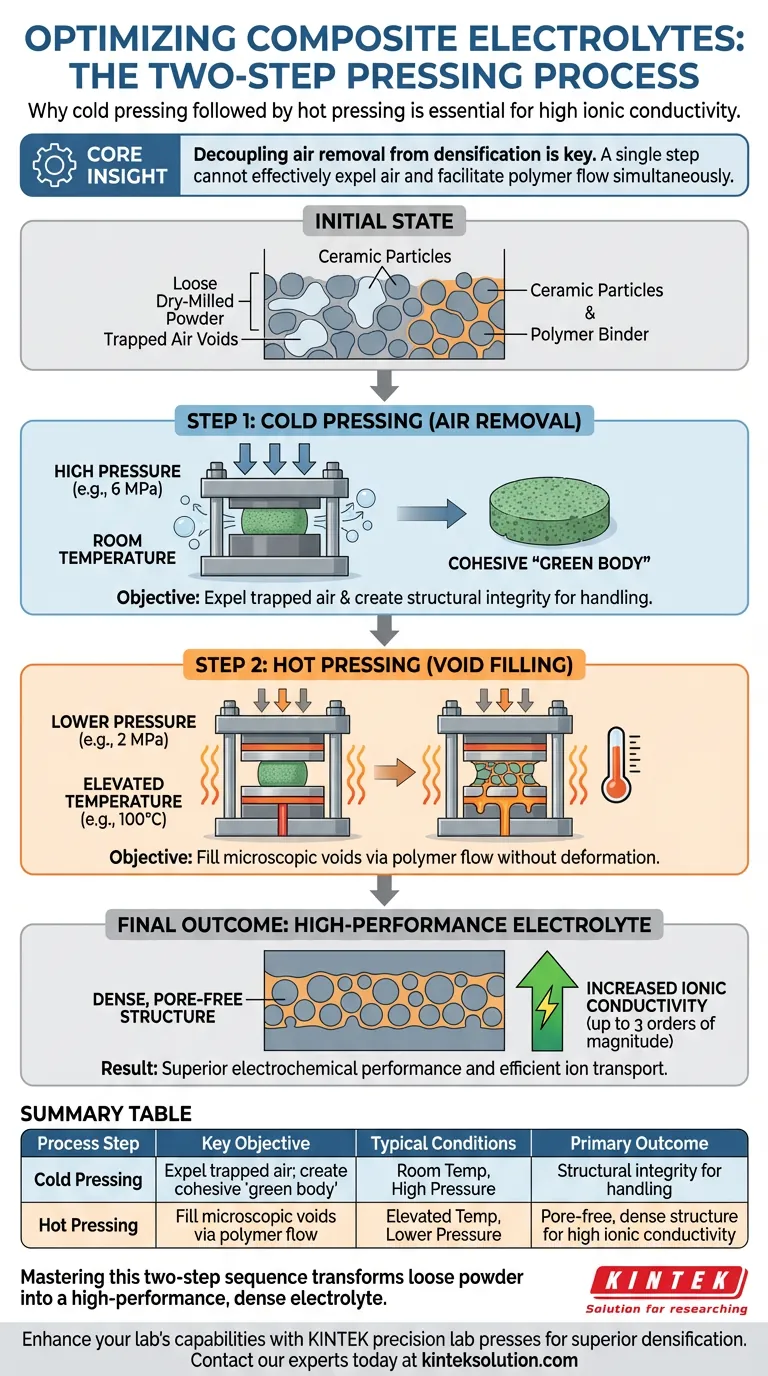
A two-step pressing process is employed primarily to decouple the removal of air from the densification of the polymer matrix. By first applying high pressure at room temperature (cold pressing), you expel trapped air and establish a cohesive structure; following this with heat and lower pressure (hot pressing) allows the polymer to flow and fill microscopic voids, resulting in a significantly denser and more conductive electrolyte.
Core Insight: Achieving high ionic conductivity requires eliminating porosity, which acts as a barrier to ion transport. A single pressing step cannot simultaneously expel air effectively and facilitate the necessary polymer flow; the two-step sequence is required to optimize both structural integrity and electrochemical performance.
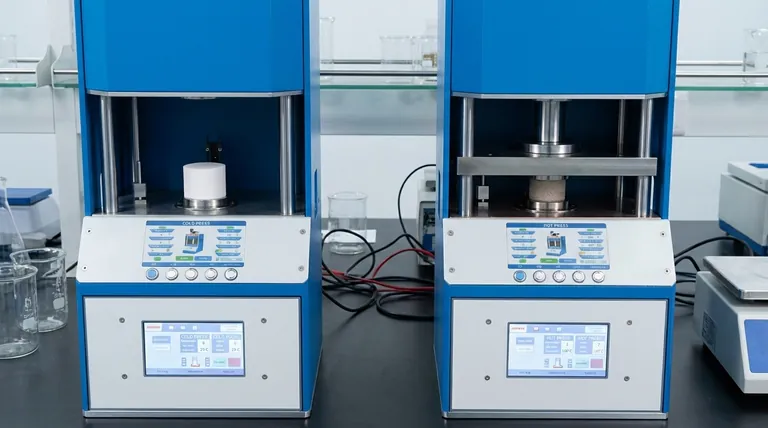
The Mechanics of Densification
Step 1: Cold Pressing for Air Removal
The initial phase involves using a hydraulic press at room temperature with relatively high pressure (e.g., 6 MPa). The primary objective here is to mechanically compress the loose powder mixture.
This step expels a significant volume of air trapped between the dry-milled particles. It successfully creates a "green body," a pre-formed solid that possesses enough mechanical strength to be handled for the subsequent processing stage.
Step 2: Hot Pressing for Void Filling
Once the air is removed and the shape is set, the material undergoes hot pressing at an elevated temperature (e.g., 100°C) but significantly lower pressure (e.g., 2 MPa).
The application of heat causes the polymer component within the composite to soften and transition into a molten state. Because the pressure is lower, the polymer creates a viscous flow that fills the remaining microscopic voids between the ceramic particles without distorting the overall form.
Understanding the Process Benefits
Eliminating Microscopic Pores
The defining advantage of the second (hot) step is its ability to target the microstructure. While cold pressing packs particles together, it leaves microscopic gaps that act as resistance points.
By inducing polymer flow, the hot press effectively seals these gaps. This creates a continuous, pore-free interface between the ceramic particles and the polymer matrix.
The Impact on Conductivity
Densification is not merely structural; it is the primary driver of electrochemical efficiency. The elimination of pores significantly reduces the resistance to ion transport.
Evidence suggests that proper densification via hot pressing can increase room-temperature ionic conductivity by as much as three orders of magnitude. This dramatic increase is essential for the electrolyte to function effectively in a battery cell.
Common Pitfalls and Trade-offs
The Limitations of Single-Step Pressing
Attempting to achieve full density in a single step often results in structural defects. Cold pressing alone creates a shape but fails to eliminate the microscopic voids required for high conductivity.
Conversely, applying heat immediately to loose powder without a pre-forming step can trap air pockets inside the melting polymer. This results in a sample that may look dense on the surface but contains internal porosity that hinders performance.
Pressure Management
It is important to note the counter-intuitive drop in pressure during the second step (e.g., from 6 MPa down to 2 MPa).
Maintaining the high pressure used in the cold step during the hot phase could lead to excessive deformation or squeezing out of the molten polymer. The lower pressure is sufficient to guide the flow into voids without destroying the structural integrity established in the first step.
Making the Right Choice for Your Goal
To maximize the performance of your composite electrolyte, consider how each variable affects the final product:
- If your primary focus is Structural Integrity: Ensure your cold pressing stage utilizes sufficient pressure (e.g., 6 MPa) to create a robust green body that can withstand handling.
- If your primary focus is Ionic Conductivity: Prioritize the temperature control during the hot pressing stage (e.g., 100°C) to ensure the polymer reaches the correct viscosity to fill all microscopic voids.
Mastering this two-step sequence transforms a loose powder into a high-performance, dense electrolyte capable of efficient ion transport.
Summary Table:
| Process Step | Key Objective | Typical Conditions | Primary Outcome |
|---|---|---|---|
| Cold Pressing | Expel trapped air; create a cohesive 'green body' | Room Temperature, High Pressure (e.g., 6 MPa) | Structural integrity for handling |
| Hot Pressing | Fill microscopic voids via polymer flow | Elevated Temperature (e.g., 100°C), Lower Pressure (e.g., 2 MPa) | Pore-free, dense structure for high ionic conductivity |
Ready to optimize your composite electrolyte production?
At KINTEK, we specialize in precision lab press machines, including automatic lab presses and heated lab presses, designed to deliver the exact pressure and temperature control required for this critical two-step process. Our equipment helps researchers like you achieve the superior densification necessary for high-performance batteries.
Enhance your lab's capabilities and boost your ionic conductivity results. Contact our experts today to find the perfect press for your needs!
Visual Guide
Related Products
- Lab Heat Press Special Mold
- Lab Round Bidirectional Press Mold
- Warm Isostatic Press for Solid State Battery Research Warm Isostatic Press
- Lab Polygon Press Mold
- Cylindrical Lab Electric Heating Press Mold for Laboratory Use
People Also Ask
- How is a laboratory heat press used to evaluate bio-based aliphatic polyesters? Prepare Reliable Samples for Analysis
- How is a laboratory heat press utilized in MEA preparation? Achieve High-Efficiency Iron-Chromium Redox Flow Batteries
- Why is a laboratory heat press necessary for biodegradable films? Unlock Precision Bonding and Barrier Performance
- What is the purpose of incorporating cartridge heaters into a lab press mold for MLCC block compression? Optimize Results
- How is a laboratory heated press used for XPP structural analysis? Expert Guide to Sample Preparation













