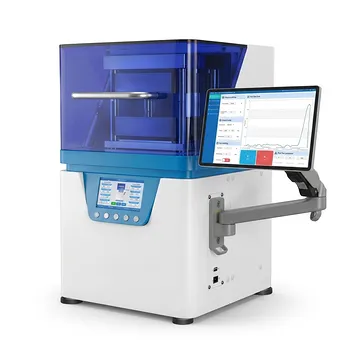
Hydraulic presses represent a high-value investment for laboratories because they combine a low initial acquisition cost with minimal long-term operational expenses. Particularly in the case of mini and manual versions, these devices provide a budget-friendly entry point for essential tasks like sample preparation without sacrificing the precision or durability required for rigorous scientific analysis.
True cost-effectiveness in laboratory equipment is measured by the Total Cost of Ownership (TCO), not just the sticker price. Hydraulic presses secure their status as a budget-conscious solution by minimizing maintenance downtime and maximizing usable bench space, while ensuring the data integrity required for critical research.
The Economics of Acquisition and Maintenance
Lower Initial Capital Investment
For laboratories facing strict budget constraints, mini hydraulic presses and manual models offer a significant price advantage over larger, automated counterparts.
By stripping away complex electronic automation in favor of robust mechanical systems, these units reduce the upfront cost barrier. This makes high-quality sample preparation accessible to smaller facilities, such as undergraduate chemistry labs or startup pharmaceutical operations.
Minimal Operational Expenses
The cost benefits extend well beyond the purchase date due to the equipment's inherent durability.
Hydraulic presses are designed to be rugged and require minimal upkeep. This reduction in maintenance frequency translates to lower service costs and fewer disruptions to laboratory workflows, ensuring that the equipment remains an asset rather than a liability.
Efficiency and Space Optimization
Maximizing Bench Space
In many laboratories, physical space is a premium resource; compact design is a direct contributor to cost-effectiveness.
Mini hydraulic presses occupy a small footprint, allowing labs to utilize their bench space for multiple instruments. This efficiency prevents the need for facility expansion or renovation to accommodate bulky machinery.
Reducing Waste Through Consistency
Cost-effectiveness is also defined by the reliability of results.
Hydraulic presses deliver consistent pressure, creating homogeneous pellets and thin films essential for spectroscopic techniques like XRF and FTIR. By producing high-quality samples that do not require re-testing, labs save money on consumable materials and valuable researcher time.
Understanding the Trade-offs
Manual vs. Automatic Throughput
While manual hydraulic presses are the most affordable option, they introduce a labor trade-off.
They are exceptionally cost-effective for laboratories that do not require frequent use of the press. However, for high-volume environments requiring hundreds of samples daily, the physical effort and time required to operate a manual lever may eventually outweigh the equipment savings.
The Limits of Simplicity
The streamlined design that makes these presses affordable may lack the advanced data logging features of expensive automated systems.
Users must verify that the pressure consistency provided by a manual or mini press meets the specific regulatory or precision standards of their specific testing protocols.
Making the Right Choice for Your Goal
To maximize the return on your investment, align your choice of hydraulic press with your laboratory's specific operational volume.
- If your primary focus is Budget Optimization: Choose a manual or mini hydraulic press to minimize upfront costs and maintenance while preserving bench space.
- If your primary focus is Low-Volume Precision: Select a manual press for occasional sample preparation, as it delivers high-quality, homogeneous samples without the overhead of automation.
- If your primary focus is High-Throughput Efficiency: Re-evaluate the cost benefit; the physical effort of a manual press may become a bottleneck, making a more expensive automatic version more "cost-effective" in terms of labor hours.
By selecting the press that matches your sample volume, you ensure that low cost does not come at the expense of laboratory productivity.
Summary Table:
| Feature | Manual/Mini Hydraulic Press | Cost-Effectiveness Benefit |
|---|---|---|
| Initial Cost | Low Capital Investment | Reduced barrier to entry for small labs/startups |
| Maintenance | Robust Mechanical System | Minimal upkeep and lower service expenses |
| Footprint | Compact Benchtop Design | Optimizes premium lab space without renovations |
| Performance | High Consistency/Precision | Minimizes sample waste and re-testing time |
| Durability | Rugged Construction | High ROI over a long equipment lifespan |
Optimize Your Lab’s Efficiency with KINTEK Pressing Solutions
Don’t let budget constraints limit your research precision. KINTEK specializes in comprehensive laboratory pressing solutions, offering a versatile range of manual, automatic, heated, multifunctional, and glovebox-compatible models, alongside advanced cold and warm isostatic presses for specialized applications like battery research.
Whether you need the budget-friendly simplicity of a mini manual press or the high-throughput efficiency of an automated system, KINTEK provides the durability and precision your data demands. Contact us today to find the most cost-effective solution tailored to your laboratory's specific goals!
Related Products
- Automatic Hydraulic Hot Press with Large Plate and Precision Temperature Control for Advanced Material Sample Preparation and Industrial Research
- Automatic Hydraulic Heat Press Machine with Multi Stage Programmable Control and Integrated Water Cooling Plate Size 180x180mm
- Automatic High Temperature Heated Hydraulic Press Machine with Heated Plates for Lab
- Automatic Heated Hydraulic Lab Press with Programmable Touch Screen Controls and Precision Temperature Regulation
- Manual Heated Hydraulic Lab Press with Integrated Hot Plates Hydraulic Press Machine
People Also Ask
- What are the specific features and applications of hydraulic hot press machines? Precision Solutions for Modern Labs
- How does an automatic hydraulic press operate? Achieve Precision and Consistency in Lab Pelleting
- What are the advantages and common applications of an automatic hydraulic press? Elevate Your Lab's Precision
- What is the technical significance of setting a precise dwell time? Achieve Peak Material Density and Stability
- When is an automatic hydraulic press more suitable than a manual press? Scale Your Lab with Precision & Speed