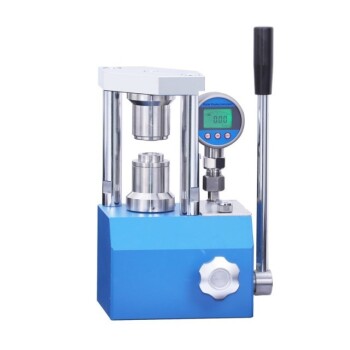
A coin cell crimping machine acts as the critical final step in battery assembly, applying uniform, repeatable pressure to hermetically seal the internal components within a CR2032 case. This mechanical process secures the anode, cathode, electrolyte, and spacers, ensuring the physical integrity required for operation. Without this precise sealing, the cell cannot maintain the stable internal environment necessary for valid electrochemical testing.
The crimper effectively eliminates mechanical variables from your experiment. By strictly controlling internal pressure and sealing, it ensures that measured variations in performance are due to your materials, not inconsistencies in the assembly process.
Achieving a Hermetic Seal
The primary function of the crimping machine is to isolate the internal chemistry of the battery from the external environment.
Preventing Environmental Contamination
The machine applies force to mechanically deform the casing, creating an airtight seal. This is vital for preventing the ingress of atmospheric air and moisture, which can degrade sensitive components like lithium anodes or solid electrolytes.
Electrolyte Containment
Proper crimping ensures that liquid or quasi-solid electrolytes remain contained within the cell. A precise seal prevents leakage, which would not only alter the cell's chemical balance but also potentially damage the testing equipment.
Standardizing Internal Contact Pressure
Beyond sealing, the crimper determines how the internal components physically interact.
Reducing Interfacial Resistance
The machine applies controllable radial pressure to force the internal layers—cathode, anode, and separator—into tight physical contact. This compression is essential for reducing interfacial contact resistance (impedance), facilitating efficient electron and ion transfer.
Eliminating Internal Voids
By compressing the stack uniformly, the crimper eliminates gaps or voids between layers. This ensures a stable solid-to-solid interface, which is a prerequisite for obtaining accurate data during high-sensitivity tests like Electrochemical Impedance Spectroscopy (EIS).
Stability During High Current Density
Tight mechanical bonding maintains electrical continuity even when the cell undergoes stress. This stability is critical for preventing contact loss during demanding procedures such as high current density testing or long-cycle life evaluations.
The Necessity of Data Reproducibility
For scientific data to be valid, the assembly process must be repeatable.
Eliminating Manual Variance
Manual assembly cannot apply the consistent force required for standardized testing. An automated or hydraulic crimper ensures that every cell in a batch is subjected to identical pressure, making results comparable across different samples.
Consistency for Advanced Metrics
Advanced testing techniques, such as Cyclic Voltammetry (CV) or Potentiostatic Electrochemical Impedance Spectroscopy (PEIS), rely heavily on the geometric uniformity of the cell. The crimper guarantees that the internal compression remains constant, ensuring that the resulting data reflects true electrochemical performance rather than assembly artifacts.
Understanding the Precision Trade-off
While a crimping machine is essential, the quality of the data is entirely dependent on the precision of the tool.
The Risk of Incorrect Pressure
If the machine is not calibrated to provide precise and uniform force, the results can be misleading. Insufficient pressure leads to high resistance and "noise" in the data, while excessive pressure can damage the separator or short the electrodes. The tool is only as effective as its ability to maintain exact mechanical tolerances.
Making the Right Choice for Your Goal
The specific value of the crimping machine depends on what aspect of battery performance you are measuring.
- If your primary focus is Cycle Life and Safety: The machine ensures a hermetic seal that prevents electrolyte leakage and moisture ingress, which are the primary causes of premature cell failure.
- If your primary focus is Kinetic Analysis (EIS/CV): The machine provides the uniform internal compression required to minimize contact resistance, ensuring your impedance data is accurate and not an artifact of poor assembly.
Ultimately, a coin cell crimping machine transforms a collection of raw materials into a standardized scientific instrument capable of yielding trusted data.
Summary Table:
| Key Function | Impact on Testing | Benefit for Researchers |
|---|---|---|
| Hermetic Sealing | Prevents moisture ingress & electrolyte leaks | Ensures chemical stability and safety |
| Uniform Pressure | Reduces interfacial contact resistance | Accurate EIS and kinetic data |
| Standardization | Eliminates manual assembly variables | Guaranteed data reproducibility |
| Mechanical Integrity | Eliminates internal voids and gaps | Reliable long-cycle life evaluations |
Elevate Your Battery Research with KINTEK Precision
Don’t let assembly variables compromise your data. KINTEK specializes in comprehensive laboratory pressing solutions tailored for advanced battery research. Whether you need manual, automatic, heated, or glovebox-compatible models, our equipment ensures the perfect hermetic seal every time.
Our value to you:
- Precision Engineering: Minimize interfacial resistance for cleaner EIS and CV results.
- Versatile Solutions: From standard coin cell crimpers to advanced cold and warm isostatic presses.
- Expert Support: Equipment designed to meet the rigorous demands of modern electrochemical testing.
Ready to standardize your cell assembly? Contact KINTEK today for a consultation!
References
- Daniel Döpping, Patrick Théato. Versatile Solvent‐Free Synthesis of Composite Polymer Electrolytes for Thin High‐Performance Solid‐State Lithium Metal Batteries. DOI: 10.1002/smll.202504166
This article is also based on technical information from Kintek Solution Knowledge Base .
Related Products
People Also Ask
- Why use standardized CR2032 components & high-precision presses? Ensure reliability in lithium metal battery research.
- Why is a laboratory battery sealing press essential for desolvation energy testing? Ensure Reliable Kinetic Data
- Why is a laboratory hydraulic press or battery sealing machine essential? Ensure Coin Cell Data Integrity
- How do laboratory battery sealing machines ensure performance consistency? Master Your Lithium and LFP Battery Assembly
- What role does a laboratory sealing press play in thermal analysis of solid dispersion films? Ensure Data Integrity