
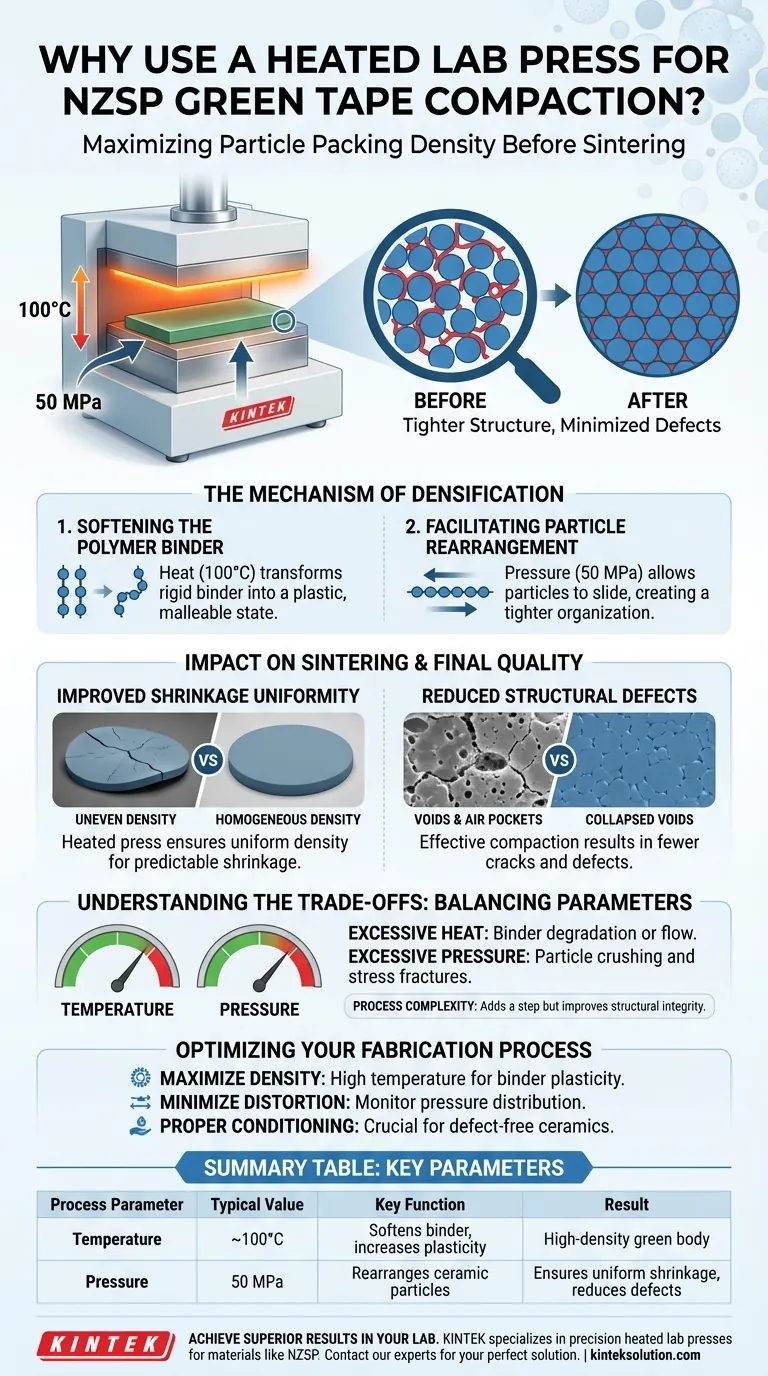
The primary function of using a heated lab press on NZSP green tape is to maximize particle packing density prior to sintering. By applying heat (typically around 100°C) and pressure (50 MPa) simultaneously, the process softens the polymer binder within the tape, increasing its plasticity. This allows the ceramic particles to rearrange more effectively into a tighter structure, minimizing potential defects in the final product.
The combination of thermal softening and mechanical pressure solves the problem of rigid particle spacing. By making the binder malleable, the press eliminates voids and creates a uniform, high-density "green" body that is structurally prepared for high-temperature sintering.
The Mechanism of Densification
Softening the Polymer Binder
The green tape is a composite of hard NZSP ceramic particles and a polymer binder. At room temperature, this binder can be rigid, resisting compression.
Applying heat transforms the physical state of the binder. By raising the temperature to roughly 100°C, the binder softens and becomes significantly more plastic.
Facilitating Particle Rearrangement
Once the binder is softened, it acts less like a glue and more like a viscous lubricant.
When 50 MPa of pressure is applied, the hard ceramic particles can slide past one another with reduced resistance. This facilitates a tighter organization of particles, significantly increasing the physical contact area between them.
Impact on Sintering and Final Quality
Improving Shrinkage Uniformity
Sintering involves high temperatures that cause the material to shrink as it solidifies.
If the green tape has uneven density, it will shrink unevenly, leading to warping. The heated press ensures a homogeneous density throughout the tape, resulting in predictable, uniform shrinkage.
Reducing Structural Defects
The presence of voids or air pockets in the green tape creates weak points.
By compacting the material effectively while the binder is plastic, these voids are collapsed. This reduction in initial porosity directly correlates to fewer cracks and defects in the final, sintered ceramic electrolyte.
Understanding the Trade-offs
Balancing Temperature and Pressure
While heat and pressure are beneficial, they must be carefully calibrated.
Excessive temperature could degrade the binder or cause it to flow uncontrollably, altering the tape's composition. Similarly, excessive pressure without adequate heat might crush particles rather than rearranging them, introducing stress fractures before sintering even begins.
Process Complexity
Using a heated lab press adds a distinct step to the manufacturing workflow.
While it improves quality, it increases the time and equipment requirements compared to cold pressing or direct sintering. However, for high-performance materials like NZSP, the gain in structural integrity usually outweighs the added processing cost.
Optimizing Your Fabrication Process
To ensure the best results for your NZSP electrolyte, align your processing parameters with your specific quality targets.
- If your primary focus is maximizing density: Ensure the temperature is high enough to fully soften the specific binder used, maximizing plasticity during compression.
- If your primary focus is minimizing geometric distortion: closely monitor the pressure distribution to ensure the tape does not spread or deform unevenly during the compaction phase.
Proper conditioning of the green tape is the single most effective way to ensure a defect-free final ceramic.
Summary Table:
| Process Parameter | Typical Value | Key Function |
|---|---|---|
| Temperature | ~100°C | Softens polymer binder, increases plasticity |
| Pressure | 50 MPa | Rearranges ceramic particles into a tighter structure |
| Result | High-density green body | Ensures uniform shrinkage and reduces defects during sintering |
Achieve superior results in your lab.
Conditioning your green tape is the most critical step for producing high-performance ceramics. KINTEK specializes in precision lab press machines, including automatic lab presses, isostatic presses, and heated lab presses, designed to deliver the exact pressure and temperature control required for materials like NZSP.
Our equipment helps you:
- Maximize particle packing density for a defect-free final product.
- Ensure uniform shrinkage during sintering, preventing warping.
- Optimize your fabrication process with reliable, repeatable results.
Ready to enhance your ceramic electrolyte fabrication? Contact our experts today to find the perfect lab press solution for your research and development needs.
Visual Guide
Related Products
- Automatic High Temperature Heated Hydraulic Press Machine with Heated Plates for Lab
- Automatic Heated Hydraulic Press Machine with Hot Plates for Laboratory
- 24T 30T 60T Heated Hydraulic Lab Press Machine with Hot Plates for Laboratory
- Automatic Heated Hydraulic Press Machine with Heated Plates for Laboratory
- Lab Heat Press Special Mold
People Also Ask
- Function of a Laboratory Hydraulic Press with Heated Platens in SSE? Enhance Battery Density & Conductivity
- What are the requirements for electrode pressing with high-viscosity ionic liquids like EMIM TFSI? Optimize Performance
- How does a laboratory heated hydraulic press facilitate PBN sample prep for WAXS? Achieve Precise X-Ray Scattering
- What are the industrial applications of heated hydraulic presses? Master Heat & Force for Precision Manufacturing
- Why is a laboratory hydraulic press with heating plates required for PLA/TEC films? Achieve Precise Sample Integrity



















