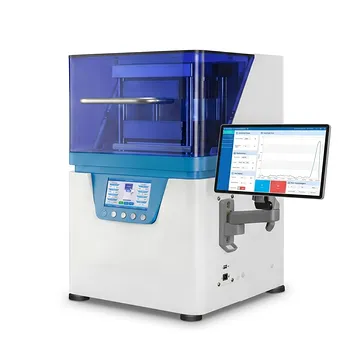
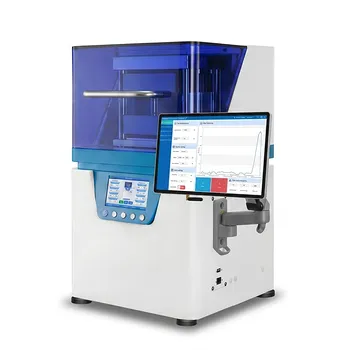
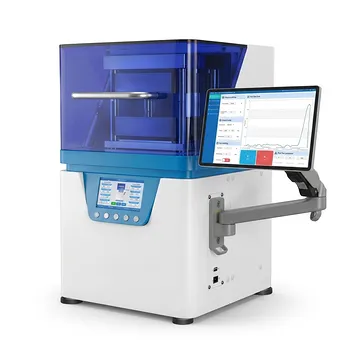
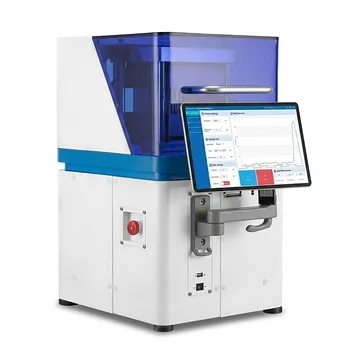
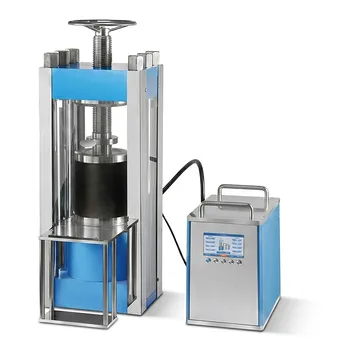
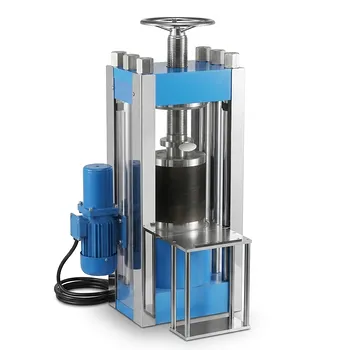
Precise control over thermal and mechanical energy is the only way to facilitate the molecular-level fusion required for high-quality vitrimer synthesis. A high-precision heated laboratory press is required because it simultaneously delivers uniform pressure and controlled high temperatures to activate dynamic covalent bond exchange (BERs) within the polymer network. This dual-action process eliminates internal micro-bubbles and density variations, ensuring that the final samples possess high homogeneity, standardized thickness, and optimal cross-linking density.
Core Takeaway: To create defect-free vitrimers, a laboratory press must maintain exact pressure and temperature to drive the material past its topology freezing transition temperature ($T_v$), allowing for complete interfacial healing and the elimination of microscopic voids.
Activating Chemical and Physical Fusion
Driving Dynamic Covalent Bond Exchange
Vitrimers transition from a rigid state to a rubbery, flowable state only when heated above their topology freezing transition temperature ($T_v$). High-precision heating ensures the material stays consistently above this threshold, enabling the internal bond exchange reactions (BERs) necessary for stress relaxation and network reorganization.
Facilitating Molecular-Level Interfacial Contact
The application of stable, uniform pressure is required to overcome the natural surface roughness of pre-cured vitrimer particles or powders. By forcing these surfaces together at the molecular level, the press allows the polymer chains to reorganize and heal across the interface, transforming discrete fragments into a single, continuous solid.
Managing the Two Stages of Particle Fusion
The fusion process occurs in two distinct stages: instantaneous deformation followed by long-term creep. A precision press maintains a constant "driving force" during the extended hot-pressing period, which is critical for ensuring the material continues to flow and fill internal gaps long after the initial compression.
Achieving Structural Integrity and Homogeneity
Elimination of Internal Micro-Bubbles and Pores
Even minor fluctuations in pressure can trap air, resulting in closed pores that weaken the material’s elastic modulus. Staged pressure increases—ranging from 50 kN to 300 kN—effectively "squeeze out" residual air and volatiles, resulting in a sample with no internal micro-porosity.
Reducing Density Gradients and Internal Stress
Consistency in the internal density of a vitrimer "green body" is a prerequisite for predictable mechanical behavior. A precision hydraulic system ensures the load is applied evenly across the entire surface area, preventing density gradients that often lead to warping or cracking during subsequent cooling or heat treatment.
Standardizing Geometry for Accurate Testing
Testing methods like Dynamic Mechanical Analysis (DMA) and Electrochemical Impedance Spectroscopy (EIS) require samples with exact thicknesses, such as 1 mm. A high-precision press allows for the production of standardized discs or films with tight tolerances, ensuring that test data is both accurate and repeatable across different batches.
Understanding the Trade-offs of Precision Equipment
The Risk of Pressure Decay
Standard manual presses often experience "pressure decay" as the material softens and creeps under heat. If the equipment cannot automatically compensate for this volume change to maintain a constant load, the vitrimer will suffer from incomplete fusion and lower-than-intended cross-linking density.
Temperature Fluctuations and Material Stability
Inaccurate temperature control can lead to "hot spots" that cause localized thermal degradation or "cold spots" where $T_v$ is never reached. This lack of thermal uniformity results in a sample with heterogeneous mechanical properties, making the research data unreliable for characterizing the true nature of the vitrimer.
Complexity vs. Consistency
While high-precision presses require more rigorous calibration and setup than basic manual weights, the benefit is the elimination of "human-factor" variables. This is essential for meeting ASTM standards and ensuring that the self-healing or mechanical property results are not artifacts of poor sample preparation.
Applying This Technology to Your Research Goals
How to Apply This to Your Project
To achieve the best results with your vitrimer samples, you must match your press settings to the specific thermal and mechanical requirements of your polymer chemistry.
- If your primary focus is Self-Healing Efficiency: Prioritize a press with highly stable pressure maintenance (e.g., 5 kN) to ensure complete crack closure and chain reorganization at the interface.
- If your primary focus is Mechanical Property Mapping: Use staged pressure increases to eliminate all micro-porosity, guaranteeing that your elastic modulus measurements reflect the material's true potential rather than its defects.
- If your primary focus is Advanced Analytical Testing (DMA/EIS): Focus on precision molds and thickness control to create standardized 1 mm or 280-micrometer discs for tight interfacial contact with electrodes.
By maintaining exact control over the variables of time, temperature, and pressure, you ensure that every vitrimer sample is a perfect representation of its molecular design.
Summary Table:
| Key Feature | Requirement for Vitrimers | Benefit to Sample Quality |
|---|---|---|
| Precise Heating | Above Topology Freezing Temp ($T_v$) | Activates Bond Exchange Reactions (BERs) |
| Uniform Pressure | Stable load spanning 50 kN to 300 kN | Eliminates micro-bubbles and density gradients |
| Pressure Stability | Automatic compensation for material creep | Prevents internal voids and ensures homogeneity |
| Thickness Control | High-precision molds and platens | Standardizes geometry for accurate DMA/EIS testing |
Elevate Your Vitrimer Research with KINTEK Precision
Achieving defect-free samples requires equipment that matches your scientific rigor. KINTEK specializes in comprehensive laboratory pressing solutions designed to eliminate micro-porosity and ensure molecular-level fusion in advanced polymers.
Our extensive range includes manual, automatic, heated, multifunctional, and glovebox-compatible models, as well as cold and warm isostatic presses widely applied in battery research and high-performance materials science. Don't let pressure decay or thermal fluctuations compromise your data accuracy.
Contact us today to discover how our precision pressing technology can enhance your lab's efficiency and sample integrity!
References
- Wim Denissen, Filip Du Prez. Chemical control of the viscoelastic properties of vinylogous urethane vitrimers. DOI: 10.1038/ncomms14857
This article is also based on technical information from Kintek Solution Knowledge Base .
Related Products
- Automatic Heated Hydraulic Lab Press with Programmable Touch Screen Controls and Precision Temperature Regulation
- Automatic Hydraulic Hot Press with Large Plate and Precision Temperature Control for Advanced Material Sample Preparation and Industrial Research
- Automatic High Temperature Heated Hydraulic Press Machine with Heated Plates for Lab
- 24T 30T 60T Heated Hydraulic Lab Press Machine with Hot Plates for Laboratory
- Automatic Heated Hydraulic Lab Press 120x120mm Plate Fully Automated Material Research Press
People Also Ask
- Why is a laboratory heated hydraulic press required? Ensure Precise Vulcanization for NBR/EPDM Nanocomposites
- What are the industrial applications of heated hydraulic presses? Master Heat & Force for Precision Manufacturing
- Why is an automatic heated lab press preferred for PEEK & CNT laminates? Achieve Precise Crystallization Control
- What is the necessity of a laboratory hydraulic press with heating functions? Master Rubber Vulcanization Precision
- How does a heated laboratory hydraulic press contribute to the formation of dense mycelium-based materials? Expert Tips