
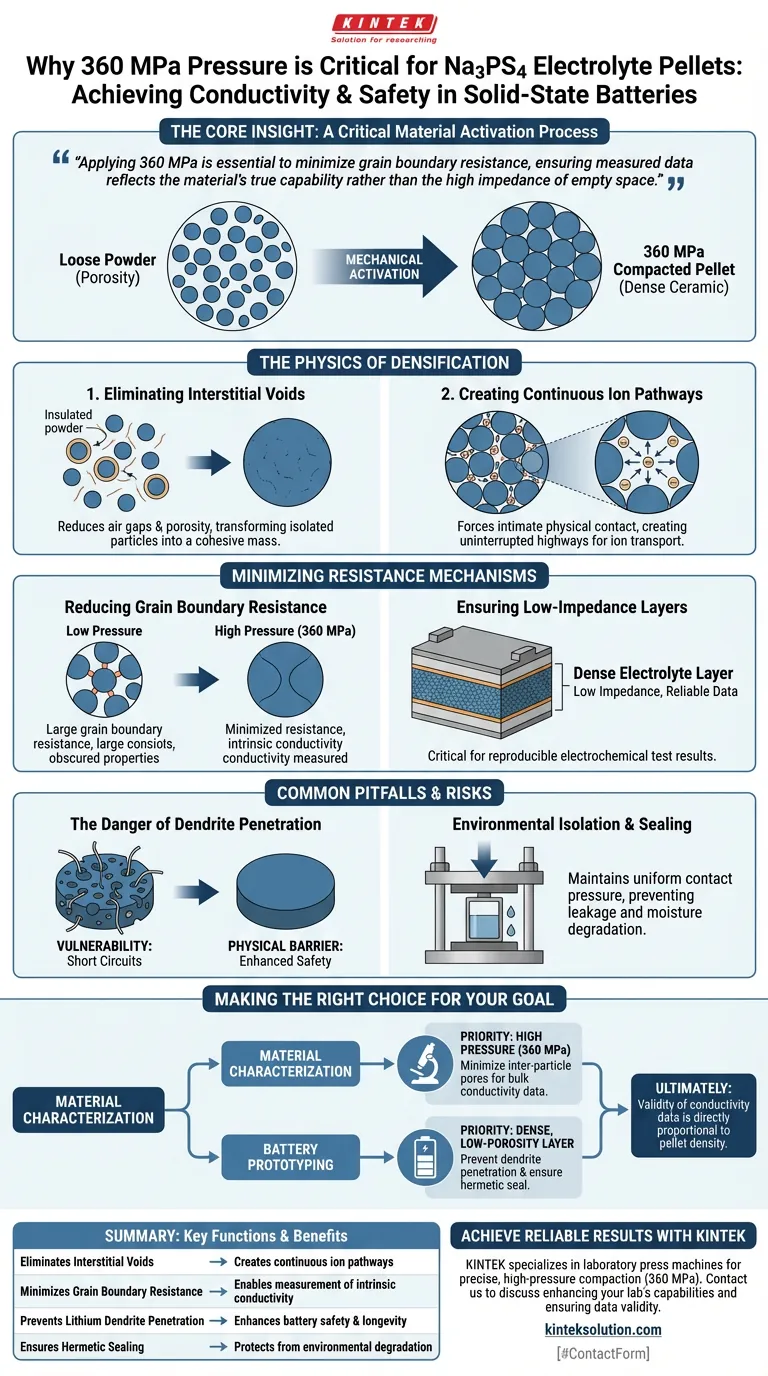
Applying 360 MPa is not merely a shaping step; it is a critical material activation process. When preparing Na3PS4 electrolyte pellets, this specific high-pressure threshold is required to mechanically force loose powder particles into a cohesive, dense ceramic. Without this extreme compression to eliminate air voids, the gaps between particles act as barriers, breaking the ionic pathways necessary for accurate conductivity testing or functional battery operation.
The Core Insight In solid-state electrolytes, performance is often limited by the connections between particles, not the particles themselves. Applying 360 MPa is essential to minimize grain boundary resistance, ensuring that measured data reflects the material's true capability rather than the high impedance of the empty space between grains.
The Physics of Densification
Eliminating Interstitial Voids
Powdered Na3PS4 naturally contains significant empty space, or porosity. These air gaps are electrically insulating.
Applying 360 MPa uniaxially compacts the powder, significantly reducing these interstitial voids. This transforms a collection of isolated particles into a near-solid mass.
Creating Continuous Ion Pathways
For a solid-state battery to function, lithium ions must travel from one electrode to the other.
High-pressure compaction forces particles into intimate physical contact. This creates the continuous, uninterrupted "highways" required for ion transport, which acts as the foundation for the material’s conductivity.
Minimizing Resistance Mechanisms
Reducing Grain Boundary Resistance
Total resistance in a ceramic pellet is a sum of the resistance inside the particle (bulk) and the resistance jumping between particles (grain boundary).
In loose or low-pressure pellets, the grain boundary resistance dominates, obscuring the material's true properties. High pressure ensures the interfaces are tight enough that ions can cross easily, allowing you to measure the intrinsic ionic conductivity accurately.
Ensuring Low-Impedance Layers
For actual battery assembly, the electrolyte layer must offer low resistance (impedance) to maximize power output.
A pellet pressed at 360 MPa forms a low-impedance electrolyte layer. This is critical for obtaining reliable electrochemical test data that is reproducible across different experiments.
Common Pitfalls and Operational Risks
The Danger of Dendrite Penetration
One of the primary failure modes in solid-state batteries is the growth of lithium dendrites (metal filaments) through the electrolyte, causing short circuits.
Porosity is a vulnerability. If the pellet is not sufficiently dense, dendrites can easily grow through the voids. High-pressure compaction closes these pathways, acting as a physical barrier to dendrite penetration and enhancing safety.
Environmental Isolation and Sealing
Pressure plays a dual role during the assembly phase: densification and sealing.
A properly calibrated press ensures a high-quality seal that isolates internal components from external air and moisture. This is vital for Na3PS4, as maintaining uniform contact pressure prevents leakage and degradation that would invalidate test results.
Making the Right Choice for Your Goal
Whether you are characterizing a raw material or building a full cell, the application of pressure dictates your success.
- If your primary focus is Material Characterization: Prioritize high pressure (360 MPa) to minimize inter-particle pores, ensuring your data reflects the material's bulk conductivity rather than artifacts of poor compaction.
- If your primary focus is Battery Prototyping: Focus on creating a dense, low-porosity layer to prevent lithium dendrite penetration and ensure a hermetic seal against environmental moisture.
Ultimately, the validity of your conductivity data is directly proportional to the density of your pellet.
Summary Table:
| Key Function of 360 MPa Pressure | Benefit for Na3PS4 Pellets |
|---|---|
| Eliminates Interstitial Voids | Creates continuous ion pathways for conductivity |
| Minimizes Grain Boundary Resistance | Enables measurement of intrinsic ionic conductivity |
| Prevents Lithium Dendrite Penetration | Enhances battery safety and longevity |
| Ensures Hermetic Sealing | Protects moisture-sensitive electrolyte from degradation |
Achieve reliable and reproducible results for your solid-state battery research. The density of your electrolyte pellet is paramount to its performance. KINTEK specializes in laboratory press machines, including automatic and heated lab presses, designed to deliver the precise, high-pressure compaction (like 360 MPa) required for accurate material characterization and robust battery prototyping. Contact us today via our [#ContactForm] to discuss how our presses can enhance your lab's capabilities and ensure the validity of your conductivity data.
Visual Guide
Related Products
- Automatic High Temperature Heated Hydraulic Press Machine with Heated Plates for Lab
- Manual Heated Hydraulic Lab Press with Integrated Hot Plates Hydraulic Press Machine
- Heated Hydraulic Press Machine with Heated Plates for Vacuum Box Laboratory Hot Press
- Laboratory Hydraulic Press 2T Lab Pellet Press for KBR FTIR
- Laboratory Hydraulic Press Lab Pellet Press Machine for Glove Box
People Also Ask
- Function of a Laboratory Hydraulic Press with Heated Platens in SSE? Enhance Battery Density & Conductivity
- What are the requirements for electrode pressing with high-viscosity ionic liquids like EMIM TFSI? Optimize Performance
- How does a laboratory heated hydraulic press facilitate PBN sample prep for WAXS? Achieve Precise X-Ray Scattering
- What are the industrial applications of heated hydraulic presses? Master Heat & Force for Precision Manufacturing
- Why is a laboratory hydraulic press with heating plates required for PLA/TEC films? Achieve Precise Sample Integrity



















