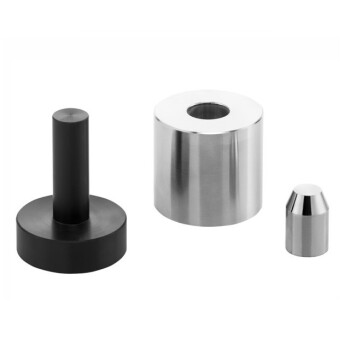
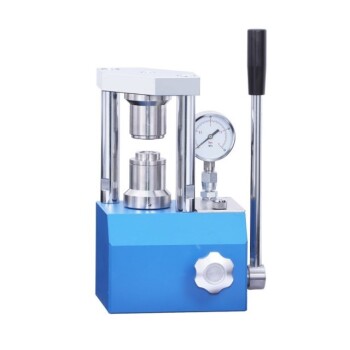
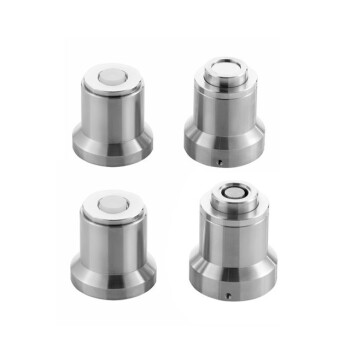
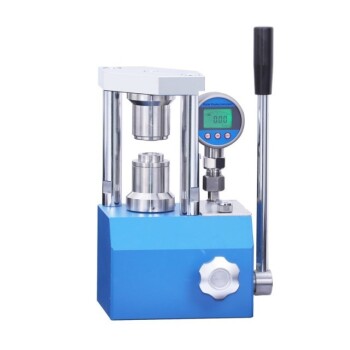
A laboratory battery sealing press is critical because it applies standardized, uniform packaging pressure to the cell components. This mechanical consistency ensures that the electrode, separator, and electrolyte maintain tight contact, eliminating experimental noise caused by loose physical interfaces. Without this precision, the kinetic data required to calculate desolvation energy becomes unreliable and impossible to reproduce.
The core value of the sealing press is mechanical consistency. It eliminates variable contact resistance, ensuring that the measured charge transfer resistance (Rct) reflects the true desolvation performance of the electrolyte, rather than artifacts of poor assembly.
The Role of Pressure in Desolvation Analysis
Standardized Packaging Pressure
Desolvation energy testing relies on precise measurements of ion movement. A manual or inconsistent assembly process introduces variability in how tightly the components are packed.
A sealing press solves this by applying a standardized pressure. This ensures that the distance and contact quality between layers are identical across every cell you test.
Optimizing Interfacial Contact
For symmetric cells (such as Li/Si configurations), the interface between the electrode and the electrolyte is where the critical chemistry happens.
The press forces these layers into tight physical contact. This effectively bonds the electrode, separator, and electrolyte, ensuring the electrolyte sufficiently wets the porous structures and eliminates gaps that would otherwise impede ion flow.
Eliminating Signal Noise
Poor contact creates "noise" or interference in electrochemical readings. In desolvation testing, this noise can obscure the subtle signals you are trying to measure.
By ensuring uniform pressure distribution, the press prevents these physical inconsistencies. This allows you to isolate the chemical behavior of the electrolyte without mechanical defects skewing the results.
Impact on Electrochemical Impedance Spectroscopy (EIS)
Ensuring Accuracy in Rct Measurements
Desolvation performance is often evaluated using Electrochemical Impedance Spectroscopy (EIS) to determine charge transfer resistance (Rct).
The primary reference indicates that a sealing press is essential for ensuring high repeatability of these Rct values. If the pressure is not uniform, the resistance data will fluctuate, making it impossible to derive accurate desolvation energy.
Calculating Activation Energy (Ea)
To determine desolvation energy, researchers calculate the activation energy (Ea) based on temperature-dependent EIS data.
This calculation requires extremely precise inputs. The sealing press ensures the mechanical environment of the cell remains stable, so that changes in Rct are attributed solely to temperature and kinetics, not to shifting components or relaxing pressure.
Critical Trade-offs: The Importance of Control
The Risk of Variable Pressure
While a press is essential, the amount of pressure must be carefully controlled.
If pressure is too low, you encounter high interfacial impedance and "dry" pockets where the electrolyte hasn't wetted the separator. This leads to false readings of high desolvation energy.
The Risk of Over-Compression
Conversely, excessive pressure can crush the separator or deform the porous framework of the electrode.
While the press is vital for sealing, it must be set to a specific, validated pressure. The goal is to maximize contact without mechanically damaging the separator structure, which could cause short circuits or artificially restricted ion paths.
Making the Right Choice for Your Goal
To ensure your desolvation energy testing is valid, consider how the sealing process aligns with your specific objectives:
- If your primary focus is obtaining accurate Kinetic Data (Rct/Ea): Use a high-precision sealing press to eliminate contact resistance, as this is the largest source of error in impedance spectroscopy.
- If your primary focus is Long-Term Cycling Stability: Ensure the press provides a hermetic seal to prevent electrolyte evaporation and moisture ingress, which can degrade the cell over time.
Ultimately, the sealing press transforms a battery cell from a loose stack of components into a unified, reproducible electrochemical system capable of yielding valid scientific data.
Summary Table:
| Feature | Impact on Desolvation Energy Testing |
|---|---|
| Standardized Pressure | Ensures uniform contact and identical cell environments across all tests. |
| Interfacial Contact | Optimizes wetting and eliminates gaps between electrodes and electrolytes. |
| Signal Noise Reduction | Minimizes variable contact resistance to isolate true chemical behavior. |
| EIS Accuracy | Provides stable Rct values necessary for calculating activation energy (Ea). |
| Mechanical Stability | Prevents component shifting to ensure temperature-dependent data integrity. |
Elevate Your Battery Research with KINTEK Precision
At KINTEK, we understand that the integrity of your desolvation energy data depends on mechanical consistency. We specialize in comprehensive laboratory pressing solutions, offering manual, automatic, heated, multifunctional, and glovebox-compatible models, alongside advanced cold and warm isostatic presses specifically designed for high-performance battery research.
Don't let variable contact resistance compromise your results. Let our experts help you select the ideal sealing press to ensure your symmetric cells yield reproducible, noise-free kinetic data. Contact KINTEK today to find your solution!
References
- Min Li, Liping Wang. Electrolyte design weakens lithium-ion solvation for a fast-charging and long-cycling Si anode. DOI: 10.1039/d4sc08125k
This article is also based on technical information from Kintek Solution Knowledge Base .
Related Products
- Button Battery Sealing Press Machine for Lab
- Lab Button Battery Tablet Press Sealing Mold
- Laboratory Hydraulic Press Lab Pellet Press Button Battery Press
- Lab Infrared Press Mold for Laboratory Applications
- Manual Button Battery Sealing Machine for Battery Sealing
People Also Ask
- Why use standardized CR2032 components & high-precision presses? Ensure reliability in lithium metal battery research.
- Why is a laboratory hydraulic press or battery sealing machine essential? Ensure Coin Cell Data Integrity
- How do laboratory battery sealing machines ensure performance consistency? Master Your Lithium and LFP Battery Assembly
- What role does a laboratory sealing press play in thermal analysis of solid dispersion films? Ensure Data Integrity
- Why is pressure control critical for HEPBA coin cell assembly? Achieve Precision Lab Sealing Results