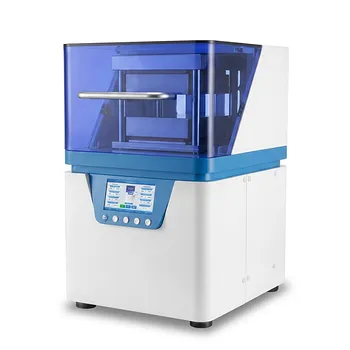
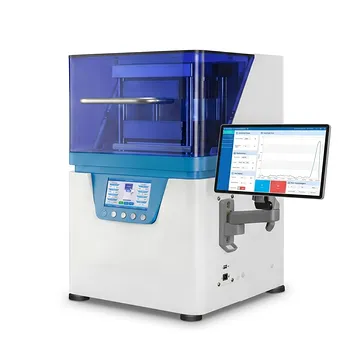
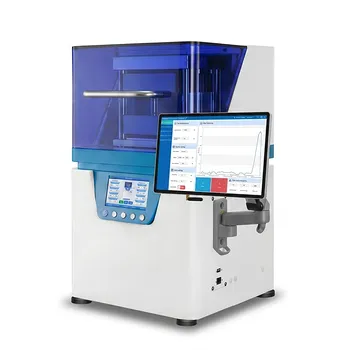
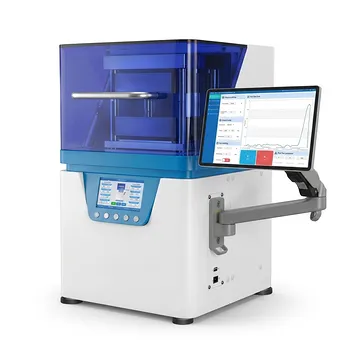
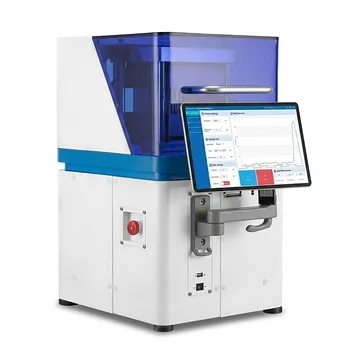
The use of a multi-stage heating laboratory hydraulic press is essential for managing the phase transitions of Polytetrafluoroethylene (PTFE) during GDL fabrication. This specialized equipment provides the precise, program-controlled coordination of temperature, pressure, and duration required to transform PTFE from a "dough" state into a fibrillated network. This process ensures a robust mechanical bond between the Micro-Porous Layer (MPL) and the carbon fiber substrate while allowing for the fine-tuning of the material's porosity and electrical properties.
A multi-stage heating press acts as the primary regulator for the structural integrity of a Gas Diffusion Layer by synchronizing thermal and mechanical fields. This synchronization is critical for inducing the specific material textures and phase transitions necessary for high-performance fuel cell components.
Managing the PTFE Phase Transition
Transitioning from Dough to Fibrils
PTFE serves as the primary binder and hydrophobic agent within the Gas Diffusion Layer.
Multi-stage heating allows the operator to guide the PTFE through a specific thermal profile that transitions the polymer from a dough-like state into a fibrillated network.
This fibrous structure is what provides the material with its internal cohesion and long-term durability under operational stress.
Ensuring Interfacial Bonding
A GDL consists of a Micro-Porous Layer (MPL) and a carbon fiber fabric support layer.
The multi-stage process ensures that the PTFE penetrates both layers uniformly before it solidifies, creating a robust physical bond between them.
Without this staged control, the layers may delaminate, leading to increased interfacial resistance and premature component failure.
Synchronizing Temperature and Pressure Fields
Precise Control of Material Properties
The multi-stage press allows for the simultaneous regulation of the temperature field and the pressure field.
By adjusting these parameters in stages, manufacturers can precisely control the final porosity, which is vital for efficient gas transport in fuel cells.
This level of control also determines the electrical conductivity and mechanical strength of the finished GDL.
Inducing Specific Material Textures
In advanced material science, the synchronization of heat and pressure can induce or inhibit specific phase transition processes.
This capability allows for the preparation of functional materials with pre-stressed states or specific textures.
Such "material tuning" significantly enhances the flexibility of how the GDL responds to strain and thermal cycling during fuel cell operation.
Understanding the Trade-offs
Balancing Porosity and Density
The primary challenge in hot-pressing GDLs is the trade-off between mechanical density and gas permeability.
Applying too much pressure or heat for too long can "blind" the pores, significantly reducing the gas transport efficiency of the GDL.
Conversely, insufficient heat or pressure results in a weak PTFE network, leading to poor electrical contact and low mechanical durability.
Complexity of Programming
Multi-stage pressing requires a deep understanding of the thermal characteristics of the specific polymers being used.
Small errors in the timing of a stage can lead to non-uniform distribution of the binder, creating "dead zones" in the material.
This necessitates rigorous testing and validation of the pressing profile for every unique material composition.
How to Optimize Your Hot-Pressing Process
Tailoring Parameters to Project Goals
Selecting the right staged profile depends entirely on the intended environment of the GDL.
- If your primary focus is mechanical longevity: Prioritize a profile that maximizes PTFE fibrillation to create a high-strength internal matrix.
- If your primary focus is high-current density performance: Optimize the stages to maintain maximum porosity, ensuring that gas transport is not restricted by compressed pores.
- If your primary focus is minimizing contact resistance: Focus on the synchronization of pressure and temperature to ensure a perfectly flat and uniform interface between the MPL and the carbon cloth.
By mastering the multi-stage heating profile, you can transform a simple mixture of carbon and polymer into a high-performance, engineered component capable of withstanding the rigors of electrochemical energy conversion.
Summary Table:
| Key Feature | Functional Role in GDL Hot-Pressing | Material Impact |
|---|---|---|
| PTFE Phase Control | Transitions PTFE from dough to fibrillated network | Enhances mechanical durability and internal cohesion |
| Interfacial Bonding | Uniform PTFE penetration across MPL and substrate | Prevents delamination and reduces contact resistance |
| Field Synchronization | Simultaneous regulation of heat and pressure | Controls final porosity and electrical conductivity |
| Material Tuning | Induces specific textures and pre-stressed states | Improves response to thermal cycling and strain |
Elevate Your GDL Research with KINTEK Precision
Achieve unmatched structural integrity and electrochemical performance in your Gas Diffusion Layers. KINTEK specializes in comprehensive laboratory pressing solutions, offering manual, automatic, heated, multifunctional, and glovebox-compatible models, as well as cold and warm isostatic presses tailored for advanced battery and fuel cell research.
Our equipment provides the precise thermal and mechanical synchronization required to master PTFE phase transitions and optimize material porosity. Don't compromise on your material science—contact us today to find the perfect pressing solution for your laboratory's needs!
References
- Matthew F. Philips, Klaas Jan P. Schouten. Production of Gas Diffusion Layers with Tunable Characteristics. DOI: 10.1021/acsomega.1c06977
This article is also based on technical information from Kintek Solution Knowledge Base .
Related Products
- Automatic Hydraulic Heat Press Machine with Multi Stage Programmable Control and Integrated Water Cooling Plate Size 180x180mm
- 24T 30T 60T Heated Hydraulic Lab Press Machine with Hot Plates for Laboratory
- Automatic Heated Hydraulic Lab Press with Programmable Touch Screen Controls and Precision Temperature Regulation
- Automatic Heated Hydraulic Lab Press 120x120mm Plate Fully Automated Material Research Press
- Automatic Heated Hydraulic Press Machine with Heated Plates for Laboratory
People Also Ask
- How does a laboratory hydraulic heat press facilitate the molding of cellulose composite specimens? Precision Molding
- How is a hydraulic heat press used for sample preparation? Achieve Uniform, Void-Free Samples for Lab Analysis
- What is the role of a hydraulic heat press in material testing? Unlock Superior Data for Research & QC
- What is a hydraulic heat press? Discover Precision Material Bonding and Sample Preparation
- What are the industrial applications of a hydraulic heat press? Powering Lamination, Bonding, and R&D Efficiency