
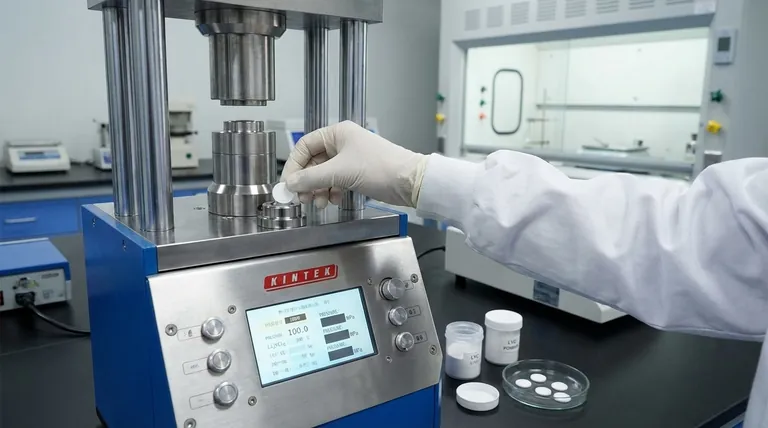
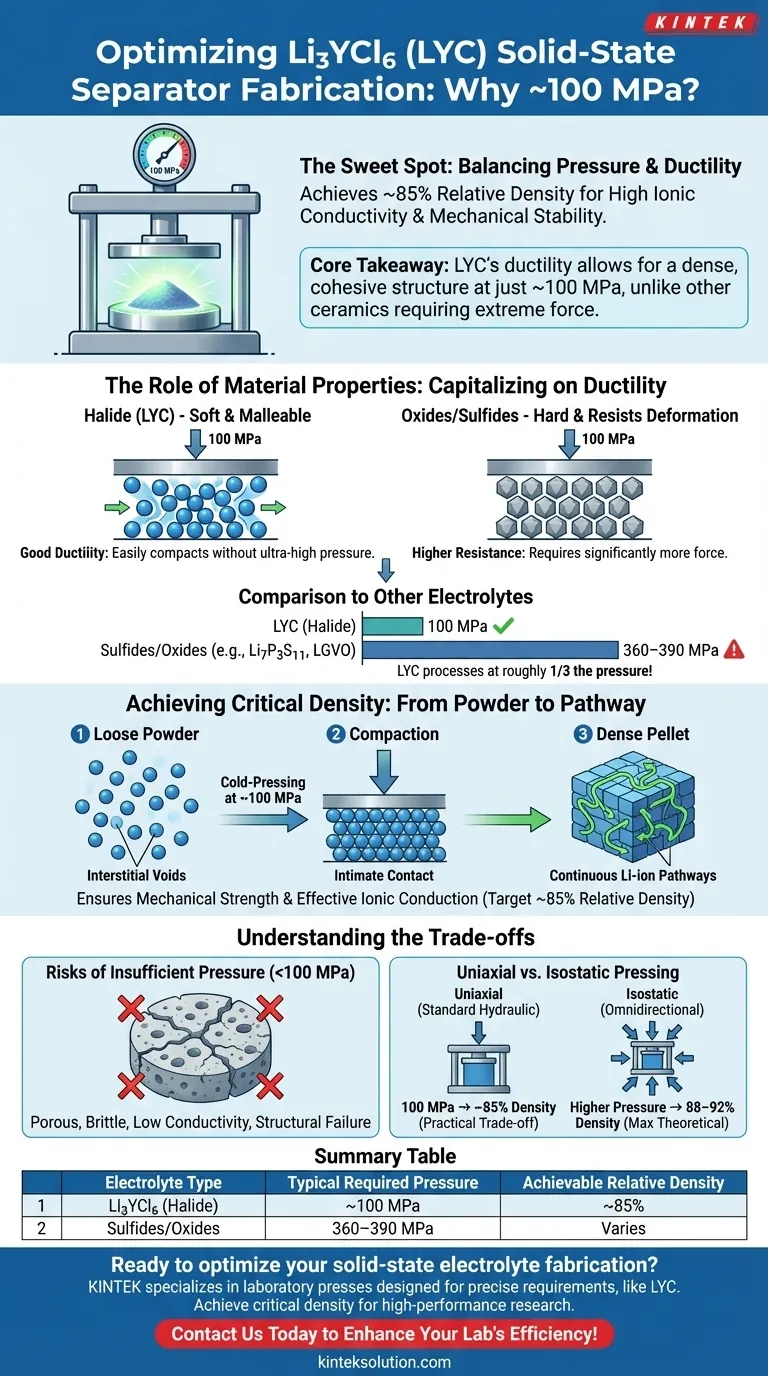
The application of approximately 100 MPa is the optimal pressure setting for fabricating Li3YCl6 (LYC) separators because it capitalizes on the material's inherent ductility to achieve high density without requiring the extreme forces needed for other ceramics. This specific pressure allows the powder particles to deform and pack tightly via cold-pressing, resulting in a pellet with a relative density of about 85%, which is required for both mechanical stability and efficient ionic conduction.
Core Takeaway While many solid-state electrolytes require pressures exceeding 300 MPa to minimize porosity, LYC facilitates a dense, cohesive structure at just ~100 MPa due to its ductility. This balance creates the continuous pathways necessary for lithium-ion transport while maintaining the structural integrity of the separator.
The Role of Material Properties
Capitalizing on Ductility
Unlike harder ceramic oxides or certain sulfides that resist deformation, Halide solid-state electrolytes like LYC exhibit good ductility.
This physical property means the material is softer and more malleable. Consequently, a laboratory hydraulic press can effectively compact the loose powder into a solid shape without necessitating ultra-high pressure.
Comparison to Other Electrolytes
To understand why 100 MPa is significant for LYC, it helps to look at the requirements for other materials.
For example, electrolytes like Li7P3S11 (Sulfide) or LGVO (Oxide) often require significantly higher pressures, ranging from 360 MPa to 390 MPa, to achieve similar densification. The ability to process LYC at roughly a third of that pressure simplifies the fabrication process while still yielding a robust separator.
Achieving Critical Density
Reducing Interstitial Voids
The primary mechanical goal of applying this pressure is the reduction of interstitial voids—the empty spaces between powder particles.
At 100 MPa, the LYC particles are forced into intimate contact, eliminating porosity. This transformation from loose powder to a solid pellet is essential for creating a continuous medium.
Establishing Ion Pathways
For a solid-state battery to function, lithium ions must move freely through the separator.
The densification process creates effective pathways for lithium-ion conduction. If the particles are not densely packed, the ionic resistance increases, and the battery’s overall performance suffers.
Ensuring Mechanical Strength
Beyond conductivity, the separator must physically separate the anode from the cathode.
The ~85% relative density achieved at this pressure provides the mechanical strength necessary for the pellet to be handled and to function as a structural component within the battery cell.
Understanding the Trade-offs
The Risks of Insufficient Pressure
If the pressure applied is significantly lower than 100 MPa, the LYC powder will not achieve the target 85% relative density.
This results in a porous, brittle separator with poor physical contact between particles. The immediate consequence is low ionic conductivity and a high risk of structural failure during cell assembly.
Uniaxial vs. Isostatic Pressing
While a standard hydraulic press (uniaxial) at 100 MPa creates a functional separator, it is worth noting that isostatic pressing (omnidirectional pressure) can achieve even higher densities.
References indicate isostatic pressing can yield relative densities of 88-92%. Therefore, using a uniaxial hydraulic press at 100 MPa is a practical trade-off that achieves sufficient density (~85%) for standard operation, though slightly higher densities are theoretically possible with more complex equipment.
Making the Right Choice for Your Goal
When determining fabrication parameters for solid-state electrolytes, your specific material dictates the pressure requirements.
- If your primary focus is working with Halides (LYC): Use ~100 MPa to leverage the material's ductility, ensuring a density of ~85% for optimal conductivity and strength.
- If your primary focus is working with Sulfides or Oxides: Be prepared to apply significantly higher pressures (360–390 MPa) to overcome the material's resistance to compaction and minimize voids.
- If your primary focus is maximum theoretical density: Consider using an isostatic press to push relative density closer to 92% for the most accurate conductivity measurements.
The success of a solid-state separator relies on matching the compaction pressure to the material's ductility to ensure a void-free, highly conductive path for lithium ions.
Summary Table:
| Electrolyte Type | Typical Required Pressure | Achievable Relative Density |
|---|---|---|
| Li3YCl6 (Halide) | ~100 MPa | ~85% |
| Sulfides/Oxides | 360–390 MPa | Varies |
Ready to optimize your solid-state electrolyte fabrication? KINTEK specializes in laboratory press machines, including automatic lab presses and isostatic presses, designed to meet the precise pressure requirements of materials like Li3YCl6. Our equipment helps you achieve the critical density and ionic pathways necessary for high-performance battery research. Contact us today to discuss how our solutions can enhance your lab's efficiency and results!
Visual Guide
Related Products
- Laboratory Hydraulic Press Lab Pellet Press Machine for Glove Box
- Laboratory Hydraulic Press 2T Lab Pellet Press for KBR FTIR
- 24T 30T 60T Heated Hydraulic Lab Press Machine with Hot Plates for Laboratory
- Laboratory Hydraulic Press Lab Pellet Press Button Battery Press
- Laboratory Hydraulic Pellet Press for XRF KBR FTIR Lab Press
People Also Ask
- How does a laboratory hydraulic press contribute to the preparation of Li3-3xScxSb samples? Optimize Ionic Conductivity
- What is the function of a laboratory hydraulic press in FT-IR of curcumin-coated MWCNTs? Achieve Optical Clarity.
- Why is a laboratory hydraulic press required for compression molding boron-siloxane? Solve High-Loading Density Challenges
- What role does a laboratory hydraulic press play in reaction pellets? Optimizing Lunar Soil and Metal Fuel Density
- What role does a laboratory hydraulic press play in the preparation of piezoelectric ceramic discs for DC-PG? | KINTEK



















