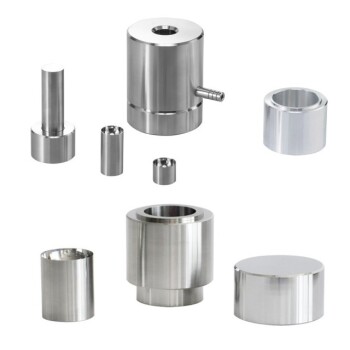
Graphite paper serves as a critical isolation and lubrication barrier placed between the raw SiC/YAG powder (the green body) and the inner walls of the graphite mold. Its primary purpose is to prevent the ceramic material from chemically bonding or mechanically adhering to the mold during the extreme heat and pressure of the sintering process.
Core Takeaway: By creating a sacrificial interface, graphite paper solves complex de-molding challenges before they occur. It preserves the structural integrity of expensive graphite tooling and ensures the ceramic sample requires minimal post-process machining.
The Role of the Interface in Extreme Environments
The Hostile Sintering Context
Hot press sintering for SiC/YAG ceramics operates at extreme temperatures ranging from 1900°C to 2000°C.
At these temperatures, the ceramic powder is under high pressure to achieve densification. Without a barrier, the materials become highly reactive and prone to fusing with the containment vessel.
Preventing Material Adhesion
The graphite paper acts as a physical isolation layer.
It prevents the SiC/YAG material from penetrating the porous surface of the graphite mold. This isolation effectively stops the ceramic from "sticking" to the mold walls, a common failure point in high-temperature processing.
Operational Benefits for Tooling and Quality
Facilitating Clean De-molding
Graphite paper provides a necessary lubrication effect between the sample and the mold.
This allows the sintered ceramic to be removed easily once the process is complete. Without this layer, removing the sample could require destructive force, potentially ruining both the sample and the mold.
Extending Mold Lifespan
High-purity graphite molds are precision components designed to maintain strength and transmit pressure uniformly.
By preventing material adhesion and penetration, the paper protects these molds from surface damage. This ensures the molds remain reusable for multiple cycles, maintaining their thermal shock resistance and structural integrity.
Simplifying Post-Processing
Direct contact between the ceramic and the mold often results in a rough or chemically reacted surface on the final part.
The graphite paper ensures the surface integrity of the ceramic sample remains high. This significantly reduces the time and effort required for mechanical processing, such as grinding or polishing, after the sample is removed.
Common Pitfalls and Trade-offs
The Consumable Nature of the Solution
It is important to recognize that graphite paper is a sacrificial auxiliary material.
It degrades during the process and cannot typically be reused. You must account for a fresh application of graphite paper for every single sintering cycle to guarantee consistent isolation.
Impact on Tolerances
While thin, the paper occupies physical space within the forming container.
When designing the mold and calculating the volume of powder (green body), you must account for the thickness of the paper layer. Failing to do so can lead to slight dimensional inaccuracies in the final sintered part.
Making the Right Choice for Your Goal
To optimize your hot press sintering process, consider the following strategic priorities:
- If your primary focus is Equipment Longevity: Prioritize the precise application of graphite paper to prevent material penetration and extend the service life of your high-purity graphite molds.
- If your primary focus is Production Efficiency: Use high-quality graphite paper to ensure smooth de-molding, thereby eliminating jams and reducing the need for aggressive post-sintering surface finishing.
Correctly utilizing this simple interface layer is the most effective way to protect your investment in both the raw materials and the processing hardware.
Summary Table:
| Function | Primary Benefit | Operational Impact |
|---|---|---|
| Isolation Barrier | Prevents chemical bonding | Protects mold surface integrity |
| Lubrication | Facilitates easy de-molding | Reduces risk of sample breakage |
| Surface Protection | High surface quality | Minimizes post-sintering machining |
| Pressure Transmission | Uniform compression | Ensures consistent ceramic density |
Maximize Your Sintering Success with KINTEK
Precision in advanced ceramics requires more than just high temperatures—it demands the right equipment. KINTEK specializes in comprehensive laboratory pressing solutions designed for demanding applications like SiC/YAG research. From manual and automatic presses to heated and glovebox-compatible models, we provide the tools necessary for superior material densification.
Whether you are performing hot press sintering or utilizing our cold and warm isostatic presses for battery research, our solutions are engineered to extend your mold lifespan and ensure consistent results.
Ready to elevate your lab's efficiency? Contact KINTEK today to find the perfect pressing solution for your research goals!
References
- Chang Zou, Xingzhong Guo. Microstructure and Properties of Hot Pressing Sintered SiC/Y3Al5O12 Composite Ceramics for Dry Gas Seals. DOI: 10.3390/ma17051182
This article is also based on technical information from Kintek Solution Knowledge Base .
Related Products
- Lab Heat Press Special Mold
- Lab Round Bidirectional Press Mold
- Special Shape Lab Press Mold for Laboratory Applications
- Cylindrical Lab Electric Heating Press Mold for Laboratory Use
- Lab Anti-Cracking Press Mold
People Also Ask
- How is a laboratory heat press used to evaluate bio-based aliphatic polyesters? Prepare Reliable Samples for Analysis
- How is a laboratory heat press utilized in MEA preparation? Achieve High-Efficiency Iron-Chromium Redox Flow Batteries
- Why is a laboratory heat press necessary for biodegradable films? Unlock Precision Bonding and Barrier Performance
- What is the purpose of incorporating cartridge heaters into a lab press mold for MLCC block compression? Optimize Results
- Why is a laboratory heated press utilized in the preparation of PPC-PCLT copolymer films? Master Uniform Film Production