
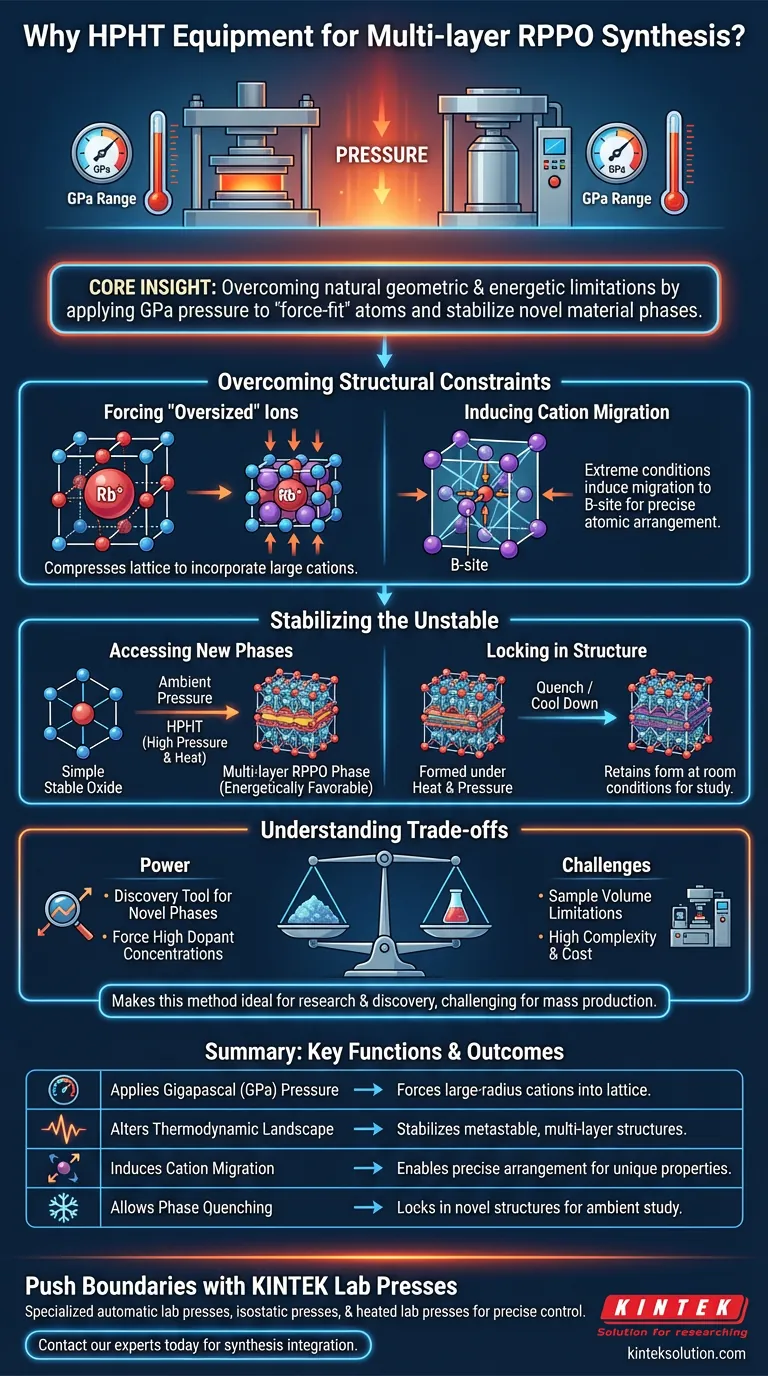
High-temperature and high-pressure (HPHT) equipment is essential for synthesizing specific multi-layer Ruddlesden-Popper perovskite oxides (RPPOs) because it generates extreme static pressure in the gigapascal (GPa) range. This massive compression alters the thermodynamic landscape, forcing large-radius cations into the crystal lattice and stabilizing complex layered structures that would be physically impossible to form or sustain under ambient conditions.
Core Insight: The primary function of this equipment is to overcome the natural geometric and energetic limitations of the crystal lattice. By applying gigapascals of pressure, you can "force-fit" atoms and stabilize novel material phases that normally do not exist in nature.
Overcoming Structural Constraints
To create specific multi-layer RPPOs, you often need to combine elements that do not naturally want to bond in a layered structure. HPHT equipment solves this by physically compressing the material environment.
Forcing "Oversized" Ions into the Lattice
In standard synthesis, large-radius cations (such as Rubidium, Rb⁺) are often too big to fit comfortably into the perovskite structure.
Without high pressure, these atoms would distort the lattice too severely, causing the structure to fail or form a completely different phase.
The application of several GPa compresses the lattice and the ions, forcing these large cations to incorporate into the structure. This "squeeze" effectively stabilizes the material despite the size mismatch.
Inducing Cation Migration
Beyond simple size accommodation, high pressure can alter where atoms sit within the crystal.
Specifically, these extreme conditions can induce cation migration to the B-site of the perovskite structure.
This migration allows for precise manipulation of the atomic arrangement, leading to electronic or magnetic properties that are unattainable when atoms remain in their standard low-pressure positions.
Stabilizing the Unstable
Many advanced multi-layer RPPOs are metastable or thermodynamically unstable at room pressure.
Accessing New Phases
Under ambient pressure, the chemical reaction might naturally prefer to create a simple, stable oxide rather than a complex multi-layer stack.
High pressure changes the energy balance, making the multi-layer RPPO phase the energetically favorable outcome during synthesis.
Locking in Structure
Once formed under heat and pressure, these structures can often be "quenched" or cooled down to retain their form at room conditions.
This process allows researchers to retrieve and study novel phases that would otherwise decompose or rearrange immediately if synthesized without the confining pressure.
Understanding the Trade-offs
While HPHT synthesis is a powerful tool for discovery, it introduces specific challenges that must be managed.
Sample Volume Limitations
Equipment capable of generating gigapascals of pressure usually has a very small sample chamber.
This limits the quantity of material you can produce in a single run, making this method ideal for research and discovery but challenging for mass production.
Complexity and Cost
Operating hot presses or isostatic presses requires specialized safety protocols and significant energy input.
The complexity of controlling two extreme variables (heat and pressure) simultaneously introduces higher risks of equipment failure or inconsistent reproducibility compared to standard solid-state synthesis.
Making the Right Choice for Your Research
The decision to utilize high-pressure synthesis should be driven by the specific structural requirements of your target material.
- If your primary focus is fundamental discovery: Use HPHT to explore novel phases with large cations (like Rb⁺) that theory suggests should have unique properties but are chemically difficult to stabilize.
- If your primary focus is doping efficiency: Utilize this method to force high concentrations of dopants into the B-site, overcoming the solubility limits inherent to standard pressure synthesis.
High pressure is not just a processing tool; it is a thermodynamic variable that redefines what is chemically possible.
Summary Table:
| Key Function | Outcome for RPPO Synthesis |
|---|---|
| Applies Gigapascal (GPa) Pressure | Forces large-radius cations (e.g., Rb⁺) into the lattice |
| Alters Thermodynamic Landscape | Stabilizes metastable, multi-layer structures |
| Induces Cation Migration | Enables precise atomic arrangement for unique properties |
| Allows Phase Quenching | Locks in novel structures for study at ambient conditions |
Ready to push the boundaries of your materials research?
KINTEK specializes in high-performance lab press machines, including automatic lab presses, isostatic presses, and heated lab presses, designed to meet the rigorous demands of synthesizing advanced materials like multi-layer RPPOs. Our equipment provides the precise control over extreme temperature and pressure required to stabilize novel phases and explore new material properties.
Let us help you achieve your next breakthrough. Contact our experts today to discuss how our presses can be integrated into your synthesis workflow.
Visual Guide
Related Products
- Automatic High Temperature Heated Hydraulic Press Machine with Heated Plates for Lab
- Heated Hydraulic Press Machine with Heated Plates for Vacuum Box Laboratory Hot Press
- Automatic Heated Hydraulic Press Machine with Hot Plates for Laboratory
- Heated Hydraulic Press Machine With Heated Plates For Vacuum Box Laboratory Hot Press
- Laboratory Split Manual Heated Hydraulic Press Machine with Hot Plates
People Also Ask
- Function of a Laboratory Hydraulic Press with Heated Platens in SSE? Enhance Battery Density & Conductivity
- How does a laboratory heated hydraulic press facilitate PBN sample prep for WAXS? Achieve Precise X-Ray Scattering
- What are the requirements for electrode pressing with high-viscosity ionic liquids like EMIM TFSI? Optimize Performance
- What are the industrial applications of heated hydraulic presses? Master Heat & Force for Precision Manufacturing
- Why is a laboratory hydraulic press with heating plates required for PLA/TEC films? Achieve Precise Sample Integrity



















