
Hot pressing is the definitive processing step that transforms a loose, spray-coated layer into a functional solid-state electrolyte. Without this step, the membrane remains a porous structure filled with voids left by solvent evaporation, rendering it electrochemically inefficient and mechanically fragile. By applying simultaneous heat and pressure, you force the polymer to flow and bond with ceramic particles, converting a disjointed coating into a dense, high-performance composite.
The core function of hot pressing is to eliminate microscopic defects and maximize interfacial contact, effectively doubling membrane density and increasing ionic conductivity by up to three orders of magnitude.
The Mechanics of Densification
Eliminating Solvent-Induced Voids
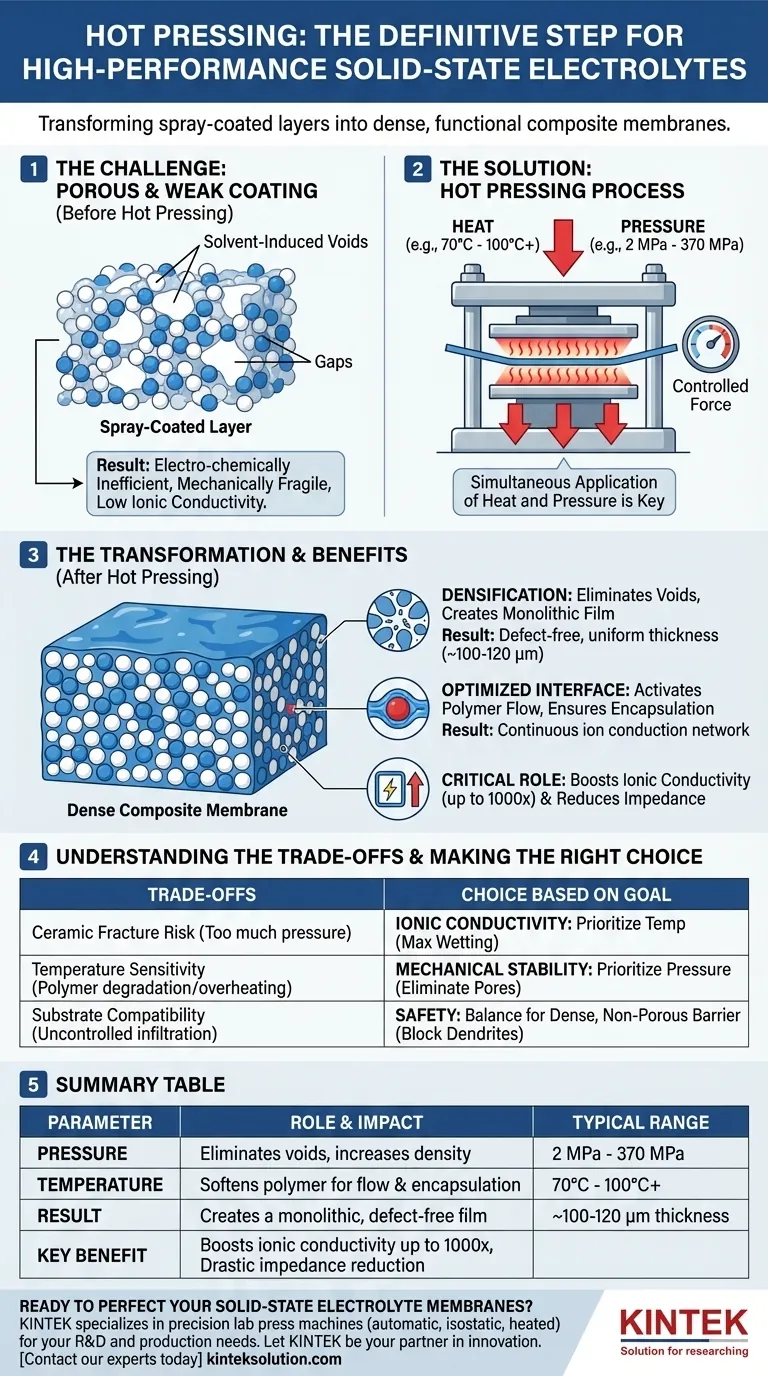
Spray coating involves dissolving polymers and suspending ceramics in a solvent. As the solvent evaporates during drying, it inevitably leaves behind microscopic pores and gaps between layers. Hot pressing applies targeted physical pressure (often ranging from 2 MPa to as high as 370 MPa depending on the system) to collapse these voids completely.
Creating a Monolithic Film
The goal is to transition from a stacked, layered structure to a single, cohesive unit. This densification prevents internal micro-short circuits by removing the empty spaces where dendrites could easily propagate. The result is a defect-free film with uniform thickness, often in the range of 100-120 micrometers.
Optimizing the Polymer-Ceramic Interface
Activating Polymer Flow
Heat is the catalyst for microstructural change. By raising the temperature (e.g., to 70°C or 100°C), the process melts or softens the thermoplastic polymer matrix (such as PEO). This significantly reduces the polymer's viscosity, transforming it from a rigid solid into a flowable material.
Ensuring Complete Encapsulation
Once the polymer is softened, the applied pressure forces it to infiltrate the interstitial spaces between ceramic particles. This ensures the polymer fully wets the filler surface, encapsulating the ceramic (like LLZTO) rather than just sitting next to it. This creates a tight physical bond that solvent casting alone cannot achieve.
Overcoming Interface Resistance
The primary barrier to performance in composite electrolytes is the high resistance at the solid-solid interface. By mechanically forcing the polymer and ceramic into intimate contact, hot pressing establishes a continuous ion conduction network. This connectivity is responsible for the drastic reduction in impedance and the massive boost in room-temperature conductivity.
Understanding the Trade-offs
The Risk of Ceramic Fracture
While high pressure is necessary for densification, there is a distinct upper limit. Applying excessive pressure to a composite with high ceramic loading can fracture the brittle ceramic particles. This disconnects the ion pathways you are trying to create and degrades electrochemical performance.
Temperature Sensitivity
The temperature must be precisely tuned to the polymer’s properties. It must be high enough to melt crystalline regions and induce flow, but strictly controlled to prevent thermal degradation of the polymer or the lithium salts. Overheating can compromise the mechanical integrity of the resulting film.
Substrate Compatibility
When densifying a film on a porous substrate, the pressure forces the slurry to infiltrate the substrate's voids. While this improves adhesion and interface quality, uncontrolled infiltration can lead to unpredictable electrolyte thickness or shorting against the underlying current collector.
Making the Right Choice for Your Goal
Hot pressing is not a passive drying step; it is an active manufacturing parameter that defines your material's final properties.
- If your primary focus is Ionic Conductivity: Prioritize temperatures that fully melt the polymer crystalline phase to ensure maximum wetting of the ceramic particles, minimizing interfacial resistance.
- If your primary focus is Mechanical Stability: Focus on pressure optimization to eliminate all internal pores and voids, ensuring a robust, flexible film that resists delamination.
- If your primary focus is Safety: Ensure the pressing duration and pressure are sufficient to create a fully dense, non-porous barrier that physically blocks lithium dendrite growth.
By mastering the variables of heat and pressure, you turn a simple mixture of powders and binders into a unified, conductive system capable of powering next-generation batteries.
Summary Table:
| Hot Pressing Parameter | Role & Impact | Typical Range |
|---|---|---|
| Pressure | Eliminates solvent-induced voids, increases density | 2 MPa - 370 MPa |
| Temperature | Softens polymer for flow and encapsulation | 70°C - 100°C+ |
| Result | Creates a monolithic, defect-free film | ~100-120 µm thickness |
| Key Benefit | Boosts ionic conductivity by up to 1000x | Drastic reduction in impedance |
Ready to perfect your solid-state electrolyte membranes?
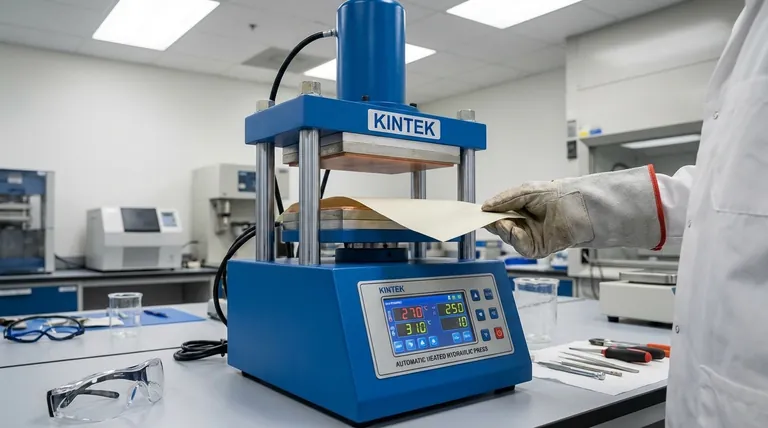
KINTEK specializes in precision lab press machines, including automatic lab presses, isostatic presses, and heated lab presses, designed to deliver the exact pressure and temperature control required for your R&D and production. Our equipment helps you achieve the high-density, defect-free films essential for superior ionic conductivity and mechanical stability.
Let KINTEK be your partner in innovation. Contact our experts today to find the ideal press for your laboratory's needs!
Visual Guide
Related Products
- Automatic High Temperature Heated Hydraulic Press Machine with Heated Plates for Lab
- Heated Hydraulic Press Machine with Heated Plates for Vacuum Box Laboratory Hot Press
- Automatic Heated Hydraulic Press Machine with Hot Plates for Laboratory
- Heated Hydraulic Press Machine With Heated Plates For Vacuum Box Laboratory Hot Press
- Laboratory Split Manual Heated Hydraulic Press Machine with Hot Plates
People Also Ask
- Function of a Laboratory Hydraulic Press with Heated Platens in SSE? Enhance Battery Density & Conductivity
- What are the requirements for electrode pressing with high-viscosity ionic liquids like EMIM TFSI? Optimize Performance
- How does a laboratory heated hydraulic press facilitate PBN sample prep for WAXS? Achieve Precise X-Ray Scattering
- What are the industrial applications of heated hydraulic presses? Master Heat & Force for Precision Manufacturing
- Why is a laboratory hydraulic press with heating plates required for PLA/TEC films? Achieve Precise Sample Integrity



















