
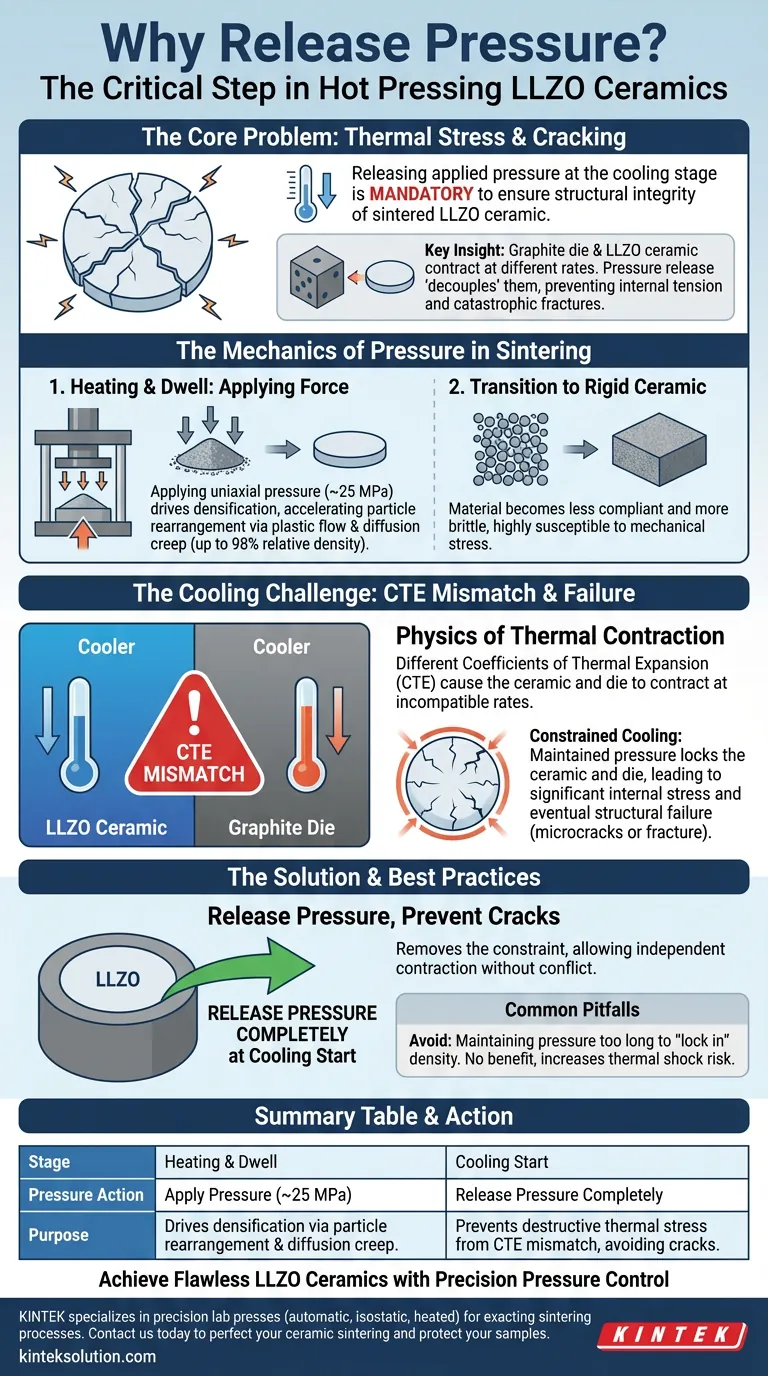
Releasing the applied pressure at the onset of the cooling phase is a mandatory step to ensure the structural integrity of the sintered LLZO ceramic. The LLZO material and the graphite die utilized in hot pressing possess different coefficients of thermal expansion. If mechanical pressure is maintained while the temperature drops, this discrepancy causes the materials to contract at incompatible rates, leading to destructive thermal stress and cracking.
The graphite die and the LLZO ceramic shrink at different speeds during cooling. Releasing pressure effectively "decouples" these materials, preventing the buildup of internal tension that causes microcracks and catastrophic fractures in the densified sample.
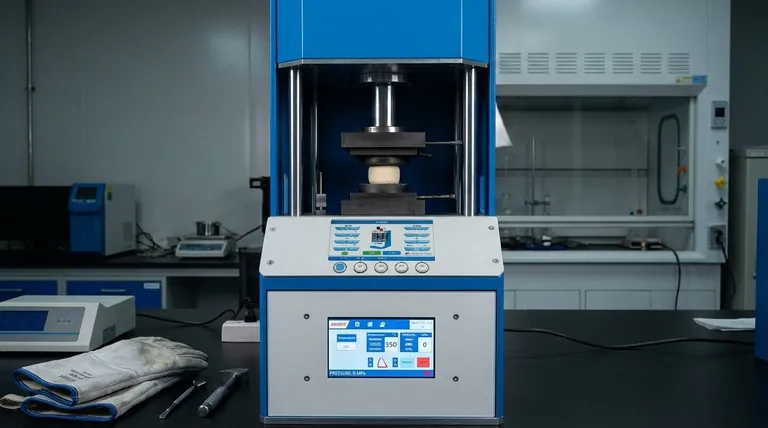
The Mechanics of Pressure in Sintering
The Role of Applied Force
During the heating and dwell stages, applying uniaxial pressure (typically around 25 MPa) is the primary driver for densification. This mechanical force accelerates the rearrangement of powder particles and increases the contact area between them. By activating mass transport mechanisms like plastic flow and diffusion creep, this pressure allows the material to reach relative densities approaching 98% much faster than pressureless methods.
The Transition to Rigid Ceramic
While pressure is beneficial for compacting the powder, its role changes once densification is complete. The material transforms from a granular powder into a solid, dense ceramic body. At this stage, the material becomes significantly less compliant and more brittle, making it susceptible to mechanical stress.
The Physics of Thermal Contraction
Coefficient of Thermal Expansion (CTE) Mismatch
The core issue during cooling is the difference in the coefficient of thermal expansion between the LLZO ceramic and the graphite die. These two distinct materials respond to temperature changes physically in different ways. As the system cools from the sintering temperature, both materials naturally attempt to shrink, but they do so to different degrees.
The Consequence of Constrained Cooling
If the hydraulic press continues to exert force, it locks the ceramic and the die together physically. Because they are contracting at different rates, significant internal stress begins to build up at the interface of the materials. The rigid LLZO ceramic cannot deform to accommodate this stress.
Resulting Structural Failure
When the internal thermal stress exceeds the material's strength, the energy is released through fracture. This manifests as either microcracks, which compromise the electrochemical performance, or a complete fracture of the sample. Releasing the pressure removes the constraint, allowing the ceramic and the die to contract independently without conflict.
Common Pitfalls to Avoid
Misjudging the Release Timing
A common error is maintaining pressure too long into the cooling ramp in an attempt to "lock in" density. This is unnecessary because the densification mechanisms (diffusion and flow) effectively cease once the temperature drops significantly. Holding pressure provides no further benefit and only introduces the risk of thermal shock and stress fractures.
Ignoring Pre-Sintering Conditions
While cooling pressure is critical for crack prevention, density is also influenced by pre-sintering treatment. Using a heated lab press at moderate temperatures (e.g., 80°C) on the green body can improve initial particle contact. However, no amount of pre-treatment will save a sample that is subjected to mechanical stress during the cooling phase of the final sinter.
Making the Right Choice for Your Process
To achieve a dense, crack-free LLZO ceramic, you must balance the need for pressure during heating with the need for relaxation during cooling.
- If your primary focus is Maximizing Density: Apply constant uniaxial pressure (e.g., 25 MPa) during the heating and dwell phases to activate diffusion creep and particle rearrangement.
- If your primary focus is Preventing Cracks: Completely release the mechanical load immediately as the cooling ramp begins to isolate the ceramic from the die's thermal contraction.
By adhering to this pressure release protocol, you protect the dense microstructure you worked to create, ensuring a high-quality final ceramic sheet.
Summary Table:
| Stage | Pressure Action | Purpose |
|---|---|---|
| Heating & Dwell | Apply Pressure (~25 MPa) | Drives densification via particle rearrangement and diffusion creep. |
| Cooling Start | Release Pressure Completely | Prevents destructive thermal stress from CTE mismatch, avoiding cracks. |
Achieve flawless, dense LLZO ceramics with precise pressure control. The correct hot pressing protocol is essential for success. KINTEK specializes in lab press machines (including automatic, isostatic, and heated lab presses) designed for exacting laboratory sintering processes. Our equipment provides the reliable control you need to perfect your ceramic sintering. Contact us today to discuss how our solutions can enhance your lab's capabilities and protect your valuable samples. Get in touch with our experts
Visual Guide
Related Products
- Automatic High Temperature Heated Hydraulic Press Machine with Heated Plates for Lab
- Laboratory Manual Heated Hydraulic Press Machine with Hot Plates
- Lab Heat Press Special Mold
- Laboratory Split Manual Heated Hydraulic Press Machine with Hot Plates
- Automatic Heated Hydraulic Press Machine with Hot Plates for Laboratory
People Also Ask
- Function of a Laboratory Hydraulic Press with Heated Platens in SSE? Enhance Battery Density & Conductivity
- What are the requirements for electrode pressing with high-viscosity ionic liquids like EMIM TFSI? Optimize Performance
- How does a laboratory heated hydraulic press facilitate PBN sample prep for WAXS? Achieve Precise X-Ray Scattering
- What are the industrial applications of heated hydraulic presses? Master Heat & Force for Precision Manufacturing
- Why is a laboratory hydraulic press with heating plates required for PLA/TEC films? Achieve Precise Sample Integrity













