
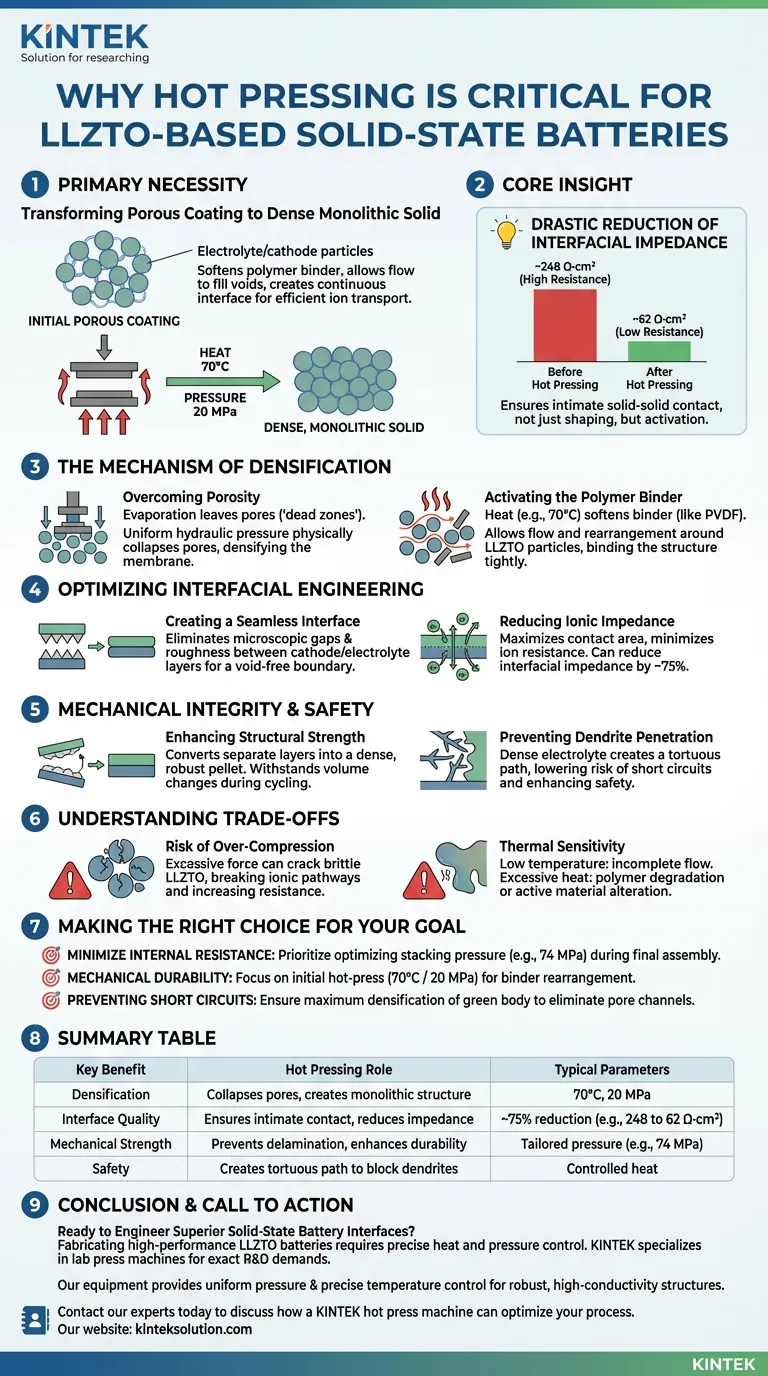
The primary necessity of using a hot press machine in this context is to transform a loose, porous coating into a dense, monolithic solid through the simultaneous application of heat and mechanical force. By applying specific conditions—such as 70°C and 20 MPa—you soften the polymer binder within the composite, allowing it to flow and fill microscopic voids left by solvent evaporation. This creates a continuous, void-free interface essential for efficient ion transport.
Core Insight: The performance of solid-state batteries is often limited by high resistance at the solid-solid interfaces. Hot pressing is not merely a shaping step; it is a critical activation process that drastically reduces interfacial impedance (e.g., from ~248 Ω·cm² to ~62 Ω·cm²) by ensuring intimate physical contact between the cathode and the solid electrolyte.
The Mechanism of Densification
Overcoming Porosity
When an electrolyte/cathode composite is initially coated, the evaporation of solvents leaves behind large pores and a relatively loose structure.
Without treatment, this porosity creates "dead zones" where ions cannot travel.
A hot press utilizes a hydraulic mechanism to apply uniform pressure, physically collapsing these pores and densifying the membrane.
Activating the Polymer Binder
In LLZTO/PVDF composite electrolytes, the application of heat is just as critical as the pressure.
The heat (typically around 70°C) softens the polymer binder (such as PVDF).
This induced softening allows the polymer to flow and rearrange itself around the rigid LLZTO ceramic fillers, tightly binding the structure into a cohesive unit.
Optimizing Interfacial Engineering
Creating a Seamless Interface
The "solid-solid" interface is the most vulnerable point in a solid-state battery.
Unlike liquid electrolytes that wet surfaces naturally, solid layers require force to achieve contact.
Hot pressing eliminates the microscopic gaps and surface roughness between the cathode and electrolyte layers, creating a seamless, void-free boundary.
Reducing Ionic Impedance
The elimination of physical gaps has a direct correlation to electrochemical performance.
By maximizing the contact area between particles, you minimize the resistance ions face when moving between layers.
References indicate that this optimization can reduce interfacial impedance by approximately 75%, which is a prerequisite for achieving high-rate capability and cycling stability.
Mechanical Integrity and Safety
Enhancing Structural Strength
A loose composite structure is mechanically weak and prone to delamination during battery cycling.
The hot-pressing process converts the separate layers into a physically dense, bilayer, or monolithic pellet.
This increased mechanical strength is vital for withstanding the volume changes that occur during charging and discharging.
Preventing Dendrite Penetration
High density is a defensive mechanism against failure.
A denser electrolyte body, achieved through proper pressing (and potentially subsequent sintering for green bodies), creates a tortuous path that is difficult for lithium dendrites to penetrate.
This significantly lowers the risk of short circuits, enhancing the overall safety profile of the battery.
Understanding the Trade-offs
The Risk of Over-Compression
While high pressure (up to 380 MPa in cold pressing scenarios) reduces voids, excessive force can damage the materials.
Applying too much pressure to a brittle ceramic like LLZTO can cause particle cracking or pulverization.
This structural damage effectively breaks the ionic pathways you are trying to create, leading to increased resistance rather than decreased.
Thermal Sensitivity
The temperature must be precisely controlled to match the binder's properties.
If the temperature is too low, the binder will not flow sufficiently to fill the voids.
Conversely, excessive heat could degrade the polymer component or alter the cathode's active material structure before the battery is even cycled.
Making the Right Choice for Your Goal
To maximize the efficacy of your hot-pressing stage, you must tailor the parameters to your specific material composition.
- If your primary focus is minimizing internal resistance: Prioritize optimizing the "stacking pressure" (around 74 MPa) during final assembly to ensure the most intimate solid-solid contact possible.
- If your primary focus is mechanical durability: Focus on the initial hot-press of the composite membrane (70°C / 20 MPa) to ensure the polymer binder has fully rearranged to lock the LLZTO particles in place.
- If your primary focus is preventing short circuits: Ensure maximum densification of the green body prior to sintering to eliminate pore channels that facilitate dendrite growth.
Success in fabricating LLZTO-based batteries relies on viewing the hot press not as a manufacturing tool, but as a precise instrument for interface engineering.
Summary Table:
| Key Benefit | Hot Pressing Role | Typical Parameters |
|---|---|---|
| Densification | Collapses pores, creates monolithic structure | 70°C, 20 MPa |
| Interface Quality | Ensures intimate contact, reduces impedance | ~75% reduction (e.g., 248 to 62 Ω·cm²) |
| Mechanical Strength | Prevents delamination, enhances durability | Tailored pressure (e.g., 74 MPa for assembly) |
| Safety | Creates tortuous path to block dendrites | Controlled heat to avoid material degradation |
Ready to Engineer Superior Solid-State Battery Interfaces?
Fabricating high-performance LLZTO-based batteries requires precise control over heat and pressure to achieve the dense, low-impedance interfaces critical for success. KINTEK specializes in lab press machines, including automatic, isostatic, and heated lab presses, designed to meet the exacting demands of laboratory research and development.
Our equipment provides the uniform pressure and precise temperature control necessary to transform your electrolyte/cathode composites into robust, high-conductivity structures, helping you overcome the challenges of solid-solid interfaces.
Contact our experts today to discuss how a KINTEK hot press machine can optimize your solid-state battery fabrication process and accelerate your research.
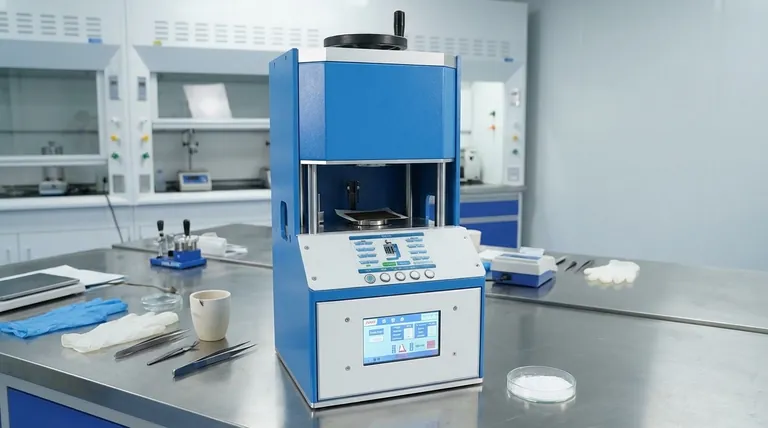
Visual Guide
Related Products
- Automatic High Temperature Heated Hydraulic Press Machine with Heated Plates for Lab
- Heated Hydraulic Press Machine with Heated Plates for Vacuum Box Laboratory Hot Press
- Automatic Heated Hydraulic Press Machine with Hot Plates for Laboratory
- Heated Hydraulic Press Machine With Heated Plates For Vacuum Box Laboratory Hot Press
- Laboratory Split Manual Heated Hydraulic Press Machine with Hot Plates
People Also Ask
- Function of a Laboratory Hydraulic Press with Heated Platens in SSE? Enhance Battery Density & Conductivity
- What are the requirements for electrode pressing with high-viscosity ionic liquids like EMIM TFSI? Optimize Performance
- How does a laboratory heated hydraulic press facilitate PBN sample prep for WAXS? Achieve Precise X-Ray Scattering
- What are the industrial applications of heated hydraulic presses? Master Heat & Force for Precision Manufacturing
- Why is a laboratory hydraulic press with heating plates required for PLA/TEC films? Achieve Precise Sample Integrity



















