
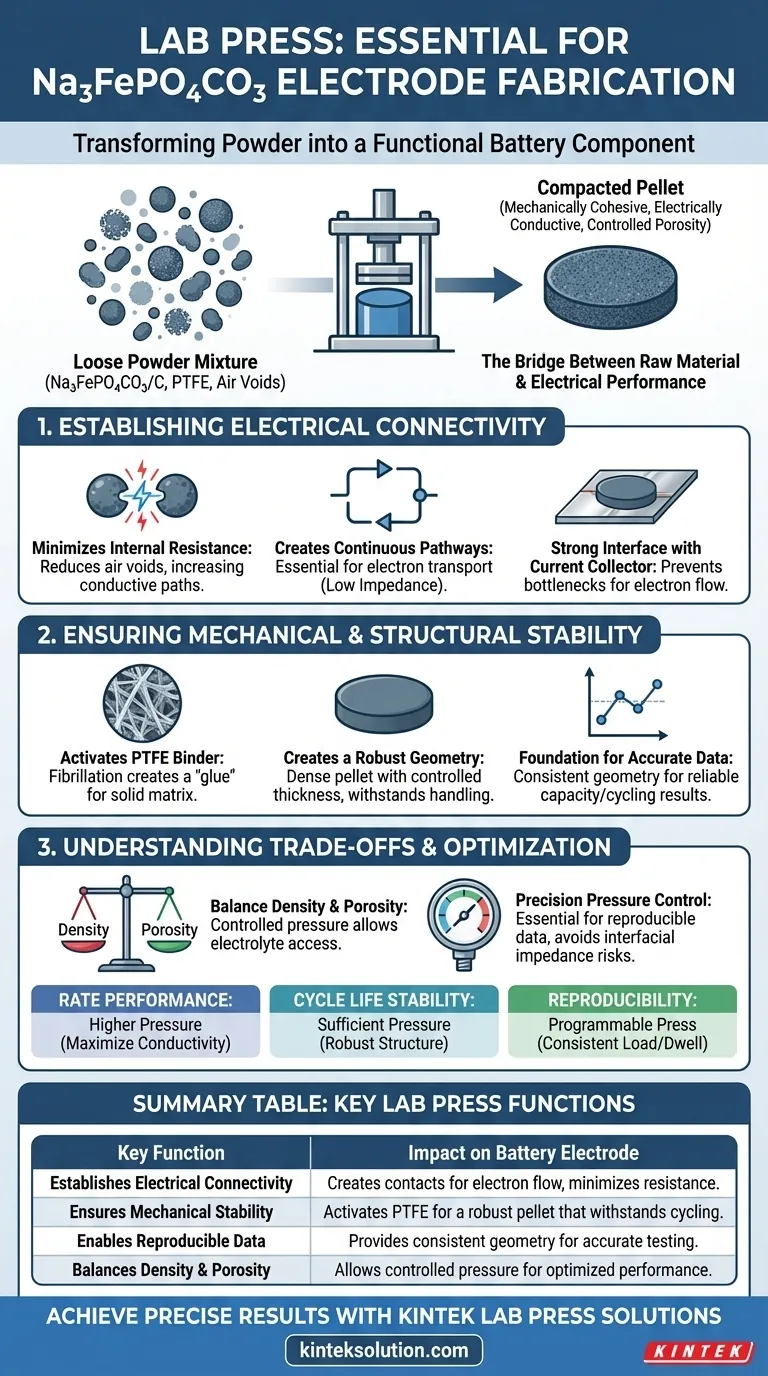
Using a lab press is not merely a shaping step; it is a fundamental requirement for electrochemical functionality. Compacting the Na3FePO4CO3/C and PTFE mixture transforms a loose, non-conductive powder into a mechanically cohesive and electrically conductive solid. Without this compression, the material lacks the necessary particle-to-particle connectivity to transport electrons, rendering reliable battery performance testing impossible.
The pressing process acts as the bridge between raw material chemistry and observable electrical performance. It establishes the physical network required for electron flow and structural integrity, directly determining the accuracy of your capacity, rate, and cycling data.
Establishing Electrical Connectivity
Minimizing Internal Resistance
Loose powders contain significant void spaces filled with air, which acts as an electrical insulator. By applying pressure, you force the active material (Na3FePO4CO3) and conductive carbon closer together.
Creating Continuous Pathways
This compaction creates a continuous conductive network essential for electron transport. Without these intimate particle-to-particle contacts, the internal resistance (impedance) of the electrode would be too high to sustain a functional current.
Interface with the Current Collector
The pressing process also secures the bond between the electrode material and the current collector (often a metal mesh or foil). A weak interface here creates a bottleneck for electron flow, severely degrading the battery's observed performance.
Ensuring Mechanical and Structural Stability
Activating the Binder
The PTFE binder in your mixture relies on mechanical force to function effectively. Pressing fibrillates the PTFE, allowing it to act as a "glue" that holds the active material and carbon particles in a solid matrix.
Creating a Robust Geometry
A lab press forms a dense, circular pellet with a controlled thickness. This mechanically stable structure ensures the electrode does not disintegrate when exposed to the electrolyte or during the physical handling required for cell assembly.
Foundation for Accurate Data
To precisely evaluate charge-discharge capacity or cycling stability, the electrode geometry must remain constant. A pressed pellet provides a reliable physical foundation, ensuring that performance fluctuations are due to the material's chemistry, not mechanical failure.
Understanding the Trade-offs
The Balance of Density and Porosity
While density is critical for contact, the "more is better" approach has limits. As indicated by air cathode fabrication principles, a pellet must retain specific controlled porosity to allow the electrolyte to penetrate and access the active material.
Precision Pressure Control
Using a lab press allows for exact pressure application (e.g., specific MPa values). Inconsistent manual pressure leads to variable pellet densities, which causes inconsistent ionic transport pathways and makes experimental data unreproducible.
Interfacial Impedance Risks
Inadequate pressure fails to minimize interfacial impedance, while excessive pressure might crush the material or close off pore pathways. Establishing the optimal pressure protocol is key to realizing the battery's electrochemical potential without damaging the structure.
Making the Right Choice for Your Goal
If your primary focus is Rate Performance: Prioritize higher pressure to maximize electrical conductivity and minimize the distance electrons must travel between particles.
If your primary focus is Cycle Life Stability: Ensure the pressure is sufficient to create a robust structure that will not degrade or detach from the current collector during repeated volume expansion and contraction.
If your primary focus is Reproducibility: Use a programmable lab press to apply the exact same pressure load and dwell time for every single pellet to eliminate fabrication variables.
A precisely compacted pellet ensures that your test results reflect the true capabilities of your chemistry, rather than the flaws of your fabrication.
Summary Table:
| Key Function of Lab Press | Impact on Battery Electrode |
|---|---|
| Establishes Electrical Connectivity | Creates particle-to-particle contacts for electron flow, minimizing internal resistance. |
| Ensures Mechanical Stability | Activates the PTFE binder to form a robust, solid pellet that withstands handling and cycling. |
| Enables Reproducible Data | Provides a consistent geometric foundation for accurate capacity, rate, and cycle life testing. |
| Balances Density & Porosity | Allows for controlled pressure to optimize both conductivity and electrolyte access. |
Ready to achieve precise and reproducible results for your sodium-ion battery research?
KINTEK specializes in lab press machines (including automatic, isostatic, and heated lab presses) designed to meet the exacting demands of laboratory electrode fabrication. Our presses provide the precise pressure control you need to create pellets with optimal electrical connectivity and mechanical stability, ensuring your test data accurately reflects your material's performance.
Let us help you eliminate fabrication variables and focus on your chemistry. Contact our experts today to find the perfect lab press for your needs!
Visual Guide
Related Products
- Laboratory Hydraulic Press 2T Lab Pellet Press for KBR FTIR
- 24T 30T 60T Heated Hydraulic Lab Press Machine with Hot Plates for Laboratory
- Manual Heated Hydraulic Lab Press with Integrated Hot Plates Hydraulic Press Machine
- Laboratory Hydraulic Press Lab Pellet Press Button Battery Press
- Laboratory Hydraulic Pellet Press for XRF KBR FTIR Lab Press
People Also Ask
- What is the role of a laboratory pressure machine and KBr in FTIR? Master Sample Preparation for Flame Retardants
- What is the role of a laboratory hydraulic press in high-loading NCM811 cathode prep for solid-state batteries?
- Why is a laboratory hydraulic press necessary for sample preparation? Precise Pelleting for Spiro Heterocyclic Analysis
- What role does a laboratory hydraulic press play in reaction pellets? Optimizing Lunar Soil and Metal Fuel Density
- Why is a laboratory hydraulic press used with a mold for FTIR of shellac nanofibers? Achieve High-Fidelity Spectra



















