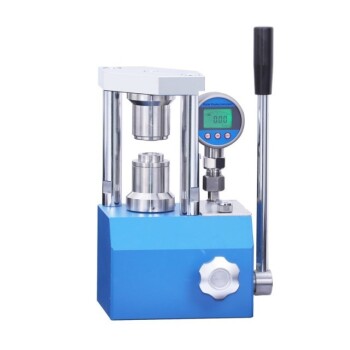
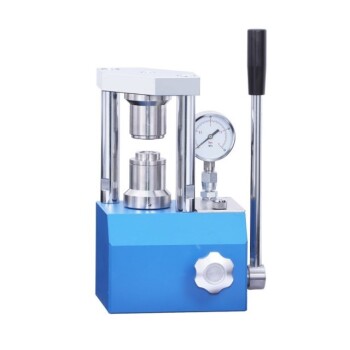
Precision in assembly translates directly to data reliability. Laboratory-grade button cell assembly equipment is essential because it provides the uniform and repeatable encapsulation pressure necessary to create a consistent interface between the lithium metal anode, functional interlayers, and cathode materials. Without this mechanical consistency, variable contact resistance will distort your data, making it impossible to accurately evaluate critical metrics like redox kinetics and cycling stability.
To isolate the true chemical performance of a material, you must first eliminate mechanical variables. Laboratory-grade equipment ensures that experimental data reflects the actual efficacy of functional interlayers in suppressing shuttle effects, rather than inconsistencies in the cell's physical assembly.
The Mechanics of Data Integrity
Achieving Uniform Encapsulation Pressure
The primary function of laboratory-grade equipment, such as precision sealing machines and manual lab presses, is to apply exact, repeatable force.
This ensures a tight, uniform bond between the internal components—specifically the lithium metal anode, the separator, and the cathode.
Eliminating Variable Contact Resistance
Inconsistent assembly pressure leads to fluctuating internal contact resistance.
By standardizing the sealing process, high-precision equipment minimizes these physical inconsistencies.
This ensures that any measured changes in impedance or voltage are due to the electrochemical properties of the materials, not poor physical contact.
Evaluating Advanced Battery Chemistries
Verifying Functional Interlayers
In lithium-sulfur and lithium-organic batteries, functional interlayers are often introduced to solve specific problems like the shuttle effect.
Precise assembly is required to ensure these interlayers are integrated seamlessly into the stack.
Only with a perfect mechanical interface can you accurately measure the interlayer's ability to suppress polysulfide shuttling.
Measuring True Redox Kinetics
Accurate data on redox kinetics requires a stable electrochemical environment.
Laboratory-grade assembly guarantees that the internal architecture of the cell remains stable during cycling.
This allows researchers to attribute accelerated kinetics directly to material improvements, rather than improved contact area from a "lucky" manual crimp.
Understanding the Trade-offs
The Scope of Button Cells vs. Pouch Cells
While laboratory-grade button cell equipment is superior for fundamental material verification, it has limitations regarding real-world application.
Button cells generally do not reflect the volumetric and mass energy densities required for commercial products.
The Role of Pouch Cell Assembly
As noted in supplementary contexts, pouch cell equipment is better suited for simulating industrial scenarios.
Pouch cells incorporate non-active components like current collectors and packaging to mimic real-world stacks.
However, for initial material screening—especially involving high sulfur loading or thin electrolytes—button cells remain the standard for establishing baseline chemical validity.
Making the Right Choice for Your Goal
To maximize the value of your equipment, align your choice with your current development phase:
- If your primary focus is Fundamental Material Verification: Use laboratory-grade button cell equipment to ensure that data regarding shuttle effect suppression and redox kinetics is chemically accurate and mechanically reproducible.
- If your primary focus is Industrial Transition: Move toward pouch cell assembly equipment to accurately simulate real-world energy densities and assess the viability of multi-layer stacked structures.
Success in battery research depends on ensuring your assembly method matches the precision required by your chemistry.
Summary Table:
| Feature | Laboratory-Grade Equipment | Manual/Inconsistent Assembly |
|---|---|---|
| Pressure Control | Precise, repeatable encapsulation | Variable and inconsistent |
| Contact Resistance | Minimized and standardized | High and fluctuating |
| Data Reliability | High; reflects chemical properties | Low; distorted by physical defects |
| Interlayer Evaluation | Seamless integration for shuttle suppression | Poor interface masking true efficacy |
| Primary Use | Fundamental material verification | Not recommended for research |
Elevate Your Battery Research with KINTEK Precision
Don't let mechanical inconsistencies compromise your breakthrough. KINTEK specializes in comprehensive laboratory pressing solutions tailored for high-stakes battery research. Whether you are developing lithium-sulfur interlayers or evaluating redox kinetics, our range of manual, automatic, heated, and glovebox-compatible presses—alongside our specialized cold and warm isostatic presses—ensure the mechanical integrity your data demands.
Ready to achieve repeatable, publication-quality results? Contact KINTEK Today to Find Your Pressing Solution
References
- Woongsik Choi, Moon Jeong Park. Ice‐Templated Synthesis of Mixed Ion‐Electron Conductors for Functional Interlayers in Lithium Batteries. DOI: 10.1002/cssc.202501138
This article is also based on technical information from Kintek Solution Knowledge Base .
Related Products
- Lab Button Battery Tablet Press Sealing Mold
- Lab Button Battery Disassembly and Sealing Mold
- Button Battery Sealing Press Machine for Lab
- Button Battery Sealing Machine for Button Batteries
- Manual Button Battery Sealing Machine for Battery Sealing
People Also Ask
- How does a sealed battery mold facilitate the assembly and testing of asymmetric supercapacitors using VO2?
- Why use standardized CR2032 components & high-precision presses? Ensure reliability in lithium metal battery research.
- Why is a laboratory battery sealing press essential for desolvation energy testing? Ensure Reliable Kinetic Data
- What is the function of specialized battery molds and sealing consumables? Optimize Your In-situ XRD Testing Today
- What role does a laboratory sealing press play in thermal analysis of solid dispersion films? Ensure Data Integrity