The application of precise and constant pressure is the fundamental requirement for overcoming the inherent physical limitations of solid-state battery materials. Unlike liquid electrolytes, which naturally wet and conform to electrode surfaces, solid components are rigid and rough; they require significant external force to establish the intimate, void-free contact necessary for efficient lithium-ion transport.
The core challenge of solid-state batteries is the "solid-solid interface." Without sustained pressure, microscopic gaps prevent ion flow and volumetric changes cause layers to separate. Pressure is not merely a variable; it is the structural glue that ensures low impedance and prevents immediate performance failure.
Solving the Solid-Solid Interface Challenge
The primary role of pressure in solid-state cells is to mechanically force two rigid materials into a unified electrochemical system.
Eliminating Physical Voids
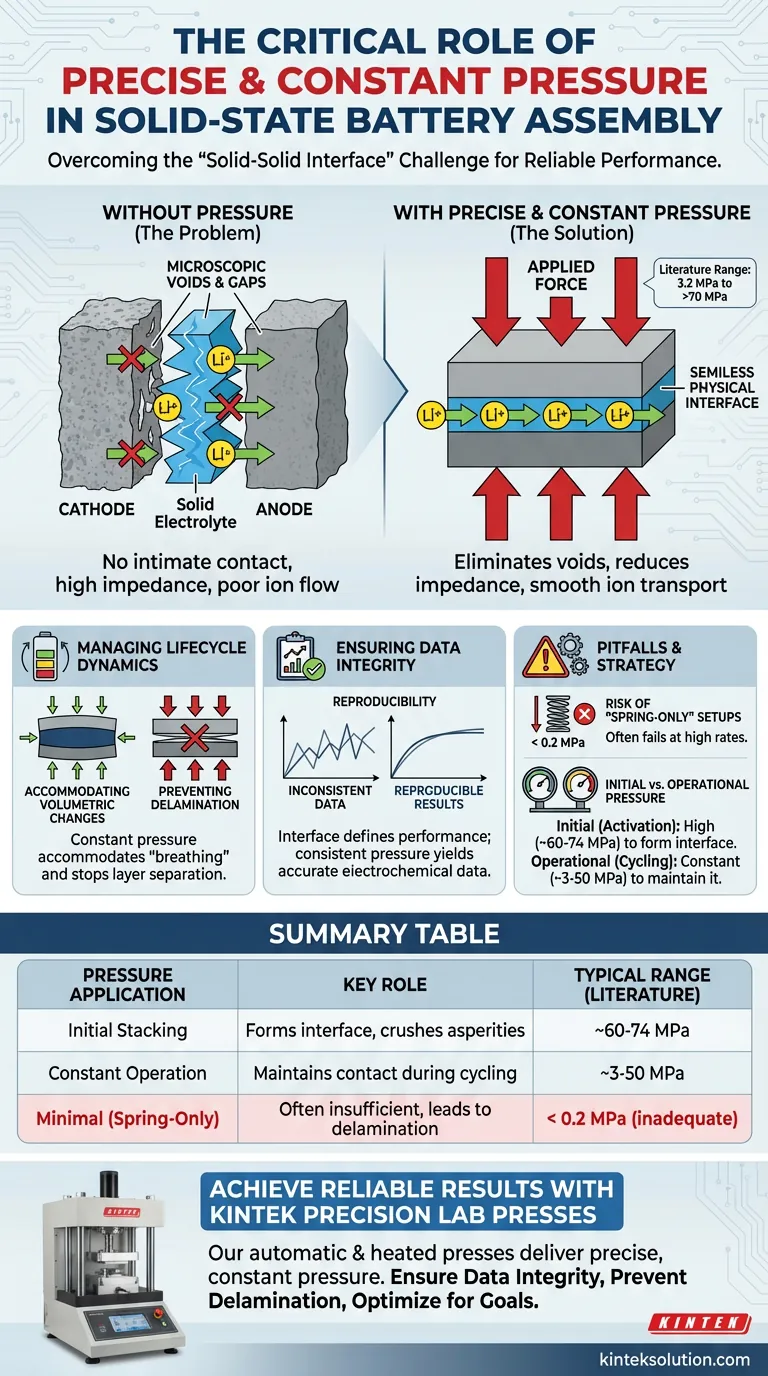
Microscopic gaps naturally exist between the cathode, solid electrolyte, and anode due to surface roughness. A laboratory press applies force (examples in literature range from 3.2 MPa to over 70 MPa) to eliminate these voids.
This creates a seamless physical interface, ensuring that particles establish continuous contact. Without this, the "active area" of the battery is significantly reduced, limiting performance before testing even begins.
Reducing Interfacial Impedance
The direct result of eliminating voids is a drastic reduction in contact resistance.
For lithium ions to move from the electrode into the electrolyte, they must physically cross this boundary. High, uniform pressure minimizes the impedance at this junction, enabling the smooth transport of lithium ions essential for high-rate performance.
Managing Lifecycle Dynamics
Pressure is not only required during assembly; it must be maintained constantly during operation to preserve the cell's integrity.
Accommodating Volumetric Changes
Electrodes "breathe" during operation—they expand and contract as lithium ions enter and exit the structure.
A constant stack pressure accommodates these volumetric changes. It ensures that even as the materials shift and swell, the electrical connection remains unbroken.
Preventing Delamination
If pressure is insufficient or fluctuating, the expansion and contraction of materials can lead to delamination, where the layers physically separate.
References indicate that cells relying on minimal spring pressure (e.g., less than 0.2 MPa) suffer from rapid capacity decay. Conversely, controlled pressure maintains the mechanical integrity of the layers, which is a prerequisite for a long cycle life.
Ensuring Data Integrity
For researchers, the application of pressure is a matter of data validity.
Reproducibility of Results
Because the interface defines performance, inconsistent pressure leads to inconsistent data.
Using a laboratory press to apply precise force ensures that the electrochemical performance data—such as ionic conductivity and cycling stability—reflects the true chemistry of the materials, rather than artifacts of poor assembly.
Common Pitfalls to Avoid
While pressure is vital, how it is applied matters just as much as the amount applied.
The Risk of "Spring-Only" Setups
It is a common pitfall to rely on simple springs which may provide insufficient force (often < 0.2 MPa).
Data shows that while this may work for initial connectivity, it often fails to suppress interfacial delamination at high rates. A dedicated pressure apparatus is often required to maintain the stability needed for rigorous testing.
Distinguishing Initial vs. Operational Pressure
It is critical to distinguish between the pressure required to form the interface and the pressure required to maintain it.
You may need a significantly higher initial stacking pressure (e.g., ~60-74 MPa) to crush surface asperities and "activate" the battery, compared to a lower but steady operating pressure (e.g., ~3-50 MPa) to maintain contact during cycling.
Making the Right Choice for Your Goal
The specific pressure strategy you employ should depend on the phase of your testing.
- If your primary focus is Cell Activation: Apply high initial pressure (e.g., 60-74 MPa) to minimize voids and ensure the lowest possible initial internal resistance.
- If your primary focus is Long-Term Cycling: Prioritize a constant, regulated pressure apparatus that can accommodate electrode swelling without allowing the pressure to drop below critical thresholds.
- If your primary focus is High-Rate Performance: Avoid minimal spring pressure; ensure the setup can maintain intimate particle contact (approx. 3.2 MPa or higher) to prevent impedance spikes during rapid discharge.
Ultimately, treating pressure as a critical assembly parameter rather than an afterthought is the only way to achieve accurate, reproducible solid-state battery data.
Summary Table:
| Pressure Application | Key Role | Typical Range (Literature) |
|---|---|---|
| Initial Stacking | Forms interface, crushes asperities | ~60-74 MPa |
| Constant Operation | Maintains contact during cycling | ~3-50 MPa |
| Minimal (Spring-Only) | Often insufficient, leads to delamination | < 0.2 MPa (inadequate) |
Achieve reliable solid-state battery test results with KINTEK's precision lab press solutions.
Our automatic lab presses and heated lab presses are engineered to deliver the precise, constant pressure required for assembling solid-state test cells. This ensures the intimate particle contact necessary to eliminate voids, reduce interfacial impedance, and accommodate volumetric changes during cycling—directly addressing the core challenges outlined in this article.
By using a KINTEK press, researchers in laboratory settings can:
- Ensure Data Integrity: Generate accurate, reproducible electrochemical performance data.
- Prevent Delamination: Maintain mechanical integrity for long cycle life testing.
- Optimize for Specific Goals: Whether your focus is cell activation, long-term cycling, or high-rate performance.
Stop relying on inadequate spring setups. Let KINTEK's expertise in lab press machines become the foundation of your solid-state battery research.
Contact us today to discuss your specific pressure requirements and how our solutions can enhance your R&D workflow.
Visual Guide
References
- Zehui Zhao, Peng Tan. Quasi/All Solid‐State Electrolytes for Lithium–Carbon Dioxide Batteries. DOI: 10.1002/cnl2.70026
This article is also based on technical information from Kintek Solution Knowledge Base .
Related Products
- Warm Isostatic Press for Solid State Battery Research Warm Isostatic Press
- Lab Button Battery Tablet Press Sealing Mold
- Lab Infrared Press Mold for Laboratory Applications
- Button Battery Sealing Press Machine for Lab
- Laboratory Hydraulic Press Lab Pellet Press Button Battery Press
People Also Ask
- Why must composite cathodes be sealed in vacuum lamination bags for WIP? Ensure Battery Stability and Density
- What is the function of elastic molds in warm isostatic pressing? Achieve Uniform Density in Composite Particles
- How do sacrificial volume materials (SVM) maintain microchannels in isostatic pressing? Ensure Structural Integrity
- What is the process involved in warm isostatic pressing? Mastering Uniform Density with WIP Technology
- What is the role of the flexible material in warm isostatic pressing? Key to Uniform Density & Precision