
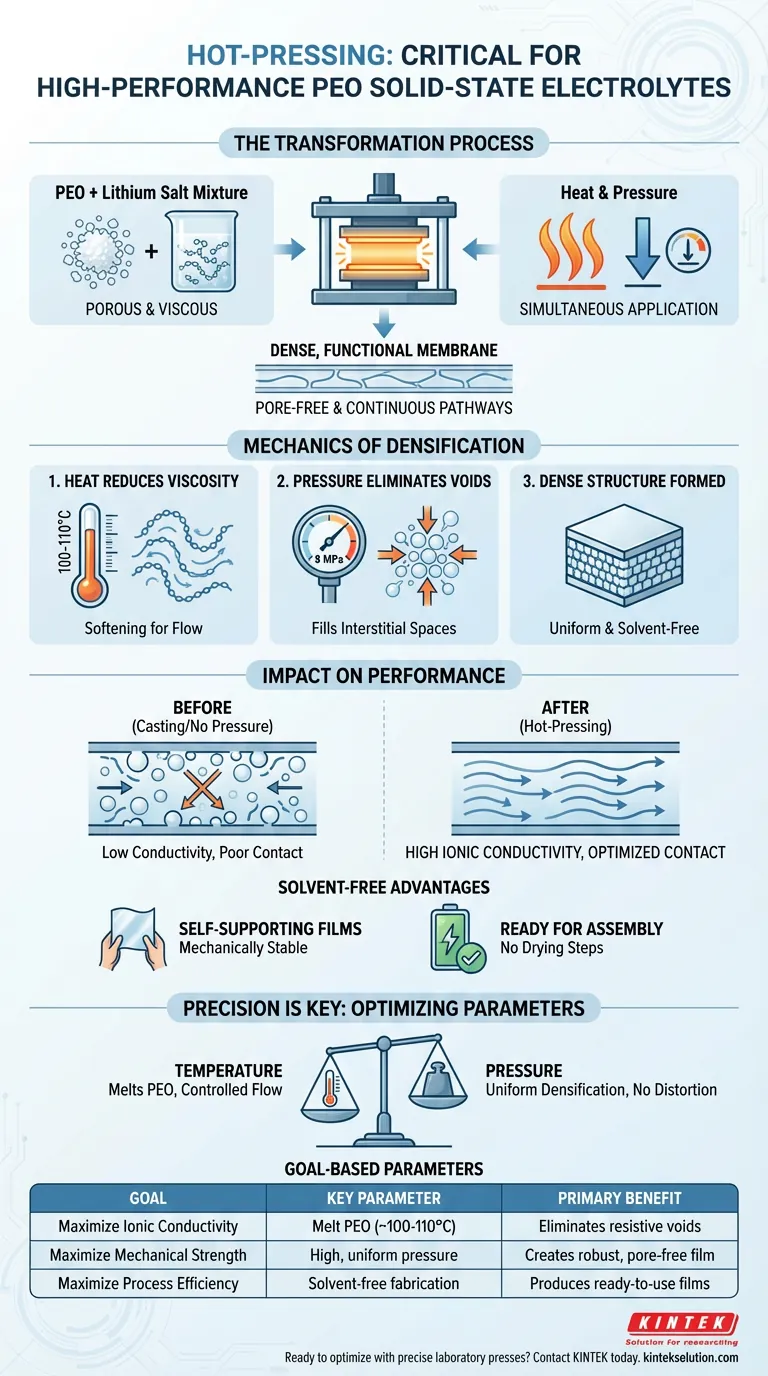
The hot-pressing process is the critical enabler for transforming PEO (polyethylene oxide) and lithium salt mixtures into functional, high-performance solid-state electrolytes. By simultaneously applying heat and pressure, this technique eliminates internal porosity, optimizes material density, and establishes the continuous pathways necessary for efficient ion transport.
The core value of hot pressing lies in its ability to soften the polymer matrix while compressing it, creating a dense, solvent-free membrane where polymer chains, fillers, and electrodes achieve maximum interfacial contact.
The Mechanics of Densification
Simultaneous Heat and Pressure
The fundamental advantage of hot pressing is the concurrent application of thermal and mechanical energy. Unlike simple casting, this process does not rely on passive evaporation.
Reduction of Viscosity
Heating the PEO mixture to specific temperatures (e.g., 100–110°C) significantly reduces the viscosity of the polymer matrix. This softening allows the polymer to flow and behave like a viscous fluid rather than a rigid solid.
Elimination of Voids
Once the polymer is softened, the applied pressure (e.g., 8 MPa) forces the material to fill interstitial spaces between particles. This effectively eliminates internal bubbles and voids, resulting in a highly dense, pore-free structure.
Impact on Electrochemical Performance
Enhancing Ionic Conductivity
Ionic conductivity in solid-state batteries relies on continuous pathways. By maximizing the relative density of the electrolyte, hot pressing ensures there are no physical gaps to interrupt the flow of lithium ions.
Optimizing Interfacial Contact
Performance is often limited by resistance at the interfaces. Hot pressing improves the contact area between the polymer chains and active materials.
Wetting of Fillers
In composite electrolytes, the softened polymer is forced to "wet" inorganic filler particles. This promotes a uniform distribution of fillers throughout the matrix, which is essential for consistent electrochemical behavior.
Solvent-Free Fabrication Advantages
Production of Self-Supporting Films
Hot pressing is a decisive shaping technology that allows for solvent-free fabrication. The process directly yields a finished, self-supporting film that is mechanically stable.
Ready for Assembly
Because the process does not involve solvents, there is no need for lengthy drying steps to remove residual chemicals. The resulting film is immediately ready for battery assembly, streamlining the manufacturing workflow.
Understanding the Necessity of Precision
The Balance of Temperature
While heat is necessary for flow, it must be precisely controlled. The temperature must be sufficient to melt the PEO crystals and lower viscosity, but not so high that it degrades the polymer or other components.
The Role of Pressure Limits
Pressure drives densification, but it must be applied uniformly. The goal is to achieve a "green body" or finished film with uniform density. Inadequate pressure leaves voids, while excessive or uneven pressure could distort the membrane geometry.
Material-Specific Parameters
The references highlight that different materials require distinct parameters (e.g., 1000°C for ceramics vs. 110°C for PEO). Applying the wrong thermal profile to PEO based on ceramic protocols would result in immediate material failure.
Making the Right Choice for Your Goal
To maximize the effectiveness of hot pressing for your specific application, prioritize the following parameters:
- If your primary focus is Ionic Conductivity: Target a temperature that fully melts the PEO crystalline phase (approx. 100-110°C) to ensure maximum wetting of fillers and elimination of all resistive voids.
- If your primary focus is Mechanical Strength: Prioritize the magnitude and uniformity of the applied pressure to maximize particle packing and create a robust, pore-free self-supporting film.
- If your primary focus is Process Efficiency: Leverage the solvent-free nature of hot pressing to produce ready-to-use films, eliminating drying times and solvent recovery steps.
Ultimately, hot pressing is not just a shaping step; it is the define-and-refine stage that determines the structural integrity and electrochemical potential of the final electrolyte.
Summary Table:
| Goal | Key Hot-Pressing Parameter | Primary Benefit |
|---|---|---|
| Maximize Ionic Conductivity | Temperature to melt PEO crystals (~100-110°C) | Eliminates resistive voids, ensures continuous ion pathways |
| Maximize Mechanical Strength | High, uniform pressure (e.g., 8 MPa) | Creates a robust, pore-free, self-supporting film |
| Maximize Process Efficiency | Solvent-free fabrication | Produces ready-to-use films, eliminating drying steps |
Ready to optimize your solid-state electrolyte development with precision hot pressing?
KINTEK specializes in laboratory press machines, including automatic, isostatic, and heated lab presses, designed to meet the exacting demands of battery research and development. Our equipment provides the precise control over temperature and pressure necessary to achieve the dense, high-performance membranes detailed in this article.
Contact our experts today to discuss how our lab press solutions can help you achieve superior ionic conductivity, mechanical strength, and process efficiency in your lab.
Visual Guide
Related Products
- Automatic High Temperature Heated Hydraulic Press Machine with Heated Plates for Lab
- Heated Hydraulic Press Machine with Heated Plates for Vacuum Box Laboratory Hot Press
- Automatic Heated Hydraulic Press Machine with Hot Plates for Laboratory
- Heated Hydraulic Press Machine With Heated Plates For Vacuum Box Laboratory Hot Press
- Laboratory Split Manual Heated Hydraulic Press Machine with Hot Plates
People Also Ask
- Function of a Laboratory Hydraulic Press with Heated Platens in SSE? Enhance Battery Density & Conductivity
- What are the requirements for electrode pressing with high-viscosity ionic liquids like EMIM TFSI? Optimize Performance
- How does a laboratory heated hydraulic press facilitate PBN sample prep for WAXS? Achieve Precise X-Ray Scattering
- What are the industrial applications of heated hydraulic presses? Master Heat & Force for Precision Manufacturing
- Why is a laboratory hydraulic press with heating plates required for PLA/TEC films? Achieve Precise Sample Integrity



















